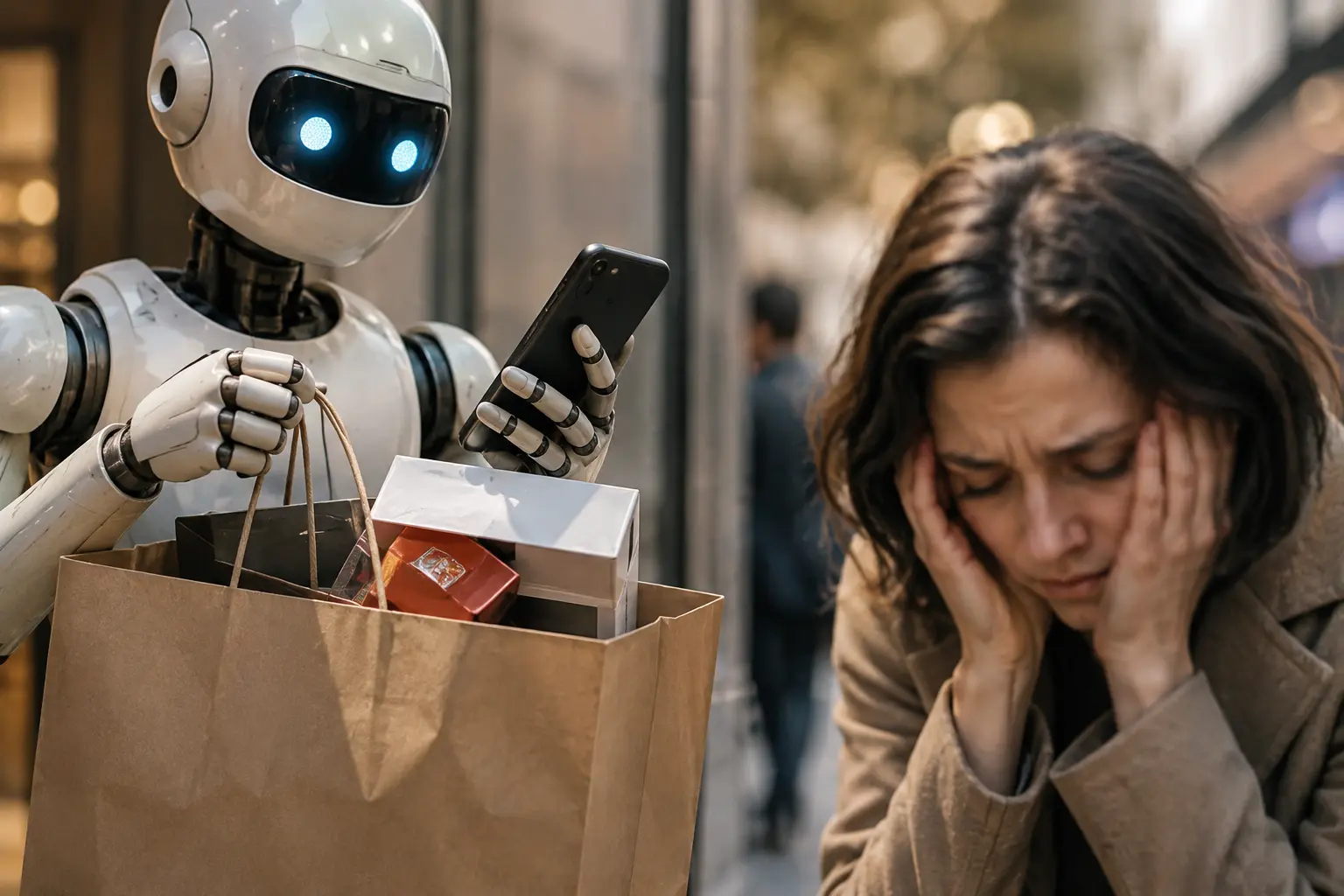
AI shopping agents don’t browse. They don’t get distracted, change their minds, or abandon carts. They set a goal, query every available merchant, evaluate price, availability, and delivery — and buy. No human required. This is not a future prediction. It is happening right now, and $5 trillion in global retail spend is already in motion.
AI shopping agents are autonomous software systems that handle the entire consumer purchase journey — from product research and comparison to checkout — without a human making individual decisions. A shopper sets an intent: “Find me trail running shoes under ₹12,000, waterproof, delivered by Friday.” The agent queries multiple merchant catalogs, reads aggregated reviews, checks real-time stock and shipping windows, and completes the purchase. The human approves or simply wakes up to a confirmation email.
This is not the same as a recommendation engine suggesting products on Amazon’s homepage. AI shopping agents operate independently, across platforms, using structured APIs rather than browser sessions. They do not scroll. They do not respond to banner ads. They evaluate what merchants expose via machine-readable data — and they skip everyone who doesn’t.
📊
Related Reading
Claude vs ChatGPT vs Gemini 2026: Which AI Is Winning Enterprise?
→
How Big Is the $5 Trillion Shift?
The numbers coming out of 2026 research are not speculative. They are operational. According to McKinsey’s 2026 Commerce Intelligence Report, agentic commerce could redirect between $3 and $5 trillion in global retail spend by 2030. Gartner separately predicts that AI agents will intermediate $15 trillion in B2B purchases by 2028. J.P. Morgan estimates AI shopping agents will account for 25% of US online sales by 2030, concentrated initially in recurring, low-risk categories like groceries, subscriptions, and household essentials.
$5T
Global retail
redirected by 2030
McKinsey 2026
25%
US online sales
via AI agents
J.P. Morgan
50M
Daily shopping
queries on ChatGPT
OpenAI Feb 2026
The near-term reality is already in motion. Adobe Analytics data from Black Friday 2025 shows AI-referred visitors had a 38% higher purchase completion rate than visitors from traditional search. Salesforce data from Cyber Week 2025 shows retailers with AI agent integration achieved roughly 7x better sales growth than those without. The gap between agent-ready and agent-invisible retailers is widening every quarter.
💰
Related Reading
AI Startups That Raised $100M+ in 2026: Full Funding List
→
Who Is Winning Agentic Commerce in 2026?
The infrastructure for AI shopping agents moved from prototype to production between September 2025 and January 2026. Three protocol launches changed the market permanently.
| Platform | Protocol / Product | Scale (2026) |
|---|
| OpenAI / ChatGPT | Agentic Commerce Protocol (ACP) — Sep 2025 | 50M shopping queries/day |
| Google | Universal Commerce Protocol (UCP) — Jan 2026 | 2B+ AI Overview users/month |
| Microsoft | Copilot Checkout — Jan 2026 | Integrated across Office 365 |
| Amazon | Rufus AI Shopping Assistant | 300M users served |
| Shopify | AI-powered order processing | 15x order growth YoY (2025) |
Google’s Universal Commerce Protocol is the most consequential development. Launched at NRF in January 2026, UCP gives AI agents a single open standard to interact with merchant catalogs and complete purchases — without consumers visiting a website. Retailers not compliant with UCP are simply not included in agent-initiated purchase flows, even when their products rank well in conventional search results. Invisible by omission.
↗
Partner Coverage
Rise of Startups — Startup Funding, Founder Stories & Venture News
How AI Shopping Agents Actually Buy
Understanding how AI shopping agents make decisions is essential for any founder or retailer who wants to survive the transition. The buying process looks nothing like a human’s.
The search bar is a tax on your customer’s time. AI shopping agents are designed to eliminate that tax — and they’re doing it 50 million times a day.
— The Business Perspective, August 2026Traditional shopping runs on a visual funnel: impression → click → browse product page → add to cart → checkout. AI shopping agents remove the visual layer entirely. Intent enters through natural language. The agent extracts structured constraints — budget, brand preference, delivery window, specifications. It then queries merchant APIs, pricing feeds, inventory systems, and shipping estimators in parallel. Evaluation is programmatic, not visual. If a merchant’s product data is unstructured, delayed, or inconsistent, the agent cannot reliably include it in the candidate set. The product does not appear. The sale does not happen.
Adobe Analytics data confirms AI-referred visitors convert at 38% higher rates than traditional search visitors (Black Friday 2025). The agent does the pre-selection work humans used to do across ten browser tabs — and delivers only the shortlist.
📈
Related Reading
Whatnot $20B Valuation: App Raises $545M Series G — Live Commerce’s Biggest Bet
→
What Founders and Retailers Must Do Now
The Business Perspective spoke to the data across five operational areas that determine whether a business will be agent-visible or agent-invisible in 2026 and beyond.
5-Point Agent Readiness Checklist
- Make product data machine-readable. Implement complete JSON-LD Product schema. Real-time pricing and inventory must be accessible via APIs, not just website pages.
- Implement UCP compliance. Google’s Universal Commerce Protocol defines how agents add items to multi-retailer carts. Non-compliant sites are skipped in agent purchase flows.
- Shift from SEO to AEO. Agent Engine Optimization focuses on structured, attribute-complete product data rather than keyword-dense descriptions. Agents query attributes — material, certification, compatibility — not prose.
- Build trust signals agents evaluate. Star ratings, return policy clarity, fulfilment speed, and buyer protection are the signals AI agents use when ranking products for selection. These are not optional.
- Test your agent discoverability. Tools like UCP Store Check show exactly how your store appears to AI shopping agents. Most retailers are shocked by what agents cannot see.
The shift from SEO to AEO — Agent Engine Optimization — is the most important reframe for digital marketers and founders in 2026. Traditional SEO optimizes pages for human search engine result pages. AEO optimizes product data, APIs, and structured attributes for AI agent queries. Tabular comparison content outperforms prose for agents by 40% in extraction reliability, per digital commerce research cited in 2026 AEO frameworks. Tables win. Prose loses.
💡
Related Reading
7 Scalable Business Ideas 2026 That Actually Make Money
→
↗
Partner Coverage
IoT Insights Hub — AI, Automation & Technology Intelligence for Business Leaders
What the Sceptics Say
What Some Experts Say Differently
Not all analysts are convinced the $5 trillion figure represents a clean transfer of purchasing power. Some retail economists at INSEAD argue that AI agents could concentrate buying power into the hands of a few dominant platforms — ChatGPT, Gemini, Alexa+ — creating new gatekeepers that are harder to negotiate with than Google’s search algorithm ever was. If agents pick winners, small brands with excellent products but limited API infrastructure could be systematically excluded. The agent layer solves one friction problem while potentially creating a new structural one: monopoly over the buying decision itself.
There is also the trust problem. Kearney’s 2026 commerce survey found 60% of shoppers expect to use AI agents within 12 months — but that same study shows significant hesitation around delegating high-value or emotionally significant purchases. Consumers will let an agent reorder coffee pods. They will not let it choose an engagement ring. The transition is real, but it is not total. Human buying decisions survive wherever emotional context, aesthetic judgment, or brand loyalty matters more than efficiency.
🎯
Related Reading
Growth Marketing Funnel: 7 Metrics Every Marketer Must Track
→
The Bottom Line for Founders
AI shopping agents are not a threat to watch in 2028. They are a live commercial reality in 2026. ChatGPT processes 50 million shopping queries daily. Amazon’s Rufus serves 300 million users. Google’s UCP is live. Shopify’s AI order volume grew 15x in a single year. The Business Perspective’s position is clear: founders who build agent-readable product infrastructure this quarter will own category visibility that will be very expensive to earn back in 2027.
The $5 trillion does not disappear. It moves to whoever the agents can see.
Frequently Asked Questions
What are AI shopping agents?
AI shopping agents are autonomous software systems that research, compare, and complete purchases on behalf of consumers without human involvement. They interpret natural language intent, query product databases, evaluate price and availability, and execute transactions end-to-end — replacing traditional browse-and-buy shopping.
How much of global retail will AI shopping agents control by 2030?
According to J.P. Morgan, AI shopping agents could account for up to 25% of US online sales by 2030. McKinsey estimates the model could redirect $3 to $5 trillion in global retail spend. Gartner separately predicts AI agents will intermediate $15 trillion in B2B purchases by 2028.
Which companies are leading agentic commerce in 2026?
ChatGPT processes 50 million shopping queries daily. Amazon’s Rufus AI assistant serves 300 million users. Google launched the Universal Commerce Protocol (UCP) at NRF in January 2026. Microsoft Copilot Checkout went live simultaneously. Shopify reports AI-powered orders grew 15x year-over-year through 2025.
What is the Universal Commerce Protocol (UCP)?
The Universal Commerce Protocol (UCP) is an open standard launched by Google at NRF in January 2026 that enables AI agents to interact with merchant catalogs and complete purchases through a single standardized interface — without the consumer ever visiting the merchant’s website. Retailers not UCP-compliant are excluded from agent purchase flows.
How should founders prepare for agentic commerce?
Founders must make product data machine-readable via structured APIs, implement UCP-compliant product endpoints, optimize for Agent Engine Optimization (AEO) rather than just traditional SEO, maintain real-time pricing feeds, and build trust signals — ratings, return policies, fast fulfilment — that AI agents evaluate when selecting products for purchase.
AI Shopping Agents
Agentic Commerce
Future of Ecommerce
AI in Retail
Ecommerce 2026