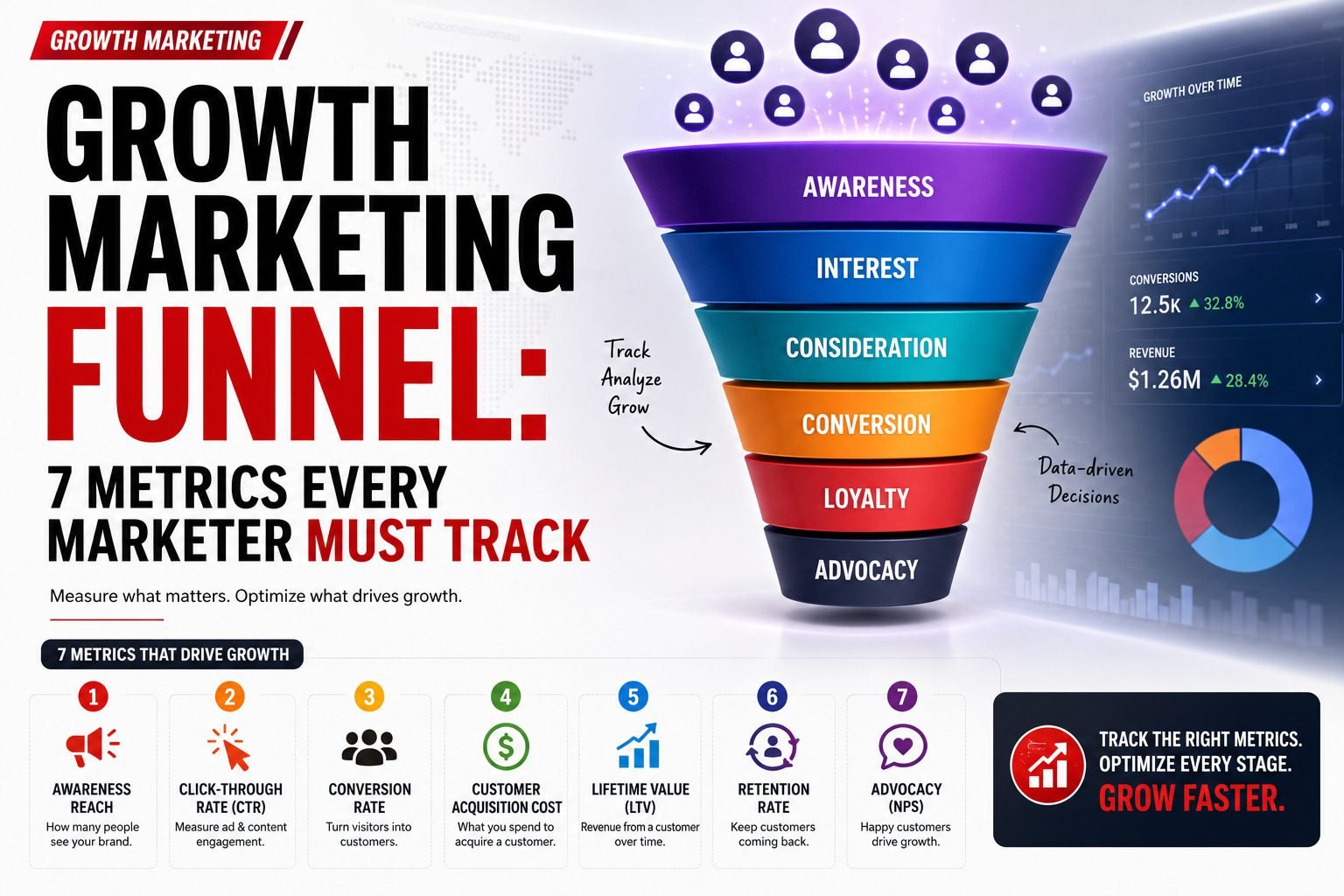
A growth marketing funnel maps the full customer journey from awareness through to revenue — not just the sale
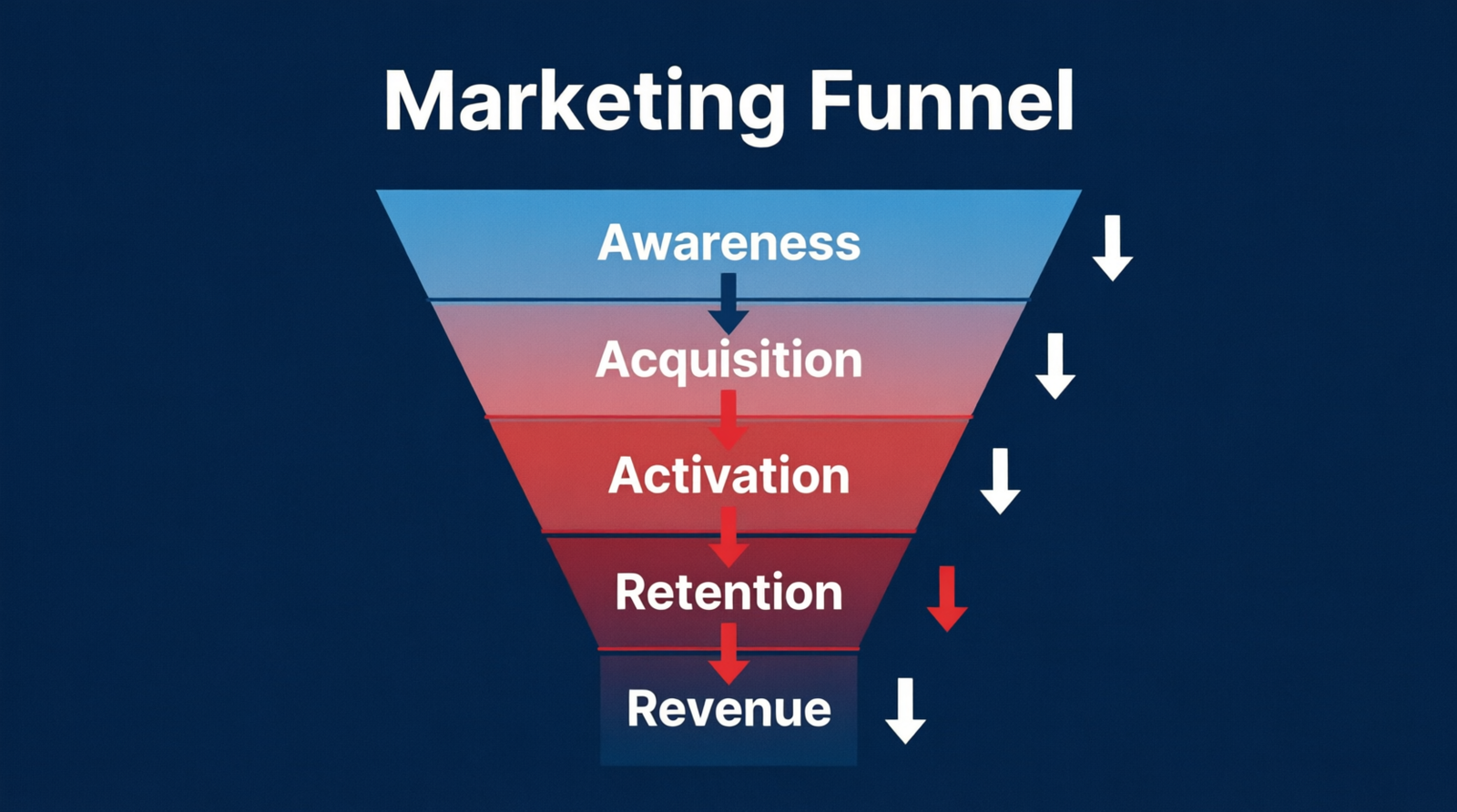
The 5 core stages are Awareness, Acquisition, Activation, Retention, and Revenue (AARRR framework)
The 7 metrics that matter most are CAC, LTV, Activation Rate, Conversion Rate, Churn Rate, MQL-to-SQL Ratio, and MRR
According to HubSpot, companies that track funnel metrics consistently grow revenue 2.5x faster than those that do not
The biggest growth marketing mistake is optimizing the wrong funnel stage — always fix the biggest drop-off point first
Most businesses build a growth marketing funnel once and never look at it again. They track website visits, celebrate new sign-ups, and wonder why revenue is not growing. The problem is not the funnel itself — it is that they are flying blind without the right metrics.
A growth marketing funnel is only as powerful as the data sitting behind it. The companies growing fastest in 2026 are not running more ads or publishing more content. They are obsessively tracking the right seven numbers and making decisions at every funnel stage based on what those numbers tell them.
At The Business Perspective, we cover what actually moves the needle in marketing strategy — and this guide breaks down the complete growth marketing funnel, the metrics that matter, and real examples of what good execution looks like.
What Is a Growth Marketing Funnel?
A growth marketing funnel is a data-driven framework that maps the complete customer journey from first awareness to long-term revenue. Unlike traditional funnels that stop at the sale, a growth marketing funnel treats every stage — from discovery to retention — as measurable, testable, and improvable through continuous experimentation.
The term was popularized by Dave McClure of 500 Startups through his AARRR framework — Acquisition, Activation, Retention, Referral, Revenue. Modern growth teams have built on this foundation, adding awareness as the true entry point and using data loops at every stage to continuously improve performance.
What separates a growth marketing funnel from a traditional sales funnel is intent. Traditional funnels are built to close deals. Growth funnels are built to understand behavior — why users enter, where they drop off, what makes them stay, and what turns them into advocates who bring others in. According to McKinsey, companies that build data loops into their marketing funnels grow revenue 1.4 times faster than those that do not.
What Are the 5 Stages of a Growth Marketing Funnel?
The 5 stages of a growth marketing funnel are Awareness, Acquisition, Activation, Retention, and Revenue. Each stage targets a specific behavior in the customer journey, and each requires a distinct strategy, content type, and set of metrics to measure progress and identify drop-off points.
The 5-stage growth marketing funnel — from awareness to revenue
1
Awareness (TOFU)
The top of your funnel is where strangers first encounter your brand. Channels include SEO content, social media, paid ads, PR, and podcast appearances. The goal at this stage is reach — getting your message in front of the right audience at the right moment. Measure with impressions, organic traffic, and brand search volume.
2
Acquisition (MOFU)
Acquisition is where you convert that attention into a trackable lead — an email sign-up, a free trial registration, a demo request, or a form submission. This is the stage most businesses focus on first, but it is only effective when awareness is already working. Measure with lead conversion rate and Cost Per Lead (CPL).
3
Activation
Activation is the “aha moment” — the first time a user experiences real value from your product or service. For a SaaS tool, it might be completing the first project. For an e-commerce brand, it is the first purchase. Activation is where most funnels leak, and fixing it has the highest ROI of any funnel stage. Measure with activation rate and time-to-value.
4
Retention
Retention determines whether your funnel builds a business or just a revolving door. Retained customers cost nothing to re-acquire and spend more over time. Email sequences, loyalty programs, personalized offers, and in-app engagement flows are the tools that drive retention. Measure with churn rate and Day 30/60/90 retention cohorts.
5
Revenue
Revenue is the output of a healthy funnel — not just initial sales but expansion revenue from upsells, cross-sells, and referrals. Companies with strong revenue stage metrics turn their best customers into acquisition channels through referral programs and case studies. Measure with Monthly Recurring Revenue (MRR), Average Revenue Per User (ARPU), and Net Revenue Retention (NRR).
How Is Growth Marketing Different From Traditional Marketing?
Traditional marketing focuses on the top of the funnel — building awareness and driving initial sales. Growth marketing covers the entire customer lifecycle, using data and experimentation at every stage. Growth marketers run A/B tests, analyze retention cohorts, and optimize for lifetime value rather than just initial conversion rates.
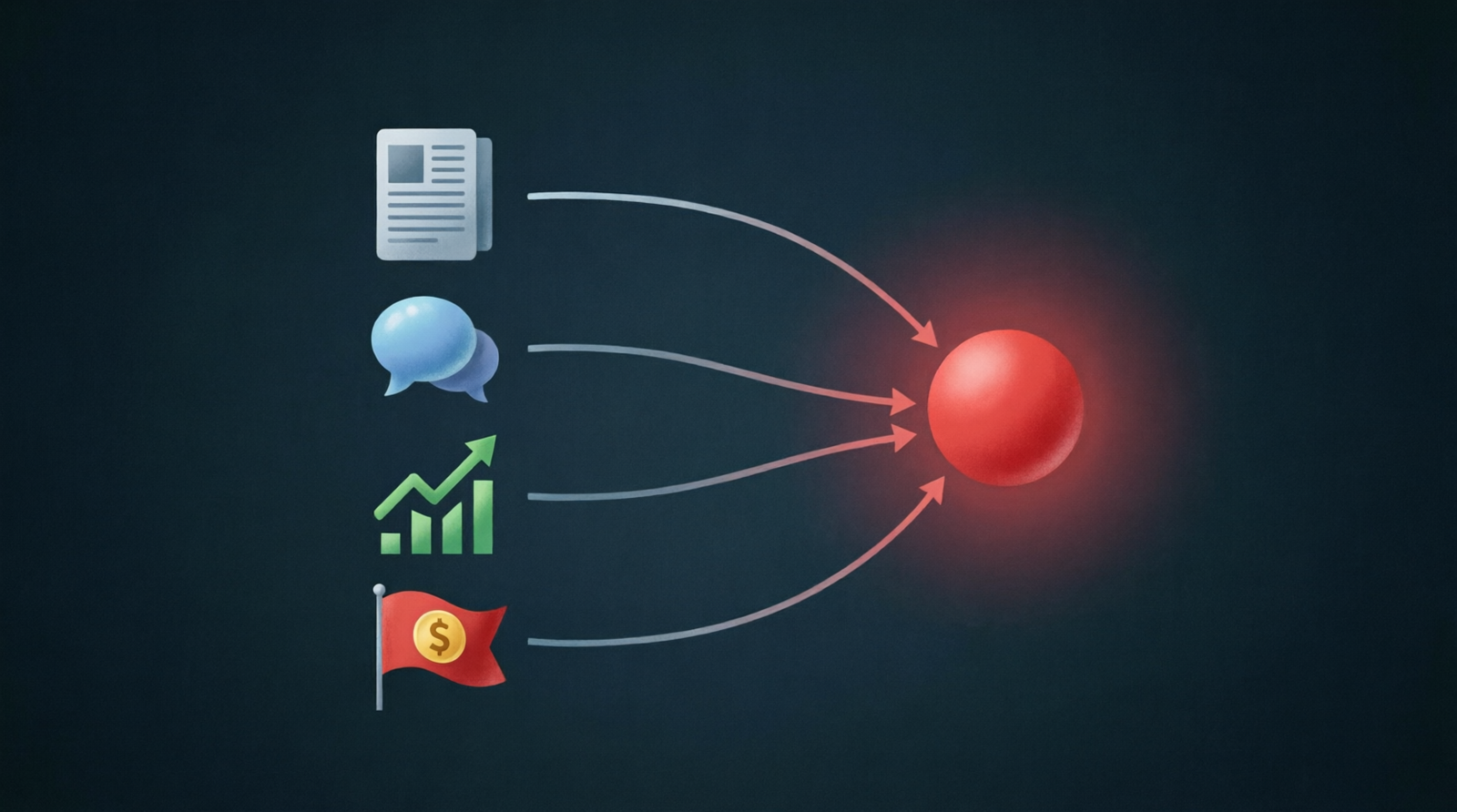
Top-of-funnel channels feeding the growth marketing funnel awareness stage
Factor
Traditional Marketing
Growth Marketing
Focus
Top of funnel — awareness and reach
Full funnel — awareness through retention
Primary Goal
Drive sales and brand recognition
Maximize lifetime customer value (LTV)
Decision Making
Intuition, creative judgment, past experience
Data, A/B testing, cohort analysis
Time Horizon
Campaign-based (weeks to months)
Continuous loop (always-on experimentation)
Success Metric
Brand awareness, reach, conversions
CAC:LTV ratio, MRR, Net Revenue Retention
Team Structure
Creative, brand, and media teams
Cross-functional: marketing, product, data
Growth marketing is not a replacement for brand marketing — it is an extension of it. The most effective companies, from Dropbox to Notion to Airbnb, combine strong brand positioning with rigorous funnel optimization. Brand builds trust; growth marketing converts that trust into measurable revenue. For a deeper look at how startups apply this, Rise of Startups covers real founder stories on scaling with lean growth frameworks.
What Are the 7 Metrics Every Marketer Must Track in a Growth Marketing Funnel?
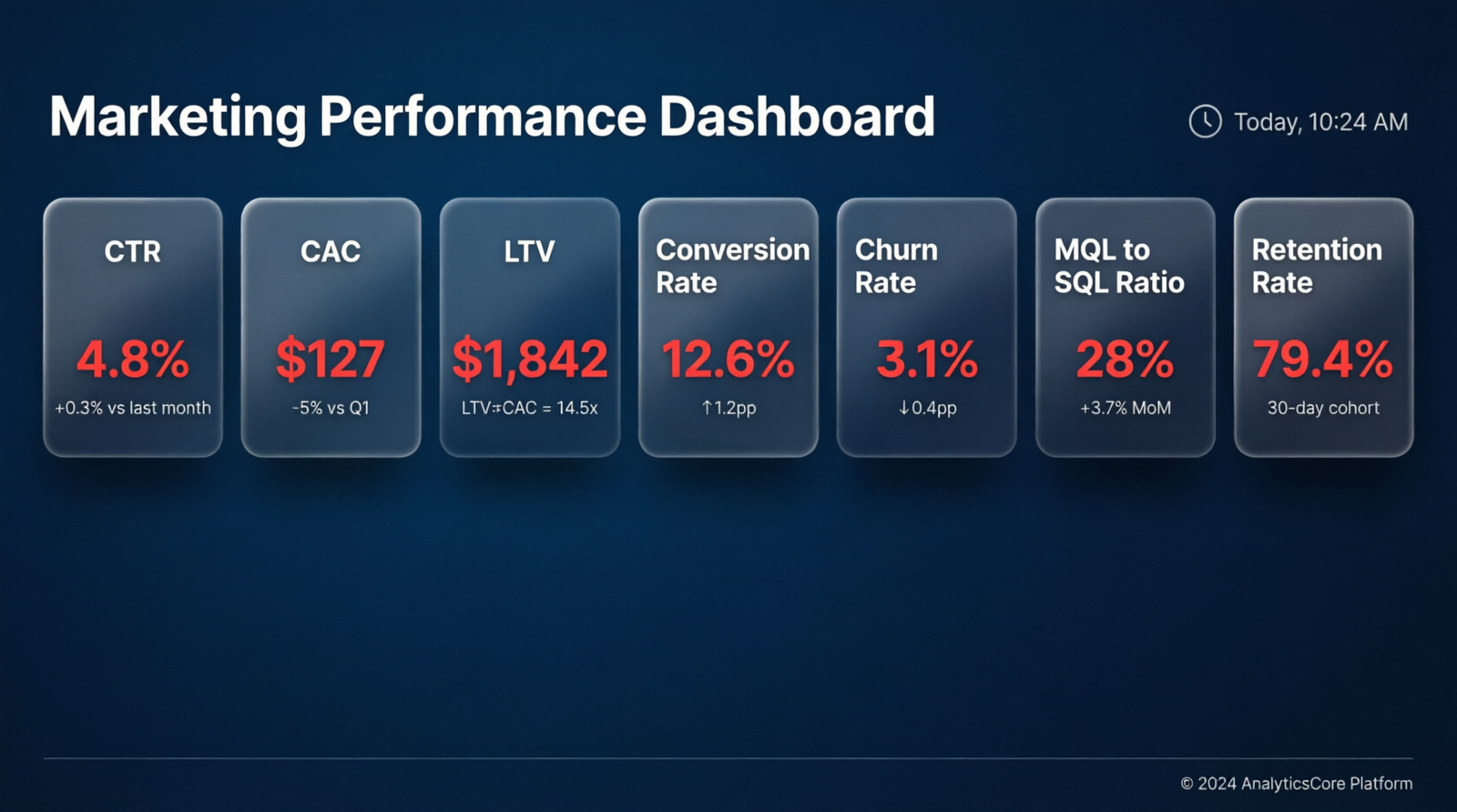
The 7 metrics every marketer must track in a growth marketing funnel are Customer Acquisition Cost (CAC), Customer Lifetime Value (LTV), Activation Rate, Funnel Conversion Rate, Churn Rate, MQL-to-SQL Ratio, and Monthly Recurring Revenue (MRR). These seven numbers give a complete picture of funnel health at every stage.
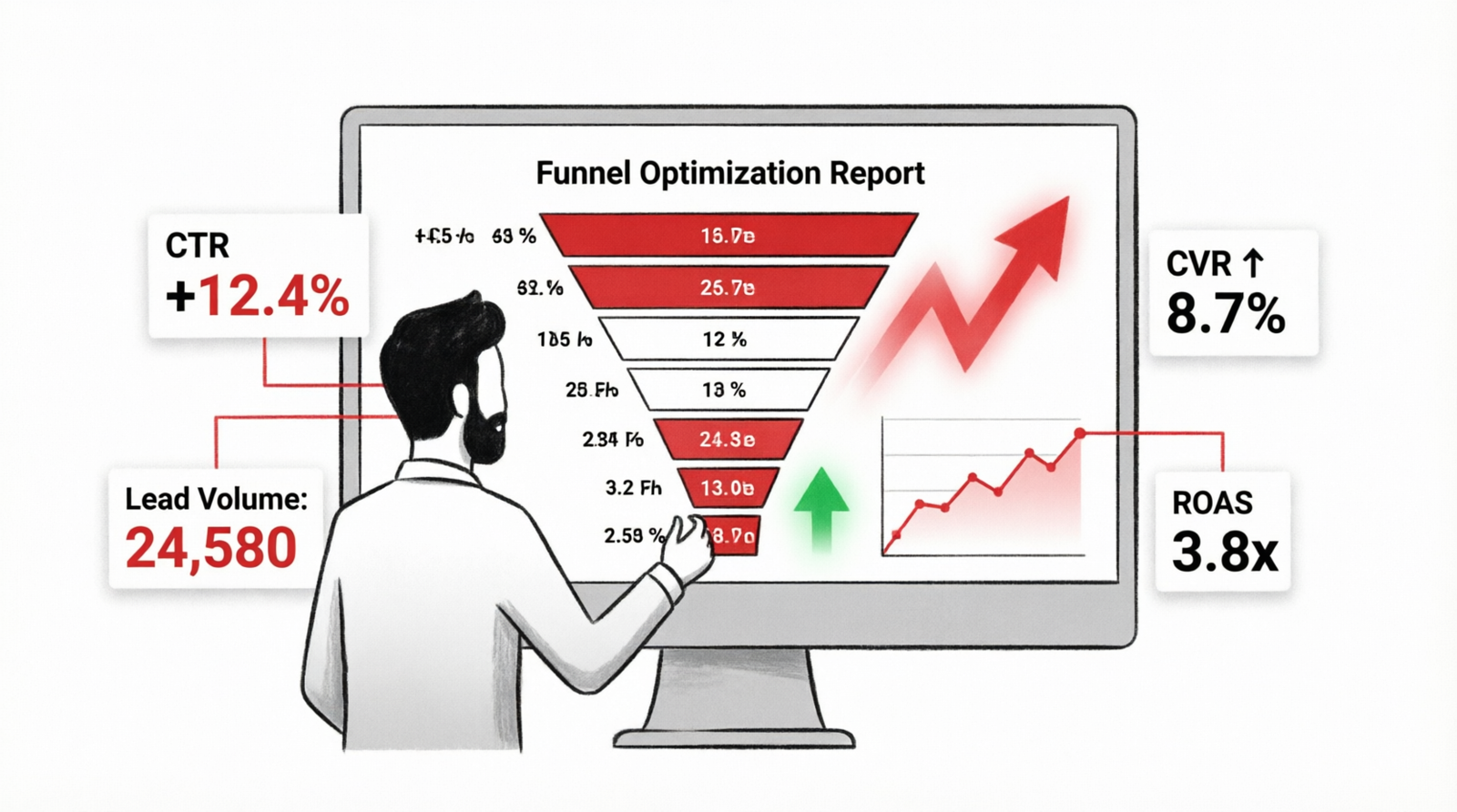
A growth marketing funnel metrics dashboard tracking the 7 essential KPIs
01
Customer Acquisition Cost (CAC)
Total spend divided by new customers acquired. Your north star for funnel efficiency. Per Gartner 2025, top SaaS companies target a CAC payback period under 12 months.
02
Customer Lifetime Value (LTV)
Average revenue a customer generates over their entire relationship with your business. A healthy LTV:CAC ratio is 3:1 or higher, per HubSpot benchmarks.
03
Activation Rate
Percentage of new users who complete the core action that signals they have experienced real value. According to Mixpanel, improving activation rate by 10% can double long-term retention.
04
Funnel Conversion Rate
The percentage of users who move from one funnel stage to the next. Track this at every transition point — not just the final sale. Industry average B2B funnel conversion is 2.5%, per Salesforce.
05
Churn Rate
The percentage of customers who stop using your product in a given period. A monthly churn rate above 2% signals a retention problem that will eventually cap revenue growth, regardless of acquisition spend.
06
MQL-to-SQL Ratio
The percentage of Marketing Qualified Leads that sales converts into Sales Qualified Leads. A ratio below 25% indicates a funnel misalignment between marketing and sales messaging.
07
Monthly Recurring Revenue (MRR)
The total predictable revenue generated each month. MRR growth rate is the single most watched metric by investors and boards because it shows whether the full funnel is compounding or stalling.
These seven metrics are not independent — they form a chain. A high CAC without a matching LTV destroys margins. A strong activation rate with high churn means your product is not delivering sustained value. Tracking them together gives you a real-time picture of where your growth marketing funnel is healthy and where it is leaking. For data-driven businesses exploring how IoT and AI are reshaping these measurement frameworks, IoT Insights Hub covers the emerging analytics tools changing how companies track funnel performance.
What Is a Real Example of a Growth Marketing Funnel?
A real example of a growth marketing funnel in action is Dropbox’s referral-driven model, where each funnel stage was optimized with a specific mechanic: SEO and word-of-mouth for awareness, a frictionless free sign-up for acquisition, immediate file-sync value for activation, and a double-sided referral program for retention and revenue expansion.
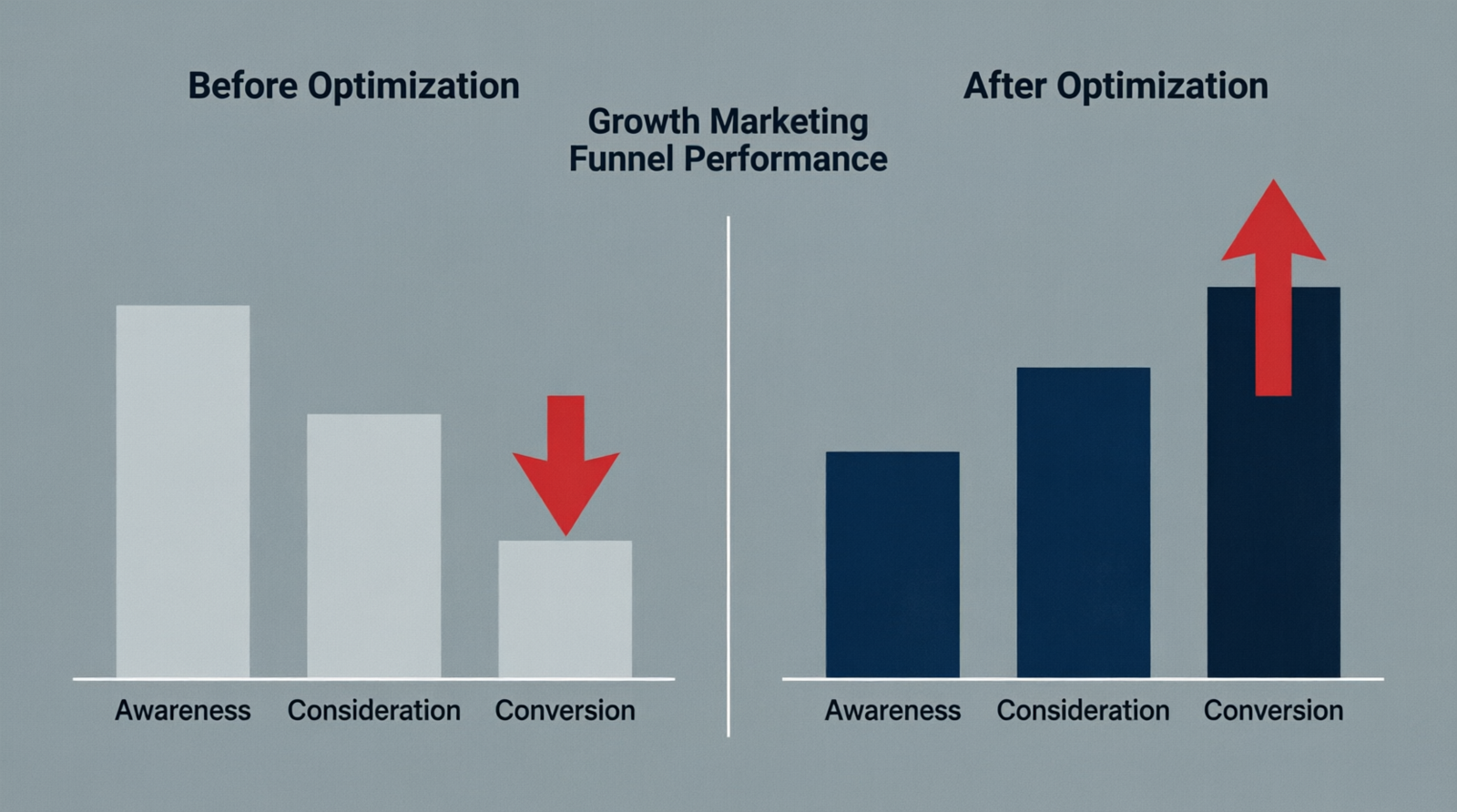
Before and after: growth marketing funnel optimization results for B2B companies
Case Example — SaaS
Dropbox: From Zero to 4 Million Users in 15 Months
Awareness: Word-of-mouth and SEO content targeting “file sharing” and “cloud storage” keywords drove organic discovery. No paid search in early stages.
Acquisition: Frictionless free plan — no credit card required, sign-up in under 60 seconds. Removed every barrier between a visitor and a working account.
Activation: The “aha moment” was defined as syncing at least one file across two devices. Onboarding flows were built entirely around reaching this one action.
Retention + Revenue: The double-sided referral program gave free storage to both the referrer and the new user. Per Drew Houston, this referral mechanic grew sign-ups by 60% permanently, according to Forbes reporting on Dropbox’s growth story.
Case Example — B2B
HubSpot: Content-Led Funnel at Scale
Awareness: HubSpot built one of the largest B2B content libraries in marketing — over 50,000 indexed pages targeting every keyword a marketer would search. This created a self-sustaining organic awareness engine.
Acquisition: Free tools (Website Grader, Email Signature Generator) captured leads without gating core content. Tools convert at 3-5x the rate of gated PDFs, per HubSpot’s own published data.
Activation: Free CRM tier let users experience value before paying. The activation benchmark was connecting at least one email account and logging five contacts.
Revenue: Paid tiers unlocked automation, reporting, and integrations — features only valuable to users who had already built habits in the free product. This made upgrade decisions feel natural, not forced.
How Do You Optimize a Growth Marketing Funnel?
To optimize a growth marketing funnel, identify the stage with the largest drop-off, run targeted A/B experiments to fix it, validate the improvement with data, then move to the next weakest stage. Never optimize multiple funnel stages simultaneously — it makes it impossible to identify which change drove results.
Marketing funnel optimization: data-driven process for improving each stage
Funnel optimization is not a one-time project — it is a continuous loop. Here is how growth teams approach it systematically:
Audit your current funnel data. Pull conversion rates for every stage transition in Google Analytics 4. Map where the biggest volume drops happen.
Prioritize by impact. Use the ICE scoring framework — Impact, Confidence, Ease — to rank experiments. Fix the stage with the highest potential revenue recovery first.
Run one experiment per stage at a time. Test landing page headlines, onboarding email sequences, pricing page layouts, or checkout flows — one variable at a time.
Set a clear success metric before running the test. Define what a 10%, 20%, or 30% improvement in conversion rate would mean for downstream revenue before touching anything.
Run tests for statistical significance. Minimum 1,000 visitors per variant before declaring a winner. Tools like Google Optimize, VWO, or Optimizely handle the math automatically.
Document every result — wins and losses. Failed experiments teach you more about your audience than successful ones. Build a shared experiment log your full team can access.
The most common optimization mistake growth teams make is spending all their budget on awareness and acquisition while ignoring activation and retention. Fixing a 10% drop in activation rate typically generates 4-6x more revenue than spending the same budget on paid acquisition — because retained customers compound over time while paid acquisition costs stay flat or rise.
For more on how The Business Perspective covers growth strategy and marketing frameworks, explore our full marketing and growth section for deeper analysis on what is working for businesses in 2026.
What Some Experts Say Differently
Not all growth marketers agree that the AARRR funnel is the right model. Critics like Andrew Chen (a16z) argue that in a world of rising CAC and platform consolidation, the traditional funnel undervalues virality and network effects. His alternative: prioritize referral mechanics and product-led growth loops from day one, rather than treating referral as a late-funnel add-on. Some B2B experts also argue that the MQL-to-SQL ratio is a broken metric in 2026, as buying committees and dark social have made it nearly impossible to attribute pipeline accurately to a single marketing source.
Frequently Asked Questions About Growth Marketing Funnels
What is a growth marketing funnel?
A growth marketing funnel is a data-driven framework that maps the full customer journey — from first awareness through to revenue and long-term retention. It treats every stage as measurable and continuously improvable through experimentation and data analysis.
What are the 5 stages of a growth marketing funnel?
The 5 stages are Awareness, Acquisition, Activation, Retention, and Revenue. Each stage targets a specific customer behavior and requires distinct strategies, content formats, and tracking metrics to measure and improve performance.
What is the most important metric in a growth marketing funnel?
For early-stage businesses, Customer Acquisition Cost (CAC) and Activation Rate are most critical. For scaling businesses, the CAC-to-LTV ratio and Monthly Recurring Revenue (MRR) are the primary growth indicators that determine long-term viability.
How is a growth marketing funnel different from a traditional marketing funnel?
Traditional funnels end at the sale. A growth marketing funnel extends beyond the purchase to retention and revenue expansion, using data and A/B testing at every stage to continuously improve conversion rates across the full customer lifecycle.
What is a good funnel conversion rate for B2B businesses?
Per HubSpot, a good overall B2B funnel conversion rate ranges from 1% to 5%. Top-performing B2B funnels consistently achieve above 3% through continuous A/B testing, strong lead qualification, and personalized nurture sequences.
How do you build a growth marketing funnel from scratch?
Start by defining your target audience and buyer journey. Map content to each funnel stage. Set up tracking and analytics. Define your 7 key metrics with baseline benchmarks. Run experiments at the weakest stage first. Scale what works and cut what does not within 90 days.
What does TOFU MOFU BOFU mean in a growth marketing funnel?
TOFU is Top of Funnel — broad awareness content like blog posts and social ads. MOFU is Middle of Funnel — content for leads comparing solutions, like case studies and webinars. BOFU is Bottom of Funnel — content for buyers ready to decide, like demos, pricing pages, and free trials.
Which tools are best for managing a growth marketing funnel?
The best tools for managing a growth marketing funnel include Google Analytics 4 for traffic tracking, HubSpot or Salesforce for CRM pipeline management, Hotjar for behavior analytics, Mixpanel for product analytics, and ActiveCampaign or Mailchimp for retention email automation.
Conclusion: Build Your Growth Marketing Funnel Around Data, Not Guesswork
A growth marketing funnel is not a set-and-forget system. It is a living framework that gets sharper with every data point, every experiment, and every customer insight your team collects. The businesses winning in 2026 are not the ones with the biggest ad budgets — they are the ones that understand exactly where their funnel leaks and fix it, stage by stage, metric by metric.
Start with the seven metrics covered in this guide. Pick the one your business is furthest from benchmark on. Run one focused experiment to improve it. Track the downstream revenue impact. Then move to the next weak point. That compounding loop — measure, test, improve, repeat — is what separates teams that grow from teams that just spend.
The growth marketing funnel is your most valuable strategic asset. Treat it like one.
Stay Ahead of Every Business Trend
Get marketing strategy, growth frameworks, and business analysis that actually moves the needle — straight from The Business Perspective.
AI startups that raised funding in September 2026 included some of the most structurally significant rounds of the year — from Cognition’s $2 billion raise at a $48 billion valuation to Harvey’s $550 million legal AI round backed by every elite VC simultaneously. The Business Perspective tracked the top 10 AI startups that raised funding...
AI agent startup funding September 2026 reached a new quarterly record — 56 tracked rounds worth approximately $5.25 billion in Q3 alone, as autonomous agent companies attracted capital from sovereign wealth funds, crossover investors, and traditional venture firms simultaneously for the first time. The Business Perspective tracks AI agent startup funding September 2026 and every...
Cognition $2 billion funding closed in September 2026 at a $48 billion valuation — making it one of the most aggressively priced AI coding companies ever backed by institutional capital, with no publicly disclosed revenue to anchor the number. The Business Perspective breaks down what the Cognition $2 billion funding round actually signals about where...