AI bubble bursting fears are growing, but Andreessen Horowitz’s September report shows tech earnings up about 56% against stock gains above 20%. The Business Perspective explains both sides of the AI bubble bursting debate, including why Treasury Secretary Bessent dismissed the concern on October 3.
⚡ Key Takeaways
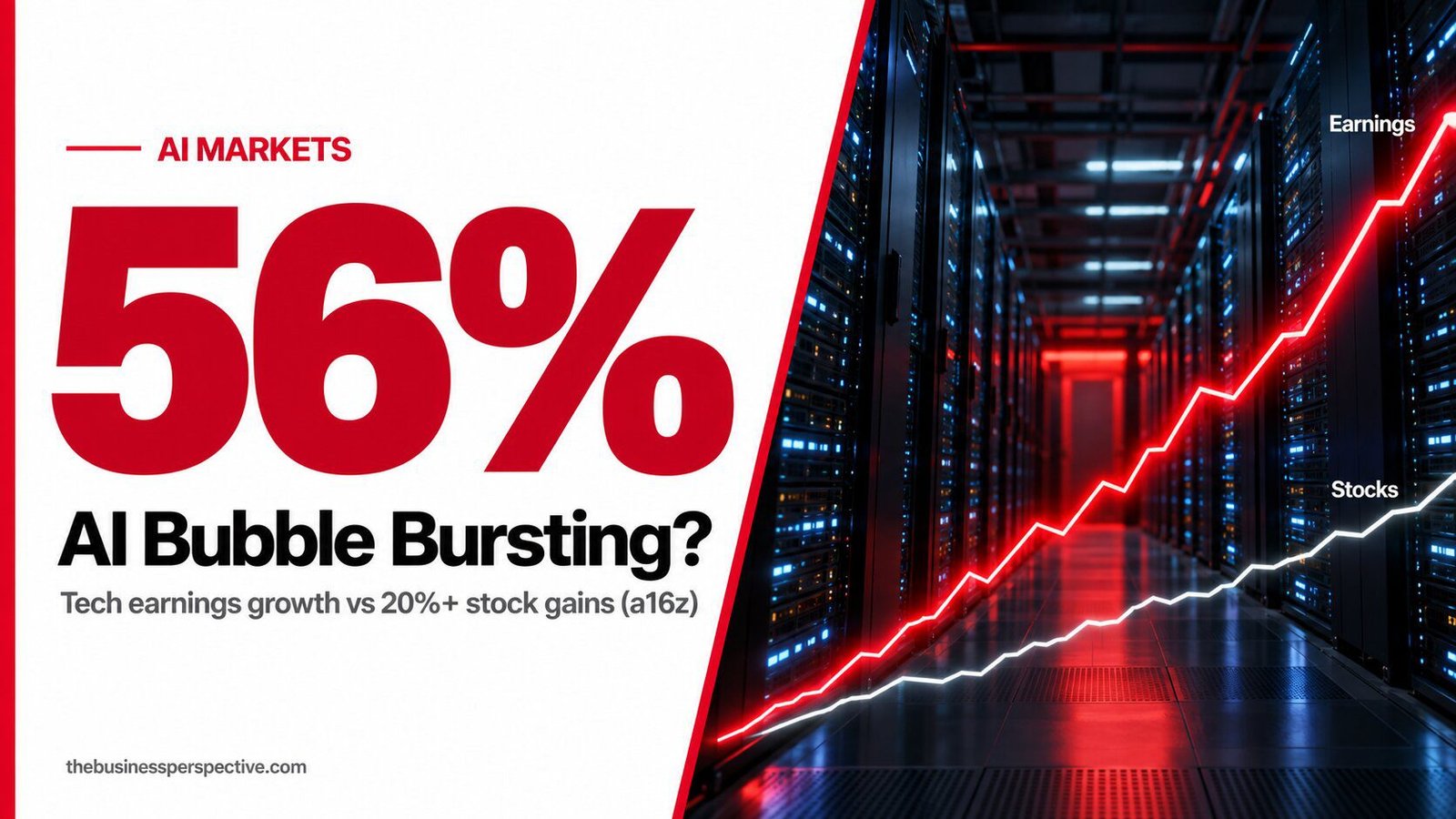
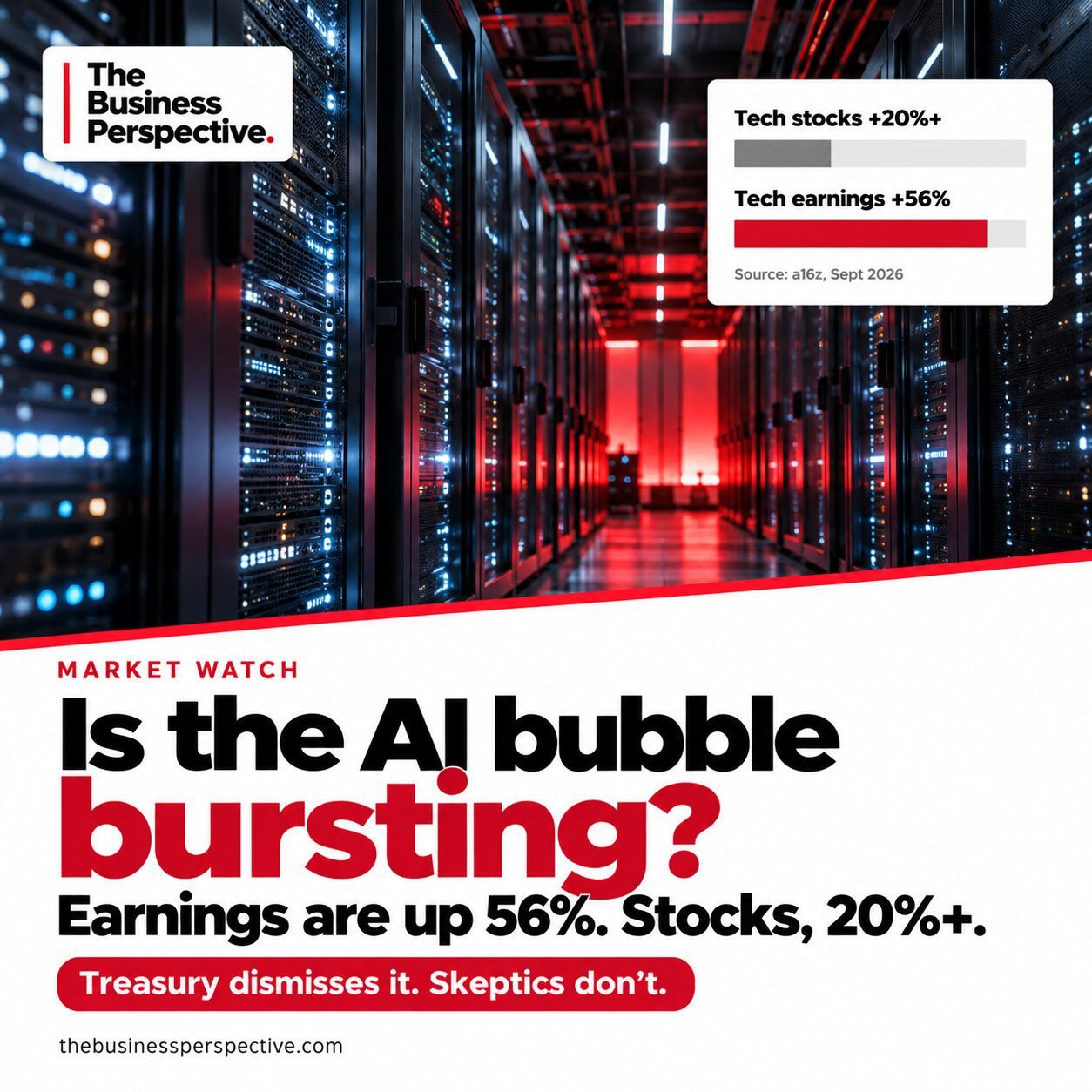
56% vs 22% — a16z’s September 2026 report shows tech earnings per share up 55.7% this year against a 22.1% price gain, per Benzinga’s coverage.
Cheaper, not pricier — The tech sector’s P/E multiple has contracted 21.6% and sits roughly 20% below its five-year average, per a16z.
Treasury’s view — Bessent dismissed AI-bubble concerns on October 3, citing heavy spending by Microsoft, Google and Meta and revenue growth at Anthropic and OpenAI (Bloomberg).
The skeptics’ case — WisdomTree’s Sam Rines says an AI capex slowdown would hit Nvidia and infrastructure suppliers first, and critics also flag circular investment flows.
Why founders care — AI took 86% of US venture dollars, per Dealroom data tracked by The Business Perspective, so a sharp repricing would be felt across funding.
AI & MarketsOctober 4, 20269 min readThe Business Perspective
AI Bubble Bursting? 56% Earnings Growth Beats Stocks
AI bubble bursting talk has a new problem: the numbers. Per Andreessen Horowitz’s September report, tech earnings per share are up 55.7% this year while tech stocks have gained 22.1%. Treasury Secretary Scott Bessent, meanwhile, dismissed bubble fears on October 3. The Business Perspective lays out both sides, because the answer hinges on what happens to AI spending next.
Here’s the thing: a bubble is a story about prices outrunning profits, and right now profits are the ones sprinting. That doesn’t make the doubters wrong. It changes what they’re really betting on, and that’s where this guide starts.
55.7%Tech earnings-per-share growth, year to date (a16z, Sept 2026)
22.1%Tech sector price gain, year to date (a16z, Sept 2026)
21.6%Contraction in the tech P/E multiple (a16z, Sept 2026)
86%Share of US venture dollars going to AI (Dealroom, via TBP)
What is the AI bubble debate really about?
Direct answer: The debate is whether AI stock prices and private valuations have run ahead of the profits AI will eventually produce. Bulls point to surging earnings and shrinking valuation multiples. Bears point to heavy spending, concentrated funding and circular investment deals. Both camps agree the outcome depends on whether AI revenue keeps catching up.
A bubble isn’t just a big rally. It’s a rally that earnings can’t justify, and that gap is what both camps are measuring. Same market, two very different readings of AI bubble bursting risk.
Question
Bull reading
Bear reading
Prices vs profits
Tech EPS up 55.7% vs a 22.1% price gain (a16z)
Earnings forecasts can change fast if AI spending slows (Benzinga)
Valuations
Tech P/E multiple down 21.6% (a16z)
OpenAI and Anthropic took 43% of global AI venture capital in H1 2026 (PitchBook)
Spending
Hyperscaler spending pushed chip earnings to unprecedented levels (a16z)
A capex slowdown would hit Nvidia and suppliers first (WisdomTree’s Sam Rines)
Financing
Big players are investing and growing revenue (Bessent, per Bloomberg)
Money circulating between the same firms may inflate values (critics)
What did Bessent say about an AI bubble bursting?
Direct answer: In an Axios interview published October 3, Treasury Secretary Scott Bessent dismissed fears of an AI bubble bursting. Per Bloomberg, he argued that Microsoft, Google and Meta are spending heavily while generating significant revenue growth for Anthropic and OpenAI, and he said the Iran-driven energy shock will fade.
Bessent made the case as a macro optimist. He said ripple effects from the Iran war are masking underlying US strength, pointing to strong consumer spending and wage growth in line with inflation, per Bloomberg.
He was just as dismissive of the doom camp. Bloomberg separately reported that he called alarmism without solutions from parts of the AI community “not leadership” and urged the industry to police itself.
That said, the same Bloomberg report lists surging AI spending among the forces pushing borrowing costs higher. So even the official who sees no bubble treats the AI boom as a market mover.
What does a16z’s data say about AI bubble bursting fears?
Direct answer: Andreessen Horowitz’s September 2026 State of Markets report says tech earnings per share grew 55.7% this year while tech stocks rose 22.1%, and the sector’s P/E multiple fell 21.6%. Its conclusion is that profits, not prices, are driving gains. That undercuts the classic bubble pattern, though it doesn’t prove stocks can’t fall.
Metric (tech sector, year to date)
Reading
Price gain
+22.1%
Earnings-per-share growth
+55.7%
P/E multiple change
−21.6%
Multiple vs five-year average
Roughly 20% below
Source: a16z State of Markets report (Sept 2026), as covered by Benzinga on October 1.
Read that table slowly. Prices rose less than half as fast as earnings, so investors pay less for each dollar of tech profit than they used to. Benzinga adds that the report sees the rally broadening beyond the Magnificent Seven.
The gap behind the debate: earnings growing far faster than stock prices.
One caveat matters. Benzinga notes the data is a September snapshot, and earnings expectations can change quickly if AI spending slows. An AI bubble bursting test is only as good as next quarter’s earnings.
How could an AI bubble bursting hit startups and venture funding?
Direct answer: An AI bubble bursting could hit startups through funding concentration. AI took 86% of US venture dollars, per Dealroom data tracked by The Business Perspective, so a repricing could shrink rounds, cut valuations and slow IPO plans. Companies with real revenue would likely cope better than those valued on narrative alone.
The money is already lopsided. Per PitchBook’s Q2 2026 AI report, AI startups raised $407 billion in the first half of 2026, more than all of 2025, with OpenAI and Anthropic absorbing 43% of it. We tracked the biggest rounds in our list of AI startups that raised $100M+ in 2026.
That concentration cuts both ways. Strong companies get funded at scale, but the risk of an AI bubble bursting is highest where capital is most concentrated, as our venture capital market share analysis shows.
Valuations running ahead of revenue are the clearest stress points. Cognition raised $2 billion at a $48 billion valuation with no publicly disclosed revenue, which we covered in Cognition’s $48B valuation trap. OpenAI, meanwhile, loses $1.60 for every $1 it earns, according to our OpenAI revenue analysis.
How do rising yields change the AI bubble bursting debate?
Direct answer: Higher yields raise the cost of money that funds AI spending and lower what investors pay for future profits. Bloomberg reports surging AI spending is helping push borrowing costs higher, and the average high-grade US corporate bond yield topped 6% this week. That makes the AI bubble bursting debate partly a debate about interest rates.
This is the link most bubble talk skips. The Fed’s Philip Jefferson said the economy is being buffeted by a cascade of shocks, including rising energy prices and the surging AI buildout, per CNBC. Bloomberg adds that the 10-year Treasury yield briefly hit its highest level since 2002 this week.
The Business Perspective covered the corporate side in our guide to why corporate bond yields crossed 6%. Cheap money fueled the AI buildout. Pricier money tests it, and projects financed with debt feel the pressure first.
Bessent’s counter is that the energy shock will fade and that the rise in yields reflects global trends, not a US-specific problem.
Is 56% earnings growth enough to rule out an AI bubble bursting?
Direct answer: Not on its own. Skeptics say strong earnings can still sit on fragile spending. WisdomTree’s Sam Rines argues an AI capex slowdown would hit Nvidia and infrastructure suppliers first, and critics flag circular investment flows. Even a16z’s data is a September snapshot, so the 56% could look different if AI budgets tighten.
Earnings depend on spending. a16z says hyperscaler AI spending lifted chip earnings to unprecedented levels. WisdomTree’s Sam Rines says, per Benzinga, that a slowdown in that spending would hit Nvidia and infrastructure providers harder than AI implementers like Meta.
Circular financing. Critics argue that money flowing between the same AI companies may be inflating their stock values, a concern summarized in Wikipedia’s AI bubble entry.
Private valuations lag the fundamentals. Cognition’s $48B valuation has no disclosed revenue behind it, and OpenAI loses $1.60 for every $1 it earns, per our OpenAI revenue analysis.
The market already flinches. SpaceX fell to about $105 on August 5 amid worries over lock-up selling and heavy AI capital spending, per TradingKey, then rebounded. It traded near $148 in early October, per SmartAsset.
What would change the picture
Signal
Why it matters
Source
Hyperscaler capex guidance
It feeds the chip earnings behind the 56%
a16z via Benzinga
10-year Treasury yield
Sets the cost of money for AI projects
Bloomberg
Corporate credit risk premiums
Show investor appetite for risk, at a six-month high
Bloomberg
Share of venture dollars going to AI
Measures how concentrated the bet is
Dealroom via TBP
Where The Business Perspective lands
This looks more like a selective repricing risk than a market-wide AI bubble bursting, but we hold that view loosely. Earnings growth of 56% is a real cushion. It just isn’t a guarantee, because a cushion built on AI spending is only as stable as the spending.
What else do readers ask about AI bubble bursting?
Is the AI bubble about to burst?
Nobody can say for certain. Andreessen Horowitz’s September report shows tech earnings per share up 55.7% against a 22.1% price gain, which argues against a classic bubble. Skeptics counter that those earnings depend on heavy AI spending that could slow, so an AI bubble bursting looks more like a repricing than a collapse.
What did Bessent say about an AI bubble?
In an Axios interview published October 3, Treasury Secretary Scott Bessent dismissed concerns about an AI-driven bubble. Per Bloomberg, he argued that Microsoft, Google and Meta are investing heavily and generating significant revenue growth for Anthropic and OpenAI, and he said the energy shock pushing up yields will fade.
What does the a16z report say about AI stocks?
a16z’s September 2026 State of Markets report, as covered by Benzinga, shows tech stocks up 22.1% this year while earnings per share grew 55.7%. The sector’s P/E multiple fell 21.6%. a16z concludes that profits, not prices, are doing the work behind the rally.
Why do some investors think AI is a bubble?
Skeptics point to heavy AI spending, funding concentrated in a few companies and circular investment flows that may inflate valuations. Per PitchBook data in The Business Perspective’s coverage, OpenAI and Anthropic absorbed 43% of global AI venture capital in the first half of 2026. OpenAI also loses $1.60 for every $1 it earns, per The Business Perspective’s analysis.
How would an AI bubble bursting affect startups?
It could shrink funding rounds, lower valuations and delay IPOs, because AI took 86% of US venture dollars, per Dealroom data tracked by The Business Perspective. Startups with real revenue and low burn would likely cope better than companies valued mainly on narrative. That is analysis, not a forecast.
How do interest rates affect the AI bubble debate?
Higher rates raise the cost of the money that funds AI spending and reduce what investors pay for future profits. Bloomberg reports surging AI spending is helping push borrowing costs higher, and the 10-year Treasury yield briefly hit its highest level since 2002 this week. Bessent says the rise matches global trends.
So is an AI bubble bursting, or just repricing?
Here’s where the evidence leaves us. Earnings are growing about 2.5 times as fast as tech stock prices, and multiples sit below their five-year average. That’s not what a classic bubble looks like.
But the cushion rests on spending, and spending is exactly what skeptics doubt. If hyperscalers pull back, the chip earnings behind the 56% would feel it first, and AI-heavy venture funding next.
At The Business Perspective, we’ll keep tracking the AI bubble bursting question as capex guidance, yields and funding data come in. For now, treat the bull and bear cases as two readings of the same numbers, and watch the next earnings season before you pick one.
Source note: data comes from Bloomberg (Oct 3, 2026), Benzinga’s coverage of a16z’s State of Markets report (Oct 1), CNBC (Sept 30), SmartAsset, TradingKey, PitchBook and Dealroom data as reported by The Business Perspective. This article is analysis, not financial advice.
a16z
ai bubble
ai bubble bursting
ai capex
ai investing
AI bubble bursting fears are growing, but Andreessen Horowitz’s September report shows tech earnings up about 56% against stock gains above 20%. The Business Perspective explains both sides of the AI bubble bursting debate, including why Treasury Secretary Bessent dismissed the concern on October 3. ⚡ Key Takeaways 56% vs 22% — a16z’s September 2026...
⚡ Key Takeaways 6% milestone — Bloomberg reports the average yield on a high-grade US corporate bond topped 6% this week for the first time since 2023, with US risk premiums at a six-month high. Treasuries set the floor — The 10-year Treasury yield stood at 5.24% on October 1, per Federal Reserve data, after...
AI startups that raised funding in September 2026 included some of the most structurally significant rounds of the year — from Cognition’s $2 billion raise at a $48 billion valuation to Harvey’s $550 million legal AI round backed by every elite VC simultaneously. The Business Perspective tracked the top 10 AI startups that raised funding...