Breaking NewsAI InfrastructureAugust 18, 2026·6 min read
⚡ Key Takeaways
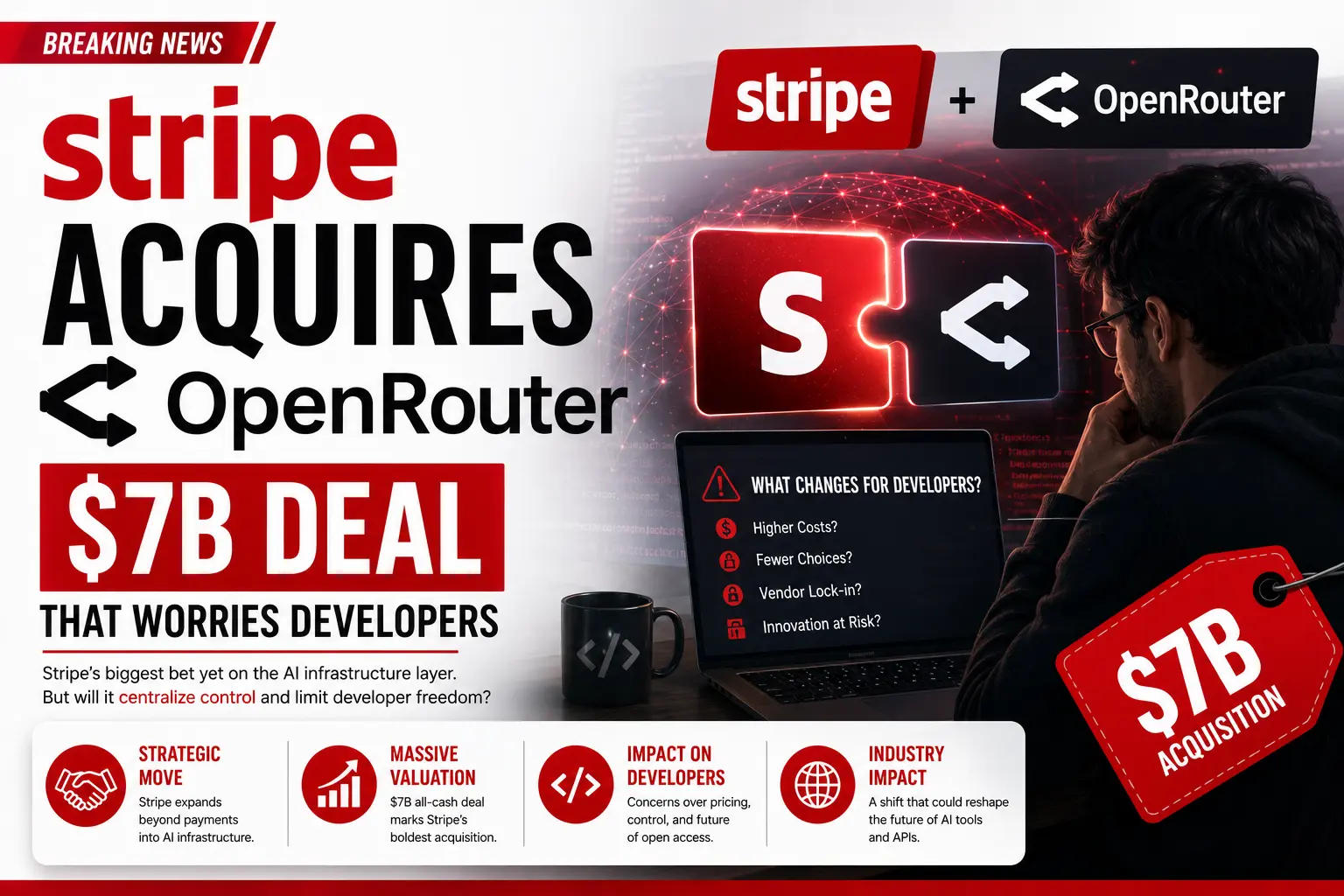
Stripe has finalised a deal to acquire OpenRouter for over $7 billion — confirmed by Bloomberg on August 16, 2026.
OpenRouter was valued at just $1.3 billion in May 2026 — Stripe paid more than 5x that figure in under 90 days.
OpenRouter gives developers access to 400+ AI models through a single API — including GPT, Claude, Gemini, and Mistral.
The deal positions Stripe as the financial and routing infrastructure layer for the entire AI economy.
Developers are asking whether AI model costs will rise after a private payment company controls the gateway.
Stripe’s $7B acquisition of OpenRouter marks a turning point for AI infrastructure in 2026. | The Business Perspective
Stripe acquires OpenRouter. Three words that sent shockwaves through developer communities on Sunday evening. The deal — confirmed by Bloomberg on August 16, 2026 — is not just another Silicon Valley acquisition. It is a signal that the payments giant is making a calculated, aggressive move to own the financial plumbing of the AI economy.
The price tag alone stops you cold. Over $7 billion. For a company that raised its Series B at a $1.3 billion valuation just 90 days earlier. That is not a premium. That is a statement. And the moment Stripe acquires OpenRouter officially closes, the AI infrastructure market will never look the same.
What exactly happened with the Stripe OpenRouter deal?
Bloomberg broke the story on August 16, 2026, reporting that Stripe had finalised an agreement to acquire OpenRouter for more than $7 billion. Axios later confirmed the deal includes a mix of cash and stock. An official announcement from both companies is expected this week.
This did not come out of nowhere. The Wall Street Journal had reported in July 2026 that Stripe and OpenRouter were in acquisition talks — initially at a price closer to $10 billion. The final number landed above $7 billion, though sources note it could still shift before the deal closes formally.
📈
5.4x
Valuation jump in 90 days — from $1.3B (May 2026 Series B) to $7B+ (August 2026 acquisition)
OpenRouter had raised $113 million in its Series B round in May 2026, backed by Sequoia, Andreessen Horowitz, Menlo Ventures, CapitalG (Alphabet’s venture arm), NVentures (Nvidia), and several others. Three months later, Stripe walked in and paid five times that valuation. No standard M&A math explains that — unless you understand what Stripe actually bought.
Why did Stripe pay $7B for a $1.3B company?
Stripe did not buy a startup. Stripe bought a position. OpenRouter sits at the exact intersection of two of the fastest-growing markets on earth — AI compute and developer payments. Every time a developer routes a request through OpenRouter, money moves. Stripe wants to own that money movement.
According to data cited by KuCoin, OpenRouter’s annualised revenue run rate sits around $140 million. At $7 billion, Stripe paid a 50x revenue multiple. That is not a valuation based on today’s profits. It is a bet on where AI infrastructure spending goes over the next five years. When Stripe acquires OpenRouter at that multiple, it is buying market position — not current earnings.
Metric
OpenRouter (May 2026)
After Stripe Deal
Valuation
$1.3 billion
$7+ billion
Revenue multiple
~9x ARR
~50x ARR
AI models available
400+
400+ (unchanged)
Developer users
8 million globally
Part of Stripe ecosystem
Key investors pre-deal
a16z, Sequoia, CapitalG
Acquired — exits confirmed
OpenRouter CEO Alex Atallah described his company as “the Stripe of AI” long before this deal. He meant it as an analogy. Stripe took it literally. The payments company already processed OpenRouter’s billing — giving Stripe a direct view into exactly how fast the platform was growing. That visibility likely made the decision easier.
“Jensen came, approached us with the idea, and we said we’d love to talk to you about it.”
— David Solomon, Goldman Sachs CEO, on Nvidia’s parallel $500B AI financing push (CNBC, August 2026)
What does OpenRouter actually do?
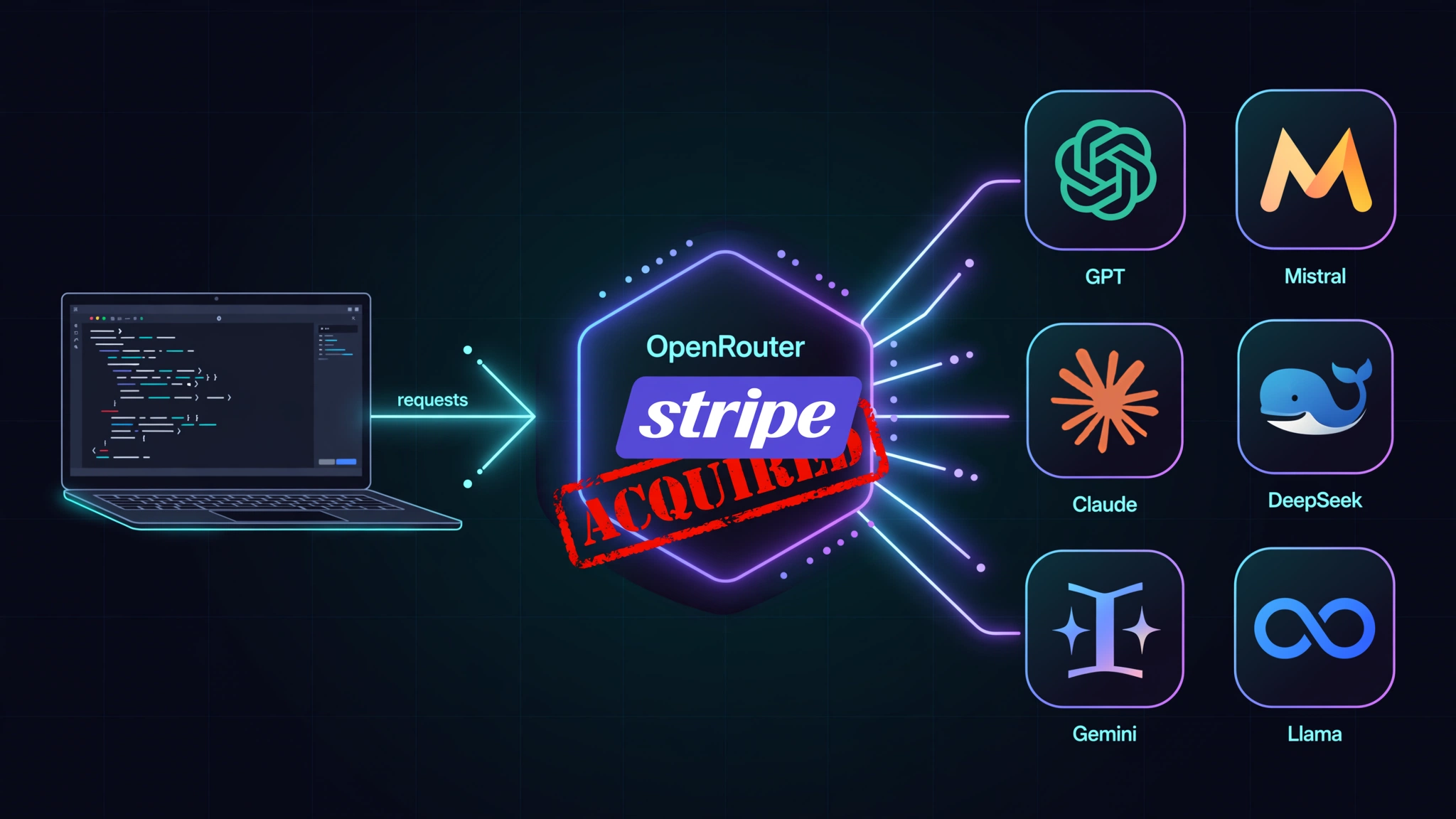
OpenRouter is an AI model gateway. It gives developers a single API key that connects to over 400 AI models — GPT-5, Claude 4, Gemini 2.5 Pro, Mistral, DeepSeek, Llama, and hundreds more. Instead of managing separate integrations, billing accounts, and authentication flows for each provider, developers plug into one endpoint and OpenRouter handles everything behind the scenes.
How OpenRouter routes developer requests across 400+ AI models through a single API. | The Business Perspective
Three things make OpenRouter genuinely useful for startups and developers building AI products:
Cost routing. OpenRouter automatically selects the cheapest model capable of handling each request. A simple summarisation task does not need a frontier model. OpenRouter routes it to a lighter, cheaper option — cutting costs without developers writing any extra code.
Automatic failover. If GPT-5 goes down, OpenRouter switches to Claude 4 or Gemini without the developer’s app going offline. For production systems, this matters enormously.
One billing account. Instead of invoices from OpenAI, Anthropic, Google, Mistral, and Meta separately, developers get one bill. Per Codecademy’s OpenRouter guide, the platform charges a small fee on credit purchases — roughly 5.5% — while passing through provider token rates at cost.
That simplicity attracted 8 million developers globally. And that scale is precisely what Stripe paid $7 billion to own.
Will your AI costs increase after this acquisition?
This is the question every developer and startup founder is asking right now. The moment Stripe acquires OpenRouter officially, 8 million developers face the same question. The honest answer: not immediately — but the risk is real over time.
⚠ Developer Alert
OpenRouter currently charges approximately 5.5% on credit purchases while passing model token costs at provider rates. Stripe has not announced any pricing changes. However, at a 50x revenue multiple, the pressure to grow revenue is significant. Watch for pricing updates in Q4 2026.
OpenRouter’s current model is transparent and lean. It does not mark up token prices. Revenue comes from a small credit-purchase fee. That structure works at startup scale. It becomes harder to justify at a $7 billion valuation inside a company that processes $1.9 trillion in payment volume annually (per Stripe’s 2025 annual letter).
A CNBC investigation published in July 2026 found that Chinese-origin models — DeepSeek, Qwen, Moonshot AI — captured 46% of US enterprise token usage on OpenRouter. That geopolitical dimension now sits inside Stripe’s compliance and regulatory stack. Managing that risk costs money. At some point, those costs find their way into pricing.
For IoT developers and AI automation builders, the implications are direct. If you are routing AI model calls through OpenRouter for smart device applications or automation pipelines, a 10–15% cost increase on that routing layer would materially affect unit economics. For a deeper look at how AI infrastructure costs are reshaping IoT deployments, the team at IoT Insights Hub has been tracking this trend closely across the industrial and enterprise sectors.
The bigger picture — Nvidia’s $500B Wall Street play
The Stripe–OpenRouter deal does not exist in isolation. It is one move in a much larger game that is reshaping how AI infrastructure gets funded and controlled.
On August 10, 2026 — just six days before the OpenRouter deal broke — Nvidia announced partnerships with six major financial institutions: Apollo, BlackRock, Blackstone, Brookfield Asset Management, Goldman Sachs, and KKR. The goal: mobilise over $500 billion in third-party capital for AI infrastructure buildout.
The logic, per CNBC, is that Nvidia chips are becoming a financeable asset class — treated the same way as commercial real estate or toll roads. You borrow against the compute, just as you borrow against property. Goldman Sachs CEO David Solomon confirmed on CNBC that Jensen Huang personally approached the bank with the idea.
Now zoom out. Nvidia controls the chips. Goldman, BlackRock, and KKR control the financing. Stripe — through OpenRouter — is positioning to control the routing and billing layer where developer money actually flows. Three separate power plays. One unified direction: Wall Street is buying into AI infrastructure at every level of the stack.
For startup founders tracking where venture capital is moving in 2026, Rise of Startups has published a detailed breakdown of how AI infrastructure consolidation is affecting seed and Series A funding dynamics this year — worth reading before your next fundraise.
What some experts say differently
Alternative View
Not everyone sees the Stripe acquisition as a threat. Some developers argue that Stripe’s involvement will professionalise OpenRouter — adding enterprise-grade SLAs, better uptime guarantees, and compliance infrastructure that the startup could not build alone. A centralised, well-funded operator may ultimately reduce costs through negotiated provider deals, not increase them. Requesty’s analysis of the deal (July 2026) noted that category validation from a $7B acquisition will accelerate competition from alternatives — which keeps pricing in check regardless of Stripe’s intentions.
What founders and developers should do right now
Immediate Action Plan — 4 Steps
If your product depends on OpenRouter for AI model routing, take these steps before any pricing or policy changes land:
Audit your OpenRouter usage today. Pull your last 30 days of token consumption and model distribution. Know exactly what you are spending and on which models.
Test one alternative in parallel. Set up LiteLLM or Requesty as a staging gateway. It costs nothing and gives you a ready fallback if OpenRouter’s terms change.
Watch the official announcement. Stripe and OpenRouter have not made a public statement yet. The official announcement — expected this week — will clarify integration plans and any initial policy changes.
Negotiate direct provider contracts if your volume qualifies. If you spend more than $5,000/month on AI tokens, reach out directly to Anthropic, OpenAI, or Google for volume pricing. Post-acquisition, having a direct relationship matters.
When Stripe acquires OpenRouter fully and the deal closes officially, it marks a watershed moment for the AI infrastructure market. Whether this raises costs or improves reliability — or both — depends on decisions Stripe has not yet made public. What is certain: the routing layer of the AI economy just became far more valuable, and far more controlled.
For AI automation and IoT teams watching how enterprise AI cost structures evolve through 2026, IoT Mail Bridge covers the operational side of AI infrastructure adoption in depth — including cost benchmarks across OpenRouter, direct APIs, and self-hosted alternatives.
The Business Perspective will update this article as Stripe and OpenRouter release official statements. Bookmark this page or follow us for real-time updates.
Frequently Asked Questions
Why did Stripe acquire OpenRouter?
Stripe acquired OpenRouter to position itself as the financial and routing infrastructure layer for the AI economy. OpenRouter processes billions of AI model requests monthly. By owning the routing layer, Stripe can now monetise every AI transaction — the same way it monetises every payment transaction on the internet.
How much did Stripe pay for OpenRouter?
Stripe paid over $7 billion for OpenRouter, according to Bloomberg (August 16, 2026). This is more than 5x OpenRouter’s $1.3 billion valuation from its Series B round just 90 days earlier in May 2026. Axios reported the deal includes a mix of cash and stock.
What does OpenRouter do?
OpenRouter is an AI model gateway that gives developers access to over 400 AI models — including GPT, Claude, Gemini, Mistral, and DeepSeek — through a single API key. It handles routing, billing, and automatic failover, so developers do not need separate integrations for each AI provider.
Will OpenRouter prices increase after the Stripe acquisition?
No official pricing changes have been announced. However, Stripe paid a 50x revenue multiple for OpenRouter. Analysts expect Stripe to eventually adjust pricing to justify the valuation. Developers should monitor pricing announcements closely over the next 6–12 months and test alternative gateways as a precaution.
What are the best OpenRouter alternatives in 2026?
The strongest alternatives to OpenRouter in 2026 include LiteLLM (open-source, self-hosted), Requesty, Merge Gateway, and direct API integrations from OpenAI, Anthropic, and Google. For startups concerned about vendor lock-in post-acquisition, LiteLLM offers maximum control at zero cost.
AI startups that raised funding in September 2026 included some of the most structurally significant rounds of the year — from Cognition’s $2 billion raise at a $48 billion valuation to Harvey’s $550 million legal AI round backed by every elite VC simultaneously. The Business Perspective tracked the top 10 AI startups that raised funding...
AI agent startup funding September 2026 reached a new quarterly record — 56 tracked rounds worth approximately $5.25 billion in Q3 alone, as autonomous agent companies attracted capital from sovereign wealth funds, crossover investors, and traditional venture firms simultaneously for the first time. The Business Perspective tracks AI agent startup funding September 2026 and every...
Cognition $2 billion funding closed in September 2026 at a $48 billion valuation — making it one of the most aggressively priced AI coding companies ever backed by institutional capital, with no publicly disclosed revenue to anchor the number. The Business Perspective breaks down what the Cognition $2 billion funding round actually signals about where...