
Q3 2026 venture funding: 64% to AI, a warning for the rest.
Q3 2026 venture funding landed at $159 billion, and nearly two-thirds of it went to AI. That is the headline from Crunchbase News’ quarterly report, published October 5. It is also the least interesting thing in it.
Look at the structure instead. A record 27 companies raised rounds of $1 billion or more, and together they took roughly a third of all the money invested. If you are building outside AI, the question is not whether capital exists. It is how much of it will ever reach you.
The Business Perspective went through the report and the coverage around it to answer that. Below are the numbers, the biggest checks, what skeptics say, and a practical read for founders who are not pitching a model or a GPU cloud.
What did Q3 2026 venture funding actually look like?
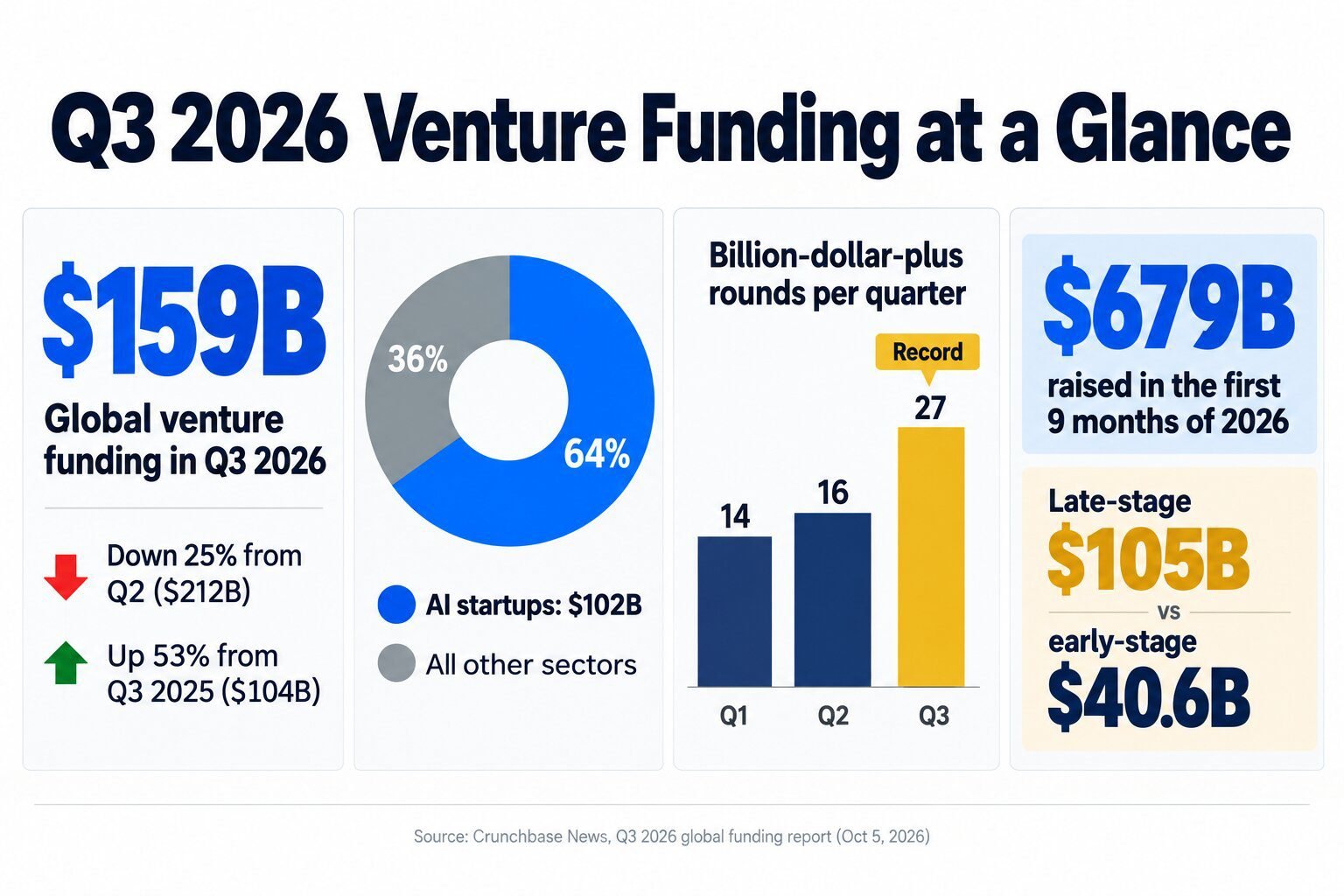
Global venture funding reached $159 billion in Q3 2026 across nearly 6,000 startups, according to Crunchbase News. That is down 25% from Q2’s $212 billion but up 53% from the $104 billion raised a year earlier. It was the weakest quarter of 2026 so far, yet the nine-month total of $679 billion is a record for the period.
Start with the shape of the year. Crunchbase’s April report put Q1 at about $300 billion, then Q2 came in at $212 billion and Q3 at $159 billion. That is a steady slide, but a slide from an absurd peak.
Against last year, Q3 looks strong. Half of all Q3 capital went to companies founded since 2022, which suggests newer firms are absorbing a big share of the market.
| Metric | Q3 2026 | How it compares |
|---|---|---|
| Global venture funding | $159 billion | Down 25% from Q2 ($212 billion); up 53% from Q3 2025 ($104 billion) |
| AI-driven startups | $102 billion | 64% of the global total |
| Startups funded | Nearly 6,000 | Half of the capital went to companies founded since 2022 |
| Late-stage funding | $105 billion | Down 23% from Q2; up 73% from Q3 2025 |
| Early-stage funding | $40.6 billion | Up 25% from Q3 2025 |
| Seed funding | $13 billion | $2.6 billion went to seed rounds of $100 million or more |
| US startups | $91 billion | About 57% of global funding |
| First nine months of 2026 | $679 billion | The most ever for the first three quarters of a year |
Data note: Figures come from Crunchbase News’ Q3 2026 global funding report, published October 5 with data as of October 2, and the coverage that followed it. Venture data gets revised as late deals are reported, so treat these as a snapshot rather than a final count. The Business Perspective will update this article if the totals move.
How much of Q3 2026 venture funding went to AI?
AI-driven startups raised $102 billion in Q3, or 64% of global venture dollars, per Crunchbase News. That is 14 percentage points above Q3 2025, but below the 80% Crunchbase reported for Q1 and the above-70% it reported for Q2. The share slipped this quarter even though the dollar amount stayed enormous.
Here is the part that surprises people. The 64% share is the lowest AI reading of the year so far, after 80% in Q1 and above 70% in Q2. The share slipped, but $102 billion is still a staggering sum for one category to absorb in a single quarter.
Geography shifted too. US startups raised $91 billion, about 57% of the global total, per Crunchbase News. In Q1, US companies took 83%.
One caveat before you quote the 64% anywhere. Crunchbase gives no tight definition of AI-driven, so the line between an AI company and one that simply uses AI is blurry. For a US-only view on a different dataset, see our analysis of AI venture capital market share in 2026.
Why did 27 billion-dollar rounds change the math for everyone else?
A record 27 companies raised rounds of $1 billion or more in Q3, up from 16 in Q2 and 14 in Q1, per Crunchbase News. Together they absorbed around a third of the quarter’s $159 billion. When a few giant rounds set the total, the headline figure hides how little is left for the typical startup.
Think about what 27 deals do to an average. Pull them out and the quarter looks far quieter. The Business Perspective tracked many of the September rounds behind this Q3 2026 venture funding surge in our monthly roundup, from Cognition to Harvey.
| Quarter | Rounds of $1B or more | AI share of global funding |
|---|---|---|
| Q1 2026 | 14 | 80% |
| Q2 2026 | 16 | Above 70% |
| Q3 2026 | 27 (a record) | 64% |
Databricks and Safe Superintelligence each raised $5 billion this year, according to Crunchbase’s report, and six more companies raised over $3 billion.
| Company | Round size |
|---|---|
| Databricks | $5 billion |
| Safe Superintelligence | $5 billion |
| Crusoe | Over $3 billion |
| Moonshot AI | Over $3 billion |
| Mistral AI | Over $3 billion (3 billion euros, about $3.5 billion) |
| Nscale | Over $3 billion |
| The Boring Company | Over $3 billion |
| Kling AI | Over $3 billion |
Mostly AI labs and AI infrastructure, yes. But The Boring Company is on the list, and it builds tunnels. For the AI and IoT infrastructure behind names like Crusoe and Nscale, IoT Insights Hub covers the technology side.
PitchBook adds one more data point: 19 startups crossed the $10 billion valuation mark this year, putting 2026’s decacorn class on track to beat the 2021 record.
What does Q3 2026 venture funding mean for non-AI founders?
The money exists, but it is concentrated. By simple subtraction, about $57 billion went to startups outside Crunchbase’s AI-driven group, and early-stage funding grew 25% year over year. The real risk for non-AI founders is not zero capital. It is being measured against AI growth curves in every pitch meeting.
Let’s be blunt about what the numbers do and don’t say. They do not say non-AI startups can’t raise. About $57 billion went to everything outside Crunchbase’s AI-driven group, by simple subtraction.
They do say the comparison set has changed. In our read at The Business Perspective, every non-AI deck now gets weighed, even if only in the back of an investor’s mind, against companies growing at AI speed.
That pressure is hardest on startups that sit near AI without being deep in it. For them, the gap between a thin wrapper and a real moat matters more than ever. Our piece on AI wrapper vs deep tech startups shows how VCs draw the line.
Is early-stage funding still healthy outside the mega-rounds?
Yes, though unevenly. Early-stage funding reached $40.6 billion in Q3, up 25% from a year earlier, and seed rounds totaled $13 billion, according to Crunchbase News. Late-stage funding grew faster, at $105 billion and up 73% year over year, so growth-stage investors still set the tone for the whole market.
The mega-round headlines make it easy to miss the base of the pyramid. Early-stage funding rose 25% from a year earlier to $40.6 billion, and seed totaled $13 billion, per Crunchbase News.
Even seed has a mega-round tail. About $2.6 billion of that total went into rounds of $100 million or more, roughly a fifth by our math. Late-stage money is moving faster still, at $105 billion in Q3.
For founders, the practical read is simple. The seed and Series A doors are open, but the bar for traction keeps moving. Our Series A funding trends 2026 breakdown shows what investors want to see before they write the check.
How should non-AI founders raise money in this market?
Treat it as a proof-of-efficiency market. Investors have plenty of capital and a short list of giant bets, so non-AI startups win by showing revenue, clear unit economics and a reason to exist beyond the AI trend. Lead with metrics, follow with the story, and never bolt an AI label onto a business that does not need one.
This part is The Business Perspective’s view, not Crunchbase’s. After reading the Q3 2026 venture funding data, here is how we would approach a raise if the company is not an AI business.
- Lead with efficiency. Revenue, margins and payback period belong on the first slides, not the last.
- Be honest about AI. Use it where it cuts cost or speeds delivery. Do not rebrand a services business as an AI company.
- Pick investors by thesis. Funds that name your sector in their strategy will read your deck differently than generalists chasing the AI cycle.
- Start earlier and plan longer. With capital pooling in a few names, follow-on rounds are less predictable, so build a runway that survives a slow quarter.
If you are still preparing your first round, our guide on how to raise seed funding for startups covers the steps in order. For founder stories and funding news from outside the AI spotlight, Rise of Startups is worth a read too.
What do critics say about the AI funding boom?
Critics say the headline numbers overstate how healthy the market is. A few AI mega-rounds inflate the totals, the same round can carry different valuations by source, and Crunchbase leaves its AI definition loose. Supporters note that early-stage and late-stage funding both grew year over year, and half of Q3 capital went to companies founded since 2022.
No quarter like this passes without pushback, and the pushback here is worth hearing.
What skeptics say
- Concentration. Twenty-seven companies took about a third of the capital, so the typical startup competes for a shrinking share of a pool that only looks enormous in aggregate.
- Valuation noise. PitchBook has reported that demand for hot AI startups is producing different valuations for the same funding round.
- A soft quarter. Q3 was the weakest of 2026 so far, and companies that raised in easier years now have to show real business results.
What optimists say
- Growth year over year. Funding rose 53% overall, 25% at early stage and 73% at late stage against Q3 2025.
- Healthy exits. Crunchbase described a strong quarter for exits, with China leading on semiconductors and robotics.
Our view: both camps are right. The market is large, young and active. It is also lopsided. The Business Perspective will keep watching whether the gap between the top 27 and everyone else narrows in Q4.
What are the most common questions about Q3 2026 venture funding?
Short version: Q3 2026 venture funding hit $159 billion, AI took 64% of it, and a record 27 rounds topped $1 billion. The Business Perspective answers the six questions founders and investors ask most about the quarter below, each drawn from Crunchbase News data in its October 5 report.
How much venture funding was raised in Q3 2026?
Global venture funding reached $159 billion in Q3 2026, according to Crunchbase News, spread across nearly 6,000 startups. That is 25% below Q2’s $212 billion and 53% above the $104 billion raised in Q3 2025. Through the first nine months of 2026, startups raised $679 billion, the highest total on record for that period.
What share of Q3 2026 venture funding went to AI startups?
AI-driven startups raised $102 billion in Q3 2026, which is 64% of global venture funding, per Crunchbase News. That share is lower than the 80% Crunchbase reported for Q1 and the above-70% it reported for Q2. The dollar amount is still enormous, and it sits 14 percentage points above Q3 2025.
How many billion-dollar rounds happened in Q3 2026?
A record 27 companies raised rounds of $1 billion or more in Q3 2026, based on Crunchbase News data. That compares with 16 in Q2 and 14 in Q1, and brings the 2026 total to 57. Those 27 deals absorbed around a third of all global venture capital invested during the quarter.
Is venture funding still available for non-AI startups?
Yes, but it is harder to stand out. About $57 billion of Q3 funding went to startups outside Crunchbase’s AI-driven group, by simple subtraction, and early-stage funding rose 25% year over year to $40.6 billion. The challenge is competing for attention with a handful of AI companies raising billions.
Did Q3 2026 venture funding go up or down?
Both, depending on the comparison. Q3 2026 venture funding fell 25% from Q2 but rose 53% from Q3 2025, according to Crunchbase News. Q3 was the weakest quarter of 2026 so far, but it still beat the same quarter last year by a wide margin.
How does Crunchbase define AI-driven startups?
Crunchbase says AI-driven startups across the stack raised $102 billion in Q3, but its report does not spell out a precise definition beyond that phrase. Other trackers use different definitions and regions, so their AI share figures can differ. Treat the 64% as a useful signal, not an exact measurement.
What is the bottom line on Q3 2026 venture funding?
Q3 2026 venture funding shows a market with plenty of money and very little breadth. AI took 64%, 27 rounds took about a third, and everyone else shared what remained. Non-AI founders can still raise, but they need sharper numbers, earlier conversations and a story that does not depend on the AI trend.
Strip away the noise and Q3 2026 venture funding tells a clear story. Capital is abundant, and it is stacked at the top. AI-driven startups took $102 billion, 27 companies raised $1 billion or more, and thousands of other startups competed for what was left.
If you are building outside AI, the takeaway is not despair. It is discipline. Show efficient growth, choose investors who understand your sector, and raise before you need to. The Business Perspective will keep tracking Q3 2026 venture funding and what comes after it, so check back as Q4 data lands.






2 thoughts on “Q3 2026 venture funding: 64% to AI, a warning for the rest.”