
Startup board meeting agenda: 5 mistakes + free template
Most founders build a startup board meeting agenda the way they build a status report: update after update, then a few minutes for questions at the end. That order wastes the one hour a quarter when your directors are actually listening.
Directors usually sit on several boards and keep packed calendars, as XSeed Capital’s Jeff Thermond has pointed out. They read your deck on the way to another meeting. The Business Perspective pulled together advice from Thermond and First Round Review’s Liz Wessel and turned it into a free 90-minute startup board meeting agenda template, a pre-read checklist and five mistakes worth fixing first.
One note up front. The minute-by-minute split below is our template. The sources give principles and a few hard numbers, such as 48 hours for the pre-read, but no single agenda fits every company.
What should a startup board meeting agenda include?
A good startup board meeting agenda has four layers: quick approvals, an honest scorecard, two to four topics labeled Update, Discussion or Decision, and a closing block for owners and dates. First Round Review’s Liz Wessel caps the meeting at two to four substantive topics and sends the pre-read ahead of time.
Wessel, a partner at First Round, builds the agenda around a short list. She limits the meeting to two to four substantive topics and labels each one an Update, a Discussion or a Decision. That one habit tells directors what outcome you expect before they read a word.
Then comes the routine layer. Start with two to three minutes of verbal approvals for legal items, she advises, and spend the next 20 to 30 minutes on questions from the pre-read. Assign someone to watch the clock so early items don’t swallow later ones.
Here is the part most agendas get wrong. Choose topics where the people in the room can actually help. A director strong in go-to-market is the wrong person to quiz about model architecture.
Every Decision item needs a recommendation behind it. Our decision framework for a startup board meeting agenda walks through how to build one.
How long should the meeting run, and in what order?
Plan for about 90 minutes, which is The Business Perspective’s suggestion rather than a fixed rule. Open with brief approvals, move to the scorecard, give the middle of the meeting to decisions, then close with risks and owners. The goal is to spend the room’s time on discussion, not on reading slides aloud.
Neither source sets a single length, so treat 90 minutes as a starting point. The split below puts decisions in the middle of the meeting, when everyone is still fresh, and keeps the last ten minutes for owners and dates. This startup board meeting agenda is the free template promised in the headline. Copy it and edit the times.
| Time | Segment | Label | What to cover |
|---|---|---|---|
| 0-5 min | Welcome and approvals | Decision | Prior minutes, option grants and legal items, prepared with counsel |
| 5-20 min | Business update and KPIs | Update | The honest scorecard, plus the CEO’s view of the quarter |
| 20-40 min | Financials and runway | Discussion | Questions from the pre-read, cash position, burn and plan versus actual |
| 40-65 min | Key decisions and strategy | Decision | Two or three topics, each with your recommendation and a clear ask |
| 65-80 min | Risks and open discussion | Discussion | What could go wrong, what you need help with, introductions |
| 80-90 min | Actions and owners | Update | Read back decisions, assign owners and dates, agree the next meeting |
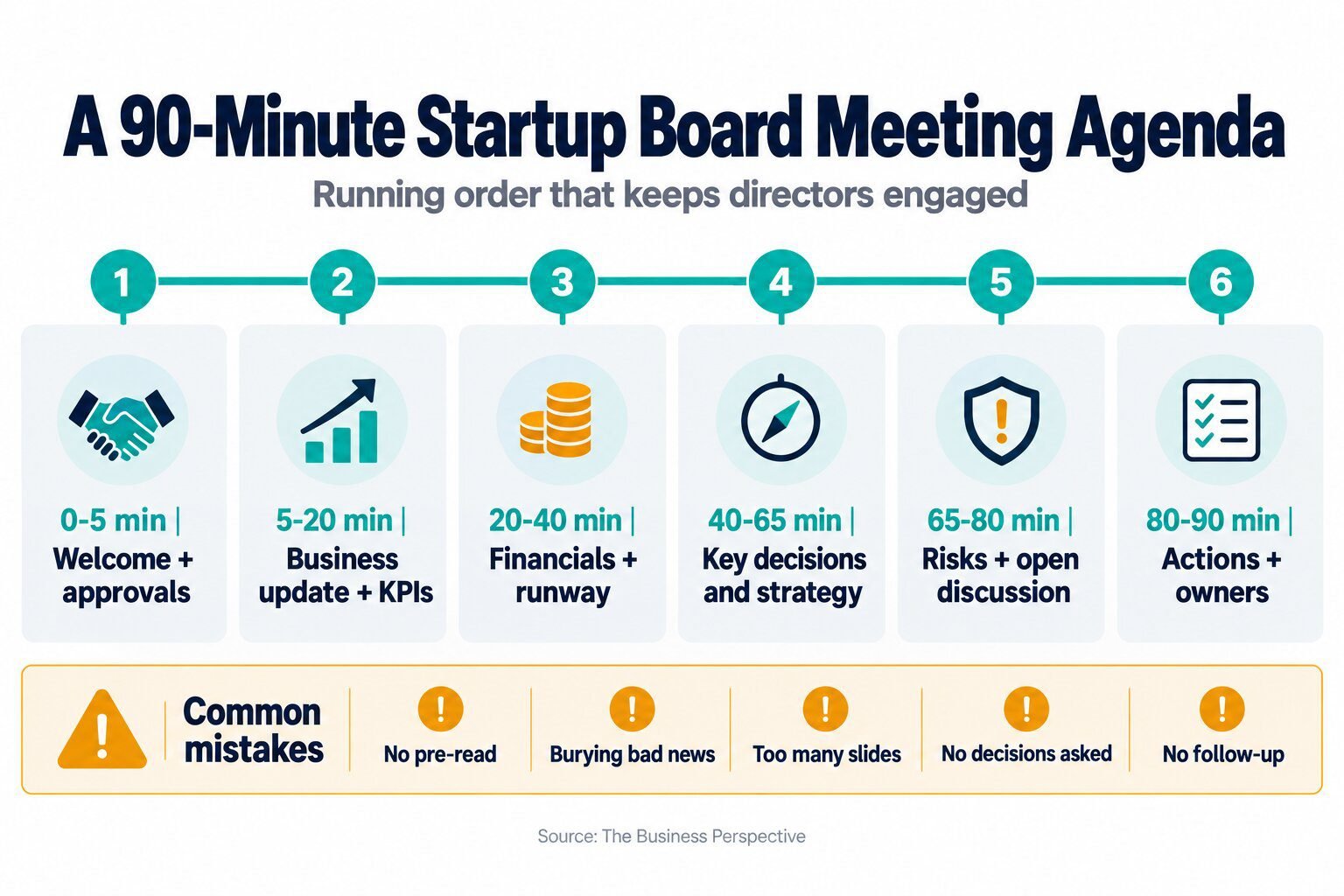
So what is the item that gets buried? In our read, it is the honest scorecard plus the single decision you need. Wessel opens her pre-read with a report card that grades each function, and warns founders not to inflate grades or invent failing ones to look ambitious. Bring that same candor to the room, right after approvals, and routine updates stop crowding it out.
With three or more investors on the board, Wessel suggests founders-only and investors-only executive sessions in the last 20 to 30 minutes. Add that time on top of the 90.
What goes in the board deck and pre-read?
Send a memo or a deck that works without narration, at least 48 hours ahead, per First Round Review’s Liz Wessel. Start with an honest report card, add the CEO’s view of the business and market, then give each discussion topic its context, your leaning, the alternatives and the specific help you want.
A startup board meeting agenda only works if the pre-read does the heavy lifting. If directors arrive having read it, the meeting becomes a conversation. If not, you present slides aloud, the dog-and-pony show Wessel warns against.
| Source | Minimum lead time | Other advice |
|---|---|---|
| Liz Wessel, First Round Review | 48 hours | Ask counsel several days earlier for prior minutes, option-grant approvals and resolutions, and send them with the pre-read |
| Jeff Thermond, XSeed Capital (Forbes, April 16, 2015) | 36 hours | Rehearse co-presenters, and cut any slide that breaks the CEO’s narrative |
Both are minimums. Thermond’s piece first ran in 2015, so treat 48 hours as the safer target today.
Free pre-read template (copy and fill in)
- Company report card. Grade each major function honestly.
- CEO view. The big picture in a few lines.
- Market view. What changed in buyer behavior, competition or the wider market.
- Function highlights. Notable events, performance versus plan, causes, and next-quarter changes.
- Discussion topics. For each: the question or decision, context and data, your current leaning, alternatives and trade-offs, and what you want from the board.
- Appendix. Prior minutes, option-grant approvals and resolutions from counsel.
Thermond adds two craft points. The CEO should personally understand the financials, and any slide that breaks the CEO’s narrative should go, even when a direct report wants it in.
Building the slides? Our startup pitch deck template covers structure, and how investors value a startup helps with the numbers behind your asks.
Which mistakes wreck a startup board meeting agenda?
Five mistakes cause most of the damage: a late pre-read, surprises in the room, too many topics, open-ended problems with no recommendation, and no follow-up. Four come from advice by First Round Review’s Liz Wessel and XSeed Capital’s Jeff Thermond. The fifth is The Business Perspective’s own addition.
Each of these can sink an otherwise solid startup board meeting agenda, and all five are cheap to fix.
- Sending the pre-read late. A rushed read produces shallow questions.
- Dropping surprises in the room. Wessel says key executive departures, major customer churn and big misses should reach the board first. In her words, “Board meetings are for discussion and decisions, not for dropping news they might need time to process.”
- Cramming in too many topics. Wessel flags dog-and-pony shows, where founders recite the pre-read instead of discussing issues.
- Raising problems with no position. Thermond calls open-ended issues a killer mistake and says he made it in his own first meeting. Wessel agrees that “Thoughts?” is rarely a useful ask.
- Skipping the follow-up. This one is our addition. Send a short recap of decisions, owners and dates while the room still remembers it.
| Mistake | Fix | Where it comes from |
|---|---|---|
| Late or missing pre-read | Send it 48 hours ahead or earlier | Wessel; Thermond |
| Surprises in the room | Share bad news with directors before the meeting | Wessel |
| Too many topics | Cap the meeting at two to four | Wessel |
| Open-ended problems | Bring a recommendation and a specific ask | Thermond; Wessel |
| No follow-up | Send a short recap of decisions, owners and dates | The Business Perspective |
How do you run the meeting once everyone is in the room?
Start and end on time, name a timekeeper, and label every item so directors know the expected outcome. Put the hard topics before routine ones, ask for a specific decision, and rehearse anyone presenting alongside you. Afterward, send a short recap and ask one trusted director for candid feedback.
Run your startup board meeting agenda like a working session. Start on time and end on schedule, Thermond says. Name a timekeeper so the first item doesn’t eat the last.
Name each item’s label from the startup board meeting agenda, then ask for what you need. A specific request gets a better answer than an open question.
Wessel says counsel’s minutes should be accurate but concise, since overly detailed records can expose privileged information. We are not lawyers, so check with your own counsel.
Afterward, ask a trusted director for candid feedback. Wessel suggests a question like: “If you were to send a report of the meeting to your firm’s partners, what would you write?” The answer tells you how the meeting actually landed.
Early boards are often small, and structure grows with each round. Heading toward a first institutional check? Read how to raise seed funding for startups and the Series A funding trends 2026 benchmarks. For founder stories, see Rise of Startups, and hardware founders can track sector news at IoT Insights Hub.
What do critics say about board meeting templates?
Critics say a polished template can hide a weak meeting. Wessel herself warns against dog-and-pony shows, where founders recite the pre-read instead of discussing issues. Others note that rigid time boxes can cut off the real conversation, and that small early boards rarely need this much structure.
Fair pushback exists.
What skeptics say
- Theater over substance. A neat agenda can disguise a meeting where founders recite updates. Wessel’s own warning about dog-and-pony shows applies to well-formatted decks too.
- Time boxes cut conversations short. Real disagreement rarely fits a clock, and a strict 90 minutes can end the useful part early. Leave slack in the middle block.
- Not every board needs this much structure. Executive sessions only make sense with three or more investors, per Wessel, and a two-person board may need only a short startup board meeting agenda.
Practitioners counter that structure protects candor, and Thermond says rehearsal and a clear CEO position sharpen discussion. Our view at The Business Perspective: treat any startup board meeting agenda as scaffolding, not a script. If the conversation is working, let it run.
What are the most common questions about board meetings?
Short version: send the pre-read at least 48 hours ahead, cap the meeting at two to four topics, and bring a recommendation on every hard issue. The Business Perspective answers the six questions founders ask most below, each drawn from advice by First Round Review and XSeed Capital.
How far in advance should you send a board deck?
Send it at least 48 hours ahead, according to First Round Review’s Liz Wessel. XSeed Capital’s Jeff Thermond treats 36 hours as the minimum for directors to review slides. Documents from outside counsel, such as prior minutes and option-grant approvals, should be requested several days earlier so they can travel with the pre-read.
How many topics should a board meeting cover?
Wessel recommends two to four substantive topics, depending on how meaty each one is and how long the meeting runs. List them at the end of the pre-read and label each as an Update, Discussion or Decision. Fewer topics leave time for real debate instead of presentations.
How long should a startup board meeting last?
The sources do not set one length. Wessel suggests two to three minutes of approvals and 20 to 30 minutes of questions from the pre-read. The Business Perspective’s template uses 90 minutes as a starting point. Adjust it to your topic count, board size and how much the pre-read already covers.
What is a board pre-read?
A pre-read is the memo or slide deck directors receive before the meeting. Wessel says it should work without narration and open with an honest report card for each major function. It carries the updates, so meeting time goes to questions, discussion and decisions rather than presenting.
Should you bring a recommendation to the board?
Yes. Wessel says to always bring one, even with low confidence, because “Thoughts?” is rarely a useful ask. Thermond calls raising problems without a CEO position a killer mistake. State your leaning, the alternatives and trade-offs, and exactly what you want from directors.
How detailed should board meeting minutes be?
Accurate but concise, according to Wessel, because overly detailed records can expose privileged information. Ask outside counsel to prepare or review the minutes and resolutions. Capture decisions and approvals there, and keep action items and owners in your own short follow-up note.
What is the bottom line on a startup board meeting agenda?
A strong startup board meeting agenda is mostly discipline. Send the pre-read early, lead with the honest scorecard, keep the topics few, and ask for decisions with a recommendation attached. The template here gives you the order, but trust with your directors comes from how candidly you fill it in.
Strip away the formatting and a good startup board meeting agenda comes down to a few habits. Send the pre-read early, lead with the honest scorecard, keep the topics few, and bring a recommendation on every hard issue.
Copy the 90-minute template above, adjust the times to your board, and fix the five mistakes before your next meeting. The Business Perspective will keep publishing practical founder guides like this one, so check back for more on running a company your directors can trust.