Knowing how to make hard decisions as a leader is the single most important skill that separates managers from executives.
Hard decisions do not get easier with more data — they get easier with a better framework.
The best leaders separate emotion from decision before gathering any information.
Jensen Huang, Dario Amodei, and Sam Altman each use a different system to make hard decisions as a leader — but all three time-box their information gathering.
Decision fatigue kills more leadership careers than bad strategy ever does.
“The quality of your decisions determines the quality of your leadership. Everything else — the team, the strategy, the culture — flows from that.”
Every leader reaches a point where they have to make hard decisions as a leader — the kind where there is no obviously right answer, where someone will be unhappy regardless of what you choose, and where the cost of getting it wrong is very real.
Learning how to make hard decisions as a leader is not something business schools teach well. They give you frameworks for strategy, finance, and marketing. But when you are standing in a room where a decision must be made today — with incomplete information, competing priorities, and people watching — most of those frameworks disappear.
This article gives you something more useful: a practical, proven, 7-step system for how to make hard decisions as a leader. It is built not from theory, but from studying how the world’s most consequential CEOs actually behave in the moments that define their careers.
The leaders who consistently make the best decisions are not the smartest people in the room. They are the ones with the clearest process, the most honest self-awareness, and the courage to commit fully once they have decided. That is what this article teaches.
72%
of leaders say decision fatigue is their biggest challenge
40%
of business decisions are reversed within 2 years
3x
faster decisions by leaders with a clear framework
85%
of executives report decision fatigue weekly
Why Hard Decisions Feel Impossible
There is a reason it feels so difficult to make hard decisions as a leader. It is not because you lack intelligence or experience. It is because hard decisions, by definition, involve real trade-offs — situations where every available option carries a meaningful cost and no option is clearly better than the others.
When a decision is easy, one path is obviously correct. When you have to make hard decisions as a leader, all paths carry risk. The discomfort you feel in those moments is not a sign you are doing something wrong. It is a sign you are dealing with a genuinely complex situation that deserves a structured approach — not gut instinct and not endless deliberation.
The single biggest mistake most leaders make is believing that more information will eventually make the decision feel comfortable. It will not. There is a point in every hard decision where additional information stops changing the outcome and starts justifying the delay. The leaders who build great organisations are the ones who find that point early — and decide before they reach it.
The real question is not whether you feel ready to decide. It is whether you have a process for deciding. Without a process, every hard decision starts from scratch. With one, you get faster and more confident every time.
How to Make Hard Decisions as a Leader: The 7-Step Framework
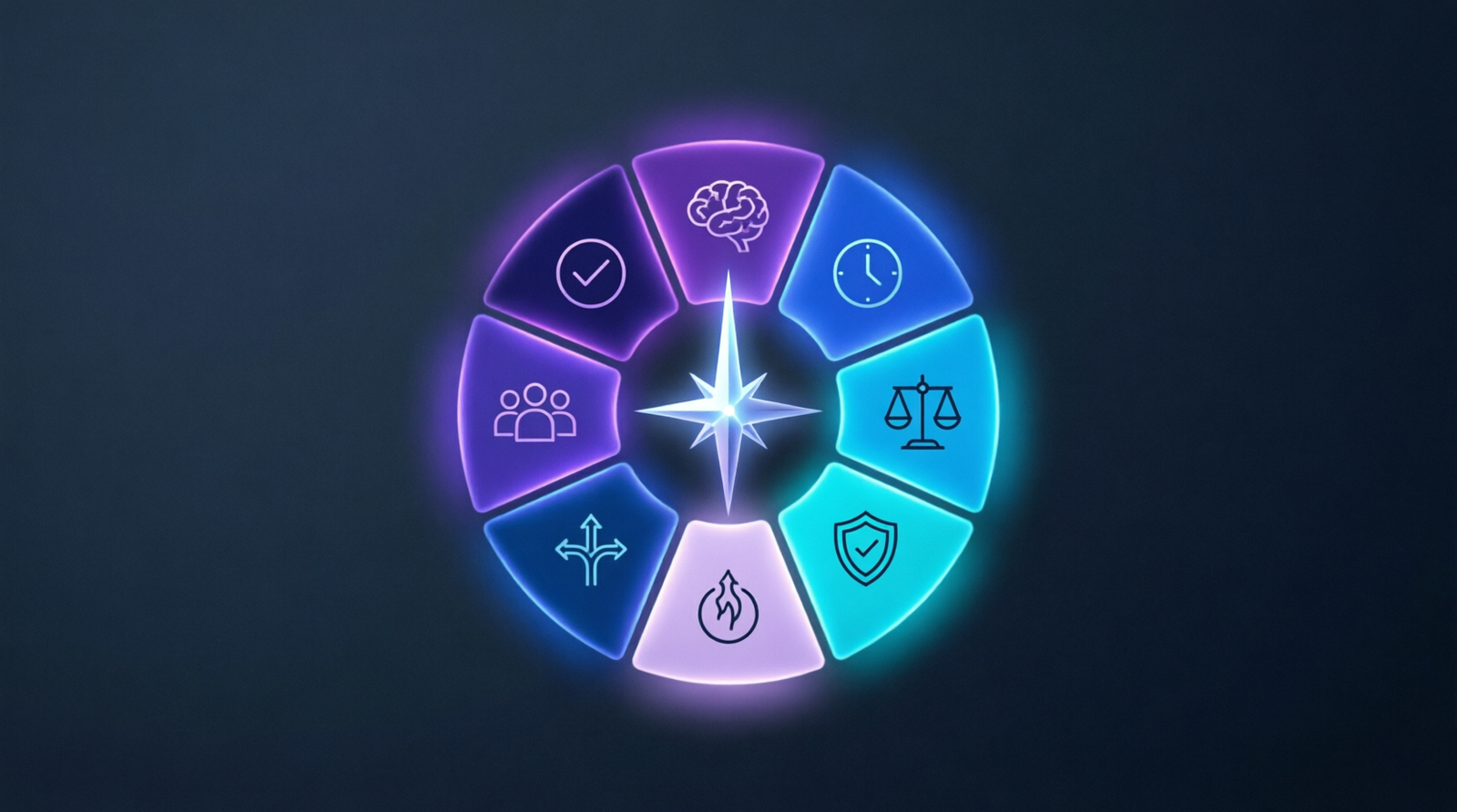
This is the framework. Every step exists for a reason. The leaders who use it consistently report that it becomes faster and more intuitive over time — until making hard decisions as a leader no longer feels like a special event, but simply part of how they think.
The 7-step framework visualised — each stage builds on the last, creating a repeatable system for high-stakes leadership decisions.
1
Separate the Decision from the Emotion
The first step to make hard decisions as a leader is to name what you are feeling before you do anything else. Anxiety? Fear of conflict? Fear of being wrong publicly? Acknowledge it — then set it aside. The emotion is real information about your values and risk tolerance. But it is not the decision. Leaders who skip this step end up making emotional choices and calling them strategic ones — and they wonder later why the decision felt right at the time but went wrong in practice.
2
Define Exactly What You Are Deciding
Write the decision in one sentence — not the situation, the actual decision. “We need to figure out our pricing strategy” is a situation. “Should we raise our enterprise plan price by 20% in Q4 or hold flat?” is a decision. If you cannot write it in one clean sentence, you are not yet ready to make hard decisions as a leader on this topic. Most teams spend hours debating the wrong question because nobody stopped to define the right one.
3
Set Your Criteria Before Looking at Options
Before you look at any options, write down the three things that matter most in this decision. Speed? Cost? Team morale? Customer impact? Long-term positioning? This is the step that separates good decision-makers from great ones when they have to make hard decisions as a leader. Setting criteria first prevents you from reverse-engineering your reasoning to justify what you already emotionally want — a trap almost every leader falls into at some point.
4
Gather the Minimum Viable Information
More data does not make hard decisions easier — it makes them slower. When you have to make hard decisions as a leader, set a clear deadline for information gathering: 24 hours for operational decisions, 72 hours for strategic ones. Ask yourself: what is the single most important piece of information I am missing right now? Find that. Everything else is noise. Leaders who wait for complete information are not being careful — they are avoiding the decision.
5
Run the Regret Minimisation Test
Project yourself forward 10 years. Look back at this moment. Which choice will you regret more — making the call and being wrong, or not making the call and never knowing? This question does not tell you the right answer when you need to make hard decisions as a leader. But it tells you which fear is driving your hesitation — and whether that fear is worth listening to. It is the most underused tool in leadership decision-making, and it works every time.
6
Decide and Commit Completely
A good decision made with full commitment outperforms a perfect decision made with hesitation. When you make hard decisions as a leader, once you decide, stop revisiting it unless materially new information emerges. Half-hearted execution of the right decision produces worse outcomes than full-hearted execution of a slightly imperfect one. Your team feels the difference. So do your customers. Commit completely — every time.
7
Review the Process — Not the Outcome
Schedule a 30-minute review 90 days after every major decision. Not to judge whether it was right — outcomes are partly a function of luck, and judging process by outcome is a logical error. The goal each time you make hard decisions as a leader is to improve the system. Were the criteria right? Did you gather the right information? Did you commit fully? Review and refine. This is how great decision-makers are built — not through talent, but through deliberate practice.
Studying how top CEOs make hard decisions as a leader reveals something surprising: none of them claim to have perfect instincts. All of them have a process. Here is how three of the most consequential business leaders of 2026 approach the decisions that define their companies.
Jensen Huang
CEO, Nvidia
“I make decisions at the speed of the opportunity, not the speed of my comfort.”
His Approach: Intelligent Speed
Huang’s way to make hard decisions as a leader is to move faster than the market, accept that some decisions will be wrong, and course-correct quickly. His framework: understand the direction, trust the team, move. At Nvidia’s scale, hesitation costs more than imperfection ever could.
Dario Amodei
CEO, Anthropic
“The most dangerous decisions are the ones where everyone in the room agrees.”
His Approach: Pre-Mortem Thinking
Before committing to any major decision, Amodei imagines it has already failed spectacularly — then asks why. His method to make hard decisions as a leader surfaces hidden risks that optimism tends to bury. For a company building AI with civilisation-level consequences, this is not paranoia — it is precision.
Sam Altman
CEO, OpenAI
“Most decisions are reversible. Act like it.”
His Approach: Two-Door Thinking
Altman categorises every decision as either a one-way door — irreversible — or a two-way door — reversible. His rule to make hard decisions as a leader: spend serious time only on one-way doors. Most decisions are two-way doors that leaders are treating like one-way doors, which creates paralysis.
The Biggest Mistakes Leaders Make When They Have to Make Hard Decisions
Understanding how to make hard decisions as a leader means understanding what not to do just as much as what to do. These five mistakes consistently produce poor outcomes — regardless of how experienced the leader is.
The difference between leaders who struggle to make hard decisions and those who do it confidently comes down to process — not intelligence or experience.
❌ Mistake 1: Confusing Delay with Diligence
Waiting for more information feels responsible when you need to make hard decisions as a leader. Often, it is avoidance wearing a professional mask. There is a point in every decision where additional information stops changing the outcome and starts justifying the delay. Identify that point and decide before you reach it.
❌ Mistake 2: Deciding by Committee
Consensus feels safe — it distributes the blame. But the ability to make hard decisions as a leader is fundamentally individual. Decisions made by committee are almost always worse than decisions made by one accountable person with broad input. Seek input widely. Decide narrowly. Own the outcome fully.
❌ Mistake 3: Reversing Decisions Due to Pushback
Leaders who change their position every time someone pushes back are not being open-minded — they are being conflict-averse. When you make hard decisions as a leader, distinguish between genuine new information — which is a valid reason to revisit — and social pressure, which is not. If nothing material has changed, hold the decision.
❌ Mistake 4: Treating All Decisions the Same
Spending three hours on a vendor contract and three hours on a company pivot is not thoroughness — it is misallocation. Match your decision-making effort to the stakes. Small decisions deserve fast decisions. When you have to make hard decisions as a leader on truly high-stakes issues, use the full 7-step framework. Do not apply the same level of process to every choice.
❌ Mistake 5: Judging Decisions by Their Outcomes
A good process to make hard decisions as a leader can produce a bad outcome. A bad process can produce a good outcome. Luck is real and it is significant. If you judge your decision-making by outcomes alone, you will start making decisions designed to look defensible rather than decisions designed to be right. Judge the process. Improve the framework. Let the outcomes follow.
How to Build Your Personal Framework to Make Hard Decisions as a Leader
The 7-step framework in this article is a starting point. The leaders who consistently make the best decisions over the long term do not just borrow someone else’s framework — they build their own, refined through repeated use and honest self-review.
Here is how to start that process today.
Start a decision journal. For the next 90 days, write down every significant decision you make: what the decision was, what criteria you used, what information you gathered, and what you chose. After 90 days, review it. You will immediately see patterns — the types of decisions you make quickly and well, and the types that consistently trip you up. That pattern is your personal roadmap for how to make hard decisions as a leader more effectively.
Identify your decision traps. Most leaders have one or two consistent failure modes when they have to make hard decisions as a leader. Some overthink and delay. Some underthink and rush. Some avoid conflict at all costs and manufacture consensus. Some make decisions based on what is easiest to defend rather than what is actually right. Knowing your trap does not eliminate it — but it gives you a critical moment of self-awareness before you fall into it.
Find a decision partner. Not someone who agrees with you — someone who asks hard questions. The most valuable thing a trusted advisor can do when you need to make hard decisions as a leader is not validate your thinking. It is challenge the assumptions you have not noticed you are making. Every great CEO has at least one person who plays this role in their professional life.
Knowing how to make hard decisions as a leader is not a soft skill — it is the core skill. Every other capability a leader develops exists in service of the moment when a genuinely hard call needs to be made. The quality of those moments defines the quality of the leadership.
The 7-step framework in this article works because it removes the things that make hard decisions feel impossible — unclear framing, emotional interference, infinite information loops, and the paralysis that comes from treating every decision like a one-way door.
Use it. Refine it. Make it yours.
Separate emotion from decision before anything else
Define exactly what you are deciding — in one clean sentence
Set your criteria before looking at any options
Time-box your information gathering ruthlessly
Use the regret minimisation test to cut through fear
Commit fully once you decide — half-hearted is worse than imperfect
Review the process 90 days later — never the outcome alone
Frequently Asked Questions
What is the best decision-making framework for leaders?
The most effective framework to make hard decisions as a leader combines three elements: clarity on criteria before evaluating options, a structured information-gathering deadline to prevent analysis paralysis, and the regret minimisation test to cut through short-term fear. Great leaders do not seek perfect information — they seek enough to make a confident call, then commit fully to execution.
How do CEOs make hard decisions?
Top CEOs separate emotion from decision, define exactly what is being decided, set criteria before looking at options, and time-box their information gathering. Jensen Huang uses intelligent speed — moving fast with incomplete information and correcting quickly. Dario Amodei runs pre-mortems before committing to any major choice. Sam Altman categorises decisions as reversible or irreversible and calibrates his time investment accordingly.
How do you make tough business decisions?
To make hard decisions as a leader in business, start by writing the decision in one sentence. If you cannot, you are not yet clear enough to decide. Set your criteria before gathering options, limit your information window to avoid analysis paralysis, and use the regret minimisation test. Commit fully once you decide, and review the process — not the outcome — 90 days later.
What do great leaders do when facing a hard choice?
Great leaders who know how to make hard decisions do four things differently from average managers: they separate urgency from importance, set decision criteria before evaluating options, time-box their information gathering, and commit without revisiting once decided — unless materially new information emerges. They also clearly distinguish between genuine new evidence and social pressure to change course.
How to overcome decision fatigue as a leader?
Decision fatigue makes it harder to make hard decisions as a leader — especially later in the day. Manage it by reducing the total number of decisions you make, not by making them faster. Systematise low-stakes decisions so they run without you. Schedule high-stakes decisions in the morning. Build a repeatable framework so each major decision follows a process rather than starting from scratch — this alone cuts decision time in half for most leaders.
What is the regret minimisation test in leadership?
The regret minimisation test is one of the most powerful tools to make hard decisions as a leader. It asks you to project yourself forward — typically 10 years — and ask which choice you will regret more: acting and being wrong, or not acting and never knowing. It cuts through short-term fear and social pressure by anchoring the decision to long-term values rather than immediate comfort. Jeff Bezos used this exact test when deciding to leave his Wall Street career to start Amazon.
CEO decision making framework
confident decision making
decision making under pressure
executive decision making
how leaders make hard decisions
AI startups that raised funding in September 2026 included some of the most structurally significant rounds of the year — from Cognition’s $2 billion raise at a $48 billion valuation to Harvey’s $550 million legal AI round backed by every elite VC simultaneously. The Business Perspective tracked the top 10 AI startups that raised funding...
AI agent startup funding September 2026 reached a new quarterly record — 56 tracked rounds worth approximately $5.25 billion in Q3 alone, as autonomous agent companies attracted capital from sovereign wealth funds, crossover investors, and traditional venture firms simultaneously for the first time. The Business Perspective tracks AI agent startup funding September 2026 and every...
Cognition $2 billion funding closed in September 2026 at a $48 billion valuation — making it one of the most aggressively priced AI coding companies ever backed by institutional capital, with no publicly disclosed revenue to anchor the number. The Business Perspective breaks down what the Cognition $2 billion funding round actually signals about where...