⚡ Key Takeaways
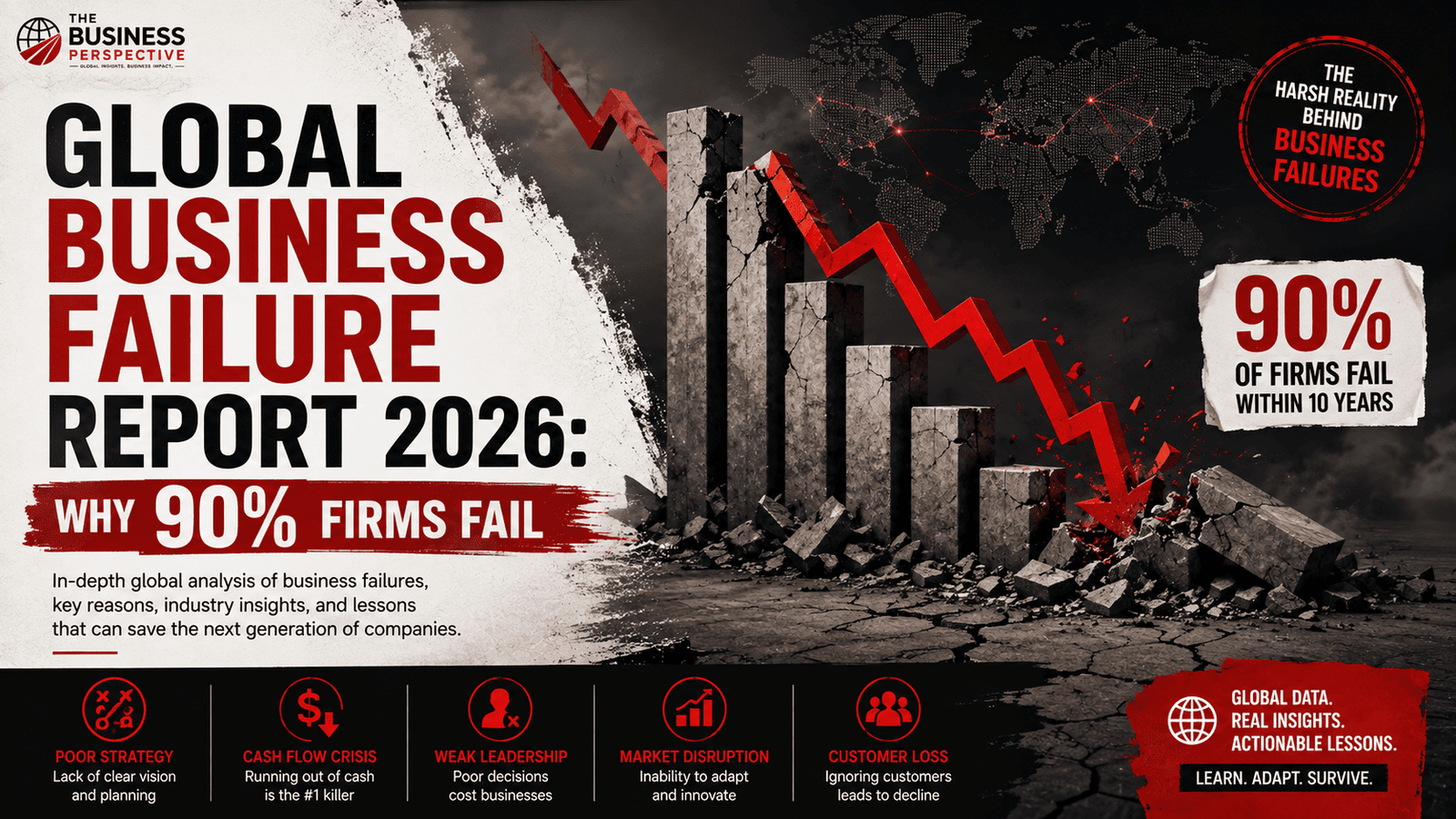
- 90% of businesses globally fail within 10 years — cash flow is the primary cause in 82% of cases (Dun & Bradstreet, 2026)
- Businesses that survive share 4 traits: cash reserves, early pivoting, repeatable sales systems, and leadership investment
- Technology startups have a 75% failure rate within 5 years despite record funding levels (CB Insights, 2026)
- The Global Business Failure Report 2026 covers data from 40+ countries — download the full 20-page PDF below

Global Business Failure Report 2026: Why 90% of Businesses Fail and What Survivors Did Differently
📅 August 12, 2026
✍️ The Business Perspective Research Team
⏱ 5 min read
Every year, millions of businesses launch with big ambitions. Most close quietly within a decade. The Global Business Failure Report 2026 from The Business Perspective pulls together data from 40+ countries to answer one question: what separates businesses that survive from the ones that don’t?
This global business failure report 2026 covers the core findings. The full 20-page PDF — with sector breakdowns, regional data, and the complete survivor playbook — is available free at the bottom of this page.
90%
of businesses fail within 10 years globally
82%
of failures linked to cash flow problems
40+
countries covered in this report
Why Do 90% of Businesses Fail Globally?
Approximately 90% of businesses fail within 10 years due to cash flow problems, weak market fit, and lack of scalable systems. According to
World Bank SME data and
OECD business statistics, 20% fail in year one, 45% by year five, and 65% by year ten — higher in emerging markets.
The business failure rate worldwide has stayed stubbornly high for two decades. What has changed is the speed. Businesses that once had 3–5 years to course-correct now face faster disruption from AI adoption, supply chain pressure, and shifting consumer behavior. The window to fix a failing model is shrinking every year.
North American and European businesses benefit from stronger capital markets yet still show 50–65% failure rates within five years. In Sub-Saharan Africa and South Asia, that figure exceeds 80% within three years, per OECD 2026 SME data. The global business failure report 2026 breaks this down by region in the full PDF.
What Are the Top Causes of Business Failure in 2026?
The number one cause of business failure in 2026 is cash flow mismanagement, found in 82% of failures per
Dun & Bradstreet’s 2026 analysis. This is followed by poor product-market fit (42%), inability to scale (38%), and leadership failures (34%).
Cash flow is the clearest warning signal in our business survival statistics 2026 data. Most businesses that fail were technically profitable on paper — they simply ran out of working capital before revenues stabilized. Per OECD data, 60% of SMEs globally operate with less than 3 months of cash reserves at any given time.
Which Industries Have the Highest Business Failure Rates?
Restaurants lead global business failure with a 60% closure rate in year one. Retail follows at 53%, construction at 41%, and professional services at 29%. Technology startups show the sharpest gap — 75% fail within five years despite record funding, per
CB Insights 2026.

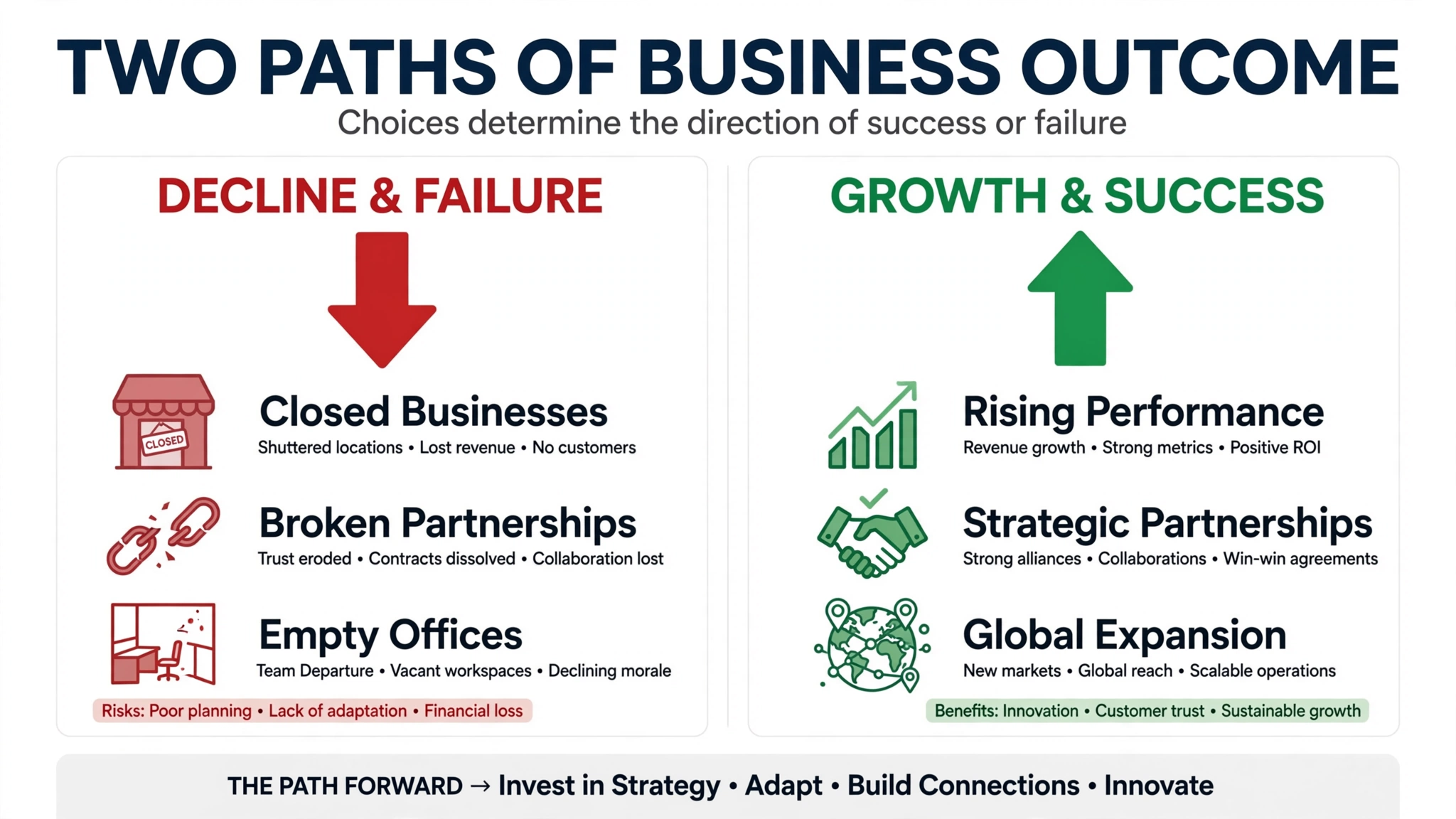
The two paths every business faces — failure vs survival. Source: The Business Perspective Research, 2026.
The technology sector failure rate is the most surprising finding in this global business failure report 2026. Despite raising more capital than any other sector, 3 in 4 tech startups close within five years. The primary reason: they scale headcount before proving a repeatable revenue model, according to CB Insights.
According to Harvard Business Review, the businesses most likely to survive a sector downturn are those that built strong unit economics in year one — before raising external capital or expanding headcount.
What Did Surviving Businesses Do Differently?
Businesses that survive consistently do four things: maintain 6+ months of operating cash reserves, validate and pivot their market fit within 18 months, build repeatable sales systems before scaling headcount, and invest in leadership development from year two. These patterns appear across all 40+ countries in this business failure report 2026.
The survivor data is the most actionable part of this report. Across 40+ countries, The Business Perspective found that surviving businesses follow a specific sequence of operational priorities — not a personality type or an industry advantage, but a repeatable playbook any business can adopt.
The 4 Survivor Traits (Full Data in PDF)
- Cash buffer discipline: Survivors kept 6–12 months of reserves. Failures averaged 2.3 months.
- Early pivoting: 78% of long-term survivors changed their core product or target customer at least once in the first 18 months, per the Global Entrepreneurship Monitor 2026.
- Sales before scale: They built a repeatable sales process before hiring more than 15 people.
- Leadership investment: Survivors spent 3x more on leadership training, per the World Economic Forum 2026 SME study.
What Some Experts Say Differently
Not all researchers agree that the 90% failure stat is accurate. Some economists argue the real rate is closer to 50–65% when measuring active closure vs dormancy, and that survival definitions vary widely across national datasets used in global business failure reports.
Professor Scott Shane of Case Western Reserve University has argued that the “90% fail” figure is overstated — many businesses classified as failed simply changed structure, were acquired, or went dormant. His research puts the true closure rate closer to 50% within 5 years for US businesses.
The counterargument from World Bank data is that in developing economies, informal sector failures are severely under-reported — meaning the global average is likely higher than developed-market studies suggest. The full global business failure report 2026 addresses this debate in section two of the PDF.
Frequently Asked Questions
What percentage of businesses fail globally?
Approximately 90% of businesses fail within 10 years globally, per World Bank and OECD data. The rate is 20% in year one, 45% by year five, and 65% by year ten — higher in emerging markets.
What is the number one reason businesses fail in 2026?
Cash flow mismanagement — found in 82% of failures per Dun & Bradstreet 2026. Most failing businesses were profitable on paper but ran out of working capital before revenues stabilized.
Which industries have the highest business failure rates?
Restaurants (60% in year one), retail (53%), construction (41%), and technology startups (75% within 5 years) have the highest rates, per CB Insights and OECD 2026 data.
What do surviving businesses do differently?
Survivors maintain 6+ months cash reserves, pivot market fit within 18 months, build repeatable sales systems before scaling, and invest in leadership from year two. These traits appear in all 40+ countries covered by The Business Perspective research.
How can I download the full Global Business Failure Report 2026?
Fill in the form below with your name and email to get free access to the full 20-page PDF from The Business Perspective. Includes sector data, regional breakdowns, and the survivor playbook.
Data Sources:
World Bank SME Finance 2026 ·
OECD Business Demography 2026 ·
Dun & Bradstreet 2026 ·
CB Insights 2026 ·
McKinsey Global Institute ·
Harvard Business Review ·
Global Entrepreneurship Monitor 2026 ·
World Economic Forum 2026