⚡ Key Takeaways
- Fintech startups that raised funding in August 2026 pulled in $808M+ in a single week, per FinTech Global data from August 14.
- Team8 led the month with $365M across its third fund and follow-on capital — bringing total AUM to nearly $2B.
- Financial infrastructure dominated with 5 of 12 tracked deals — more than PayTech, WealthTech, or InsurTech combined.
- Global fintech venture funding rose 23% YoY in H1 2026 even as deal count fell 25.7% — investors are writing fewer, bigger checks (Crunchbase, July 2026).
- The average fintech round size is now $23.2M — up 21% from 2025, per PitchBook’s Rudy Yang.
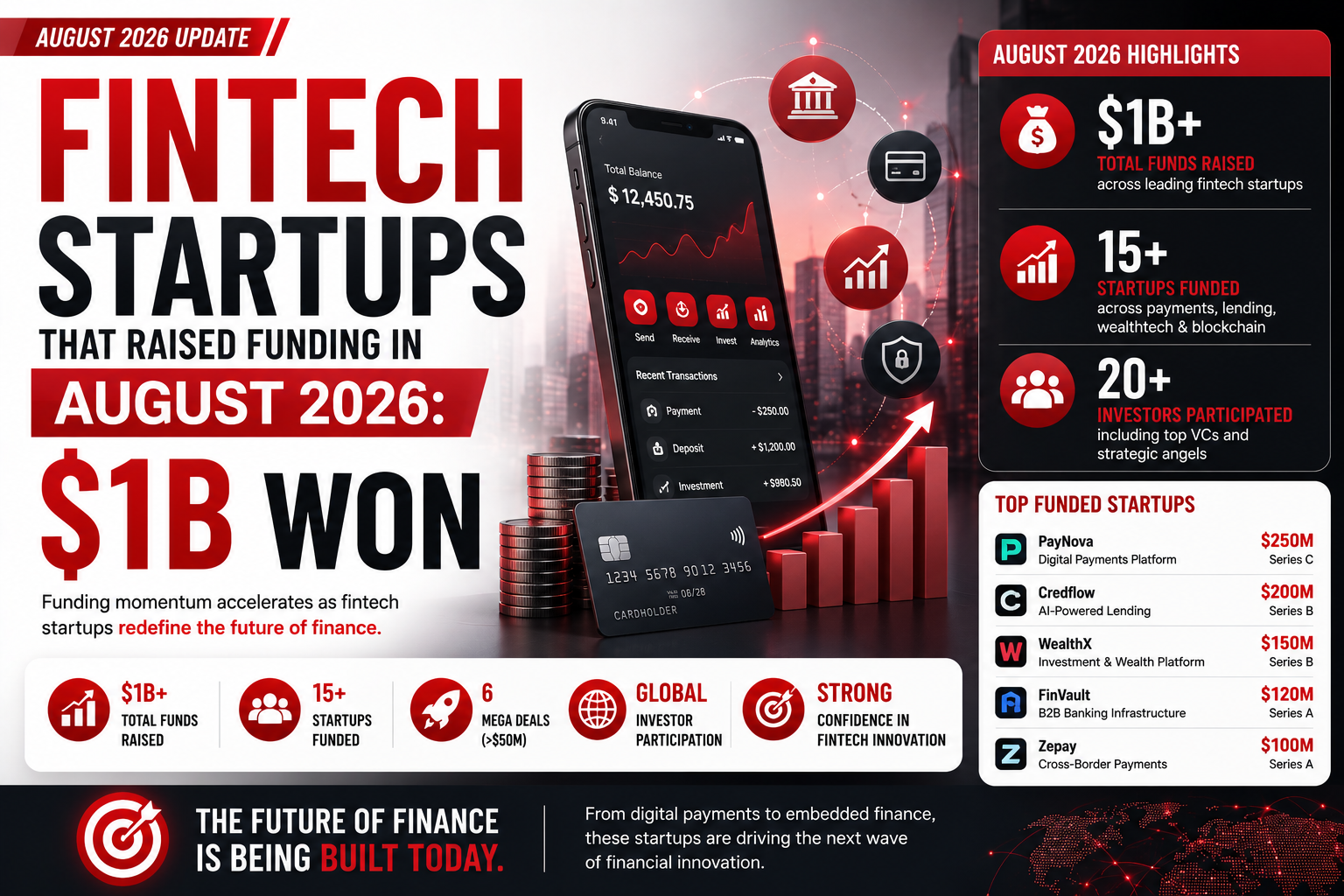
Fintech Startups That Raised Funding in August 2026: $1B Won
The fintech startups that raised funding in August 2026 turned a slow summer month into one of the year’s strongest fundraising stretches. Here is the complete, verified breakdown.
August was supposed to be a quiet month. Markets slow, inboxes empty, deals pushed to September — that’s the usual summer script. Fintech did not read it. The fintech startups that raised funding in August 2026 collectively closed over $808 million in a single tracking week, with Team8 alone pulling in $365 million. Financial infrastructure deals outnumbered every other sub-sector. AI-native payments platforms attracted Andreessen Horowitz and Tiger Global simultaneously. Below, we walk through each of the fintech startups that raised funding in August 2026 — every deal that mattered, what drove it, and what the pattern means for the rest of the year.
📋 Table of Contents
- How Much Did Fintech Startups Raise in August 2026?
- The Top Fintech Funding Rounds of August 2026
- Which Fintech Sectors Got the Most Investment?
- Which Investors Led Fintech Rounds in August 2026?
- Is Fintech Funding Growing or Shrinking in 2026?
- What Critics Say About the Concentration Problem
- FAQ: Fintech Startups That Raised Funding in August 2026
Aug 14, 2026
that week alone
fintech funding
H1 2026 vs H1 2025
How Much Did Fintech Startups Raise in August 2026?
To put August in context: global fintech venture funding rose nearly 23% year-over-year in H1 2026, per Crunchbase data published in July. Total fintech funding in H1 hit approximately $29 billion, with the US accounting for more than 52% of that — around $15 billion. The UK came second at $2.7 billion. India was third at $1.9 billion. August arrived mid-momentum.
What stands out about August specifically is the sector mix. Financial infrastructure — the rails that move money rather than the apps that display it — captured the most deals. Five of the twelve tracked rounds in the August 14 week went to infrastructure plays. That’s not a coincidence. It reflects a deliberate investor thesis: as AI reshapes the application layer of finance, the infrastructure underneath it becomes more valuable, not less.
| Week | Total Raised | Deals | Leading Sector |
|---|---|---|---|
| Aug 7 week | $673M | 15 | Mixed |
| Aug 14 week | $808M+ | 12 | Financial Infrastructure (5 deals) |
Source: FinTech Global, August 14–17, 2026
Fintech Startups That Raised Funding in August 2026: The Top Deals
Team8 co-founds and backs companies across cybersecurity, software infrastructure, fintech, and digital health. On August 11, it announced $365 million in fresh capital — $265 million for Team8 Capital’s third flagship fund, plus over $100 million set aside for follow-on bets in its highest-conviction portfolio companies. That pushes total assets under management to nearly $2 billion across eight funds since 2014.
The fund writes $5M–$15M checks into Seed and Series A rounds, and its thesis is refreshingly specific. Roughly 97% of organisations have already started deploying AI agents, yet the average security confidence score among enterprise leaders sits at just 2.32 out of 5. That gap — between how fast companies adopt AI and how poorly they secure it — is exactly where Team8 is placing its money.
PointsKash builds loyalty rewards, payments, and digital commerce infrastructure, but with a physical footprint most fintechs skip — its KashPoint kiosk network. Hawk Capital Investors structured the $100 million in two phases: up to $35 million available through October 30, 2026 for immediate commercialisation, then up to $65 million between February and April 2027, contingent on hitting agreed deployment targets.
The first tranche funds the refurbishment and rollout of roughly 2,100 company-owned KashPoint kiosks, along with technology integration, merchant activation, and the PK Pay product. It’s an unusual bet — milestone-gated capital for a hardware-heavy network at a moment when nearly everyone else is chasing software-only models.
Corma pulled in $60 million in seed funding — one of the largest fintech seed rounds of 2026 — led by Sequoia Capital, with Khosla Ventures and Coatue joining. The company builds an AI decision stack for customer intelligence, giving financial institutions a read on customer behaviour that traditional CRM tools simply can’t match.
A seed round this size says a lot. Sequoia and Khosla aren’t waiting for proof of scale here; they’re backing the team and the category itself. When two of the most disciplined early-stage funds both write checks this big at the seed stage, it’s a signal of how seriously the institutional world now takes AI-native customer intelligence.
Yuno calls itself the AI-native operating system for global payments, powering the rails for enterprise merchants, banks, and digital wallets. Its $45 million Series B was led by Global PayTech Ventures, with Andreessen Horowitz, Tiger Global, QuantumLight Capital (Revolut CEO Nik Storonsky’s fund), Monashees, and Kaszek all in. Sovereign-backed investors from Qatar and Abu Dhabi joined too.
That mix tells the real story — US top-tier VCs, a Revolut founder’s fund, and Middle Eastern sovereign wealth all in one round. Nobody bets like that on a regional Latin American play. They’re backing Yuno as global infrastructure for a world where AI agents will need to move money across borders without friction.
Axle is building the AI-native clearinghouse for the insurance sector — a niche that sounds narrow until you consider that insurance processing is still largely manual, paper-heavy, and prone to the kind of reconciliation errors that cost carriers billions annually. Base10 Partners led the $17.5 million Series A. It’s a smaller round by August 2026 standards, but insurance infrastructure is a category where incumbents move slowly and switching costs are high — exactly the conditions where a well-funded challenger with a clean AI-native stack can compound quietly for years before anyone notices.
| Company | Amount | Stage | Sector | Lead Investor |
|---|---|---|---|---|
| Team8 | $365M | Fund III | Fintech / CyberTech / HealthTech VC | Team8 LPs |
| PointsKash | Up to $100M | Growth Capital | Payments & Loyalty | Hawk Capital Investors |
| Corma | $60M | Seed | AI Customer Intelligence | Sequoia Capital |
| Yuno | $45M | Series B | Global Payments OS | Global PayTech Ventures |
| Axle | $17.5M | Series A | InsurTech / AI Clearinghouse | Base10 Partners |
Source: FinTech Global, Axios Pro Fintech, Dealroom, August 2026
What Fintech Sectors Got the Most Investment in August 2026?
The infrastructure dominance is not random. It mirrors what happened in cloud infrastructure in 2012–2014: before apps could scale, the pipes had to be rebuilt. In 2026, AI agents are beginning to transact autonomously — booking, buying, paying, reconciling — and the existing financial rails were not designed for machine-to-machine commerce at speed. Investors who understand this are funding the layer underneath the visible apps.
- Financial Infrastructure: 5 deals — largest sector by deal count in Aug 14 week
- PayTech: 2 deals — Yuno’s $45M Series B the standout
- CyberTech: 2 deals — overlaps with Team8’s broader portfolio thesis
- InsurTech: 1 deal — Axle’s $17.5M Series A
- AI Customer Intelligence: 1 deal — Corma’s $60M seed, led by Sequoia
- Loyalty & Commerce: 1 deal — PointsKash’s $100M two-phase commitment
Which Investors Led Fintech Rounds in August 2026?
What’s worth flagging in August’s investor mix is the geographic diversity of capital. Yuno’s round alone included US-based VCs (a16z, Tiger, Coatue), a founder-operator fund (QuantumLight — Storonsky’s vehicle), and sovereign wealth arms from the Middle East. That kind of cross-border syndicate is not standard for a $45 million Series B. It signals that payments infrastructure is being treated as a strategic asset class, not just a venture bet.
Team8’s LP base similarly spans multiple geographies — the fund has built its reputation partly by attracting institutional capital from global sources while staying operationally rooted in Tel Aviv’s deep cybersecurity talent pool. Their track record speaks clearly: Team8 co-led a $48 million raise for Koi in late 2025 from this very fund, and Koi was sold to Palo Alto Networks for approximately $400 million by April 2026 — less than six months later.
| Investor | Deal(s) in August 2026 | Type |
|---|---|---|
| Andreessen Horowitz (a16z) | Yuno Series B | US Tier-1 VC |
| Tiger Global | Yuno Series B | Global Growth Fund |
| Sequoia Capital | Corma Seed | US Tier-1 VC |
| Khosla Ventures | Corma Seed | US Deep-Tech VC |
| Coatue | Corma Seed | US Multi-Stage Fund |
| Global PayTech Ventures | Yuno Series B (lead) | Specialist PayTech VC |
| QuantumLight Capital | Yuno Series B | Founder-Operator Fund (Storonsky) |
| Hawk Capital Investors | PointsKash Growth Capital | Growth / Alternative Capital |
| Rasmal Ventures (Qatar) | Yuno Series B | Sovereign-Backed VC |
| Further Ventures (Abu Dhabi) | Yuno Series B | Sovereign-Backed VC |
Source: FinTech Global, Axios Pro Fintech, Dealroom, August 2026
Is Fintech Funding Growing or Shrinking in 2026?
American Banker described the dynamic plainly in its August 20 analysis: private markets are placing premiums on organic growth with AI integration across the product base, and on category leaders in highly strategic areas. Translation — if you are not already a category leader, August 2026 is a difficult time to raise. If you are, you can name your terms.
The IPO market remains mostly closed for fintech. Companies like Stripe ($159B valuation), Revolut ($75B), Ramp ($44B), and Monzo have all opted for secondary share sales or additional private financing rather than public listings. Per American Banker, KBCM analysts expect crypto-adjacent fintech IPOs to slip further, now targeting 2027–2028. The implication for private market fundraising: there is no exit pressure forcing founders to the public markets, which means more large private rounds flowing in instead.
What the Broader Startup Ecosystem Is Saying
The fintech funding picture does not exist in isolation. Across the broader startup funding landscape in August 2026, the same concentration trend appears — fewer deals, larger checks, capital flowing to infrastructure plays over consumer apps. The startup funding intelligence at Rise of Startups has been tracking this capital rotation across sectors including fintech, defense tech, and climate infrastructure throughout 2026. Meanwhile, the intersection of fintech and IoT — particularly in payments infrastructure for connected devices and smart commerce environments — is a rising theme covered extensively at IoT Insights Hub, where the convergence of financial rails and machine-to-machine transactions is already producing some of the year’s most interesting early-stage companies.
What Critics Say About the Concentration Problem
There is also a structural concern around the milestone-gated deals like PointsKash’s $100M commitment. Capital that is conditional on hitting operational targets is not guaranteed capital — it’s a performance contract. If PointsKash misses its kiosk rollout or merchant activation numbers, the second $65M tranche may never arrive. This structure protects investors, but it introduces execution risk for founders in a way that a clean closed round does not. As two-phase and tranche-gated financing becomes more common in 2026, founders need to model the downside scenario, not just the headline number.
FAQ: Fintech Startups That Raised Funding in August 2026
Which fintech startups raised the most funding in August 2026?
The largest raise was Team8’s $365 million fund — $265M for its third flagship fund plus $100M+ in follow-on capital. PointsKash secured a conditional $100M commitment from Hawk Capital, Corma raised $60M in seed funding led by Sequoia, Yuno raised $45M Series B, and Axle raised $17.5M Series A.
How much did fintech startups raise in August 2026?
Fintech startups that raised funding in August 2026 collectively pulled in $808M+ in a single week ending August 14, per FinTech Global. That was up from $673M the prior week, continuing a trend of growing dollar volume even as deal count remains below 2025 levels.
What fintech sectors got the most investment in August 2026?
Financial infrastructure dominated with five deals in the August 14 tracking week, more than any other sub-sector. PayTech and CyberTech each recorded two deals, InsurTech one. Across H1 2026, wealth management and financial infrastructure led global fintech funding by dollar volume, per Crunchbase.
Is fintech funding growing or shrinking in 2026?
Growing in dollars, shrinking in deal count. Crunchbase data shows H1 2026 fintech venture funding rose nearly 23% year-over-year, while the number of deals fell 25.7% to 1,605 rounds. The average round size climbed 21% to $23.2M. Investors are writing fewer, larger checks.
Which investors led fintech rounds in August 2026?
Key investors included Andreessen Horowitz, Tiger Global, Sequoia Capital, Khosla Ventures, Coatue, Global PayTech Ventures, Hawk Capital Investors, and QuantumLight Capital — Revolut CEO Nik Storonsky’s AI-focused fund. Sovereign-backed investors from Qatar (Rasmal Ventures) and Abu Dhabi (Further Ventures) also participated in Yuno’s round.
Why are fintech deal counts falling even as funding rises in 2026?
Investors in 2026 are concentrating capital into proven category leaders rather than spreading early-stage bets. Per American Banker, private markets are prioritising “organic growth with AI integration” and “category leaders in highly strategic areas.” Companies like Stripe, Ramp, and Revolut absorb large private rounds rather than IPOing, reducing the number of available exits and keeping institutional capital in private markets longer.
The Bottom Line on Fintech Startups That Raised Funding in August 2026
The fintech startups that raised funding in August 2026 tell a story about where institutional confidence is actually sitting right now — and it’s not in consumer neobanks or crypto wallets. It’s in infrastructure. The rails. The clearinghouses. The payment orchestration layers. The AI-native systems that sit underneath the apps people actually use.
Team8’s $365M signals that cybersecurity and fintech infrastructure investors see a decade of opportunity ahead. Corma’s $60M seed from Sequoia and Khosla says that AI customer intelligence is being treated as a category, not a feature. Yuno pulling in a16z, Tiger, and Middle Eastern sovereign capital for a $45M round tells you that global payments infrastructure is now a strategic asset class, not just a VC bet.
The deal count is down. The average check is up. The sector mix has rotated. Anyone tracking fintech funding in 2026 should be watching infrastructure, AI-native platforms, and the widening gap between the companies that can raise at scale and the ones that cannot.






One thought on “Fintech Startups That Raised Funding in August 2026: $1B Won”