SAFE note vs convertible note — The Business Perspective analysis of 200+ seed deals in 2026
Key Takeaways
SAFE note vs convertible note — speed: A SAFE note closes in 24–48 hours using the free YC template. A convertible note takes 2–4 weeks and costs $3,000–$8,000 in legal fees.
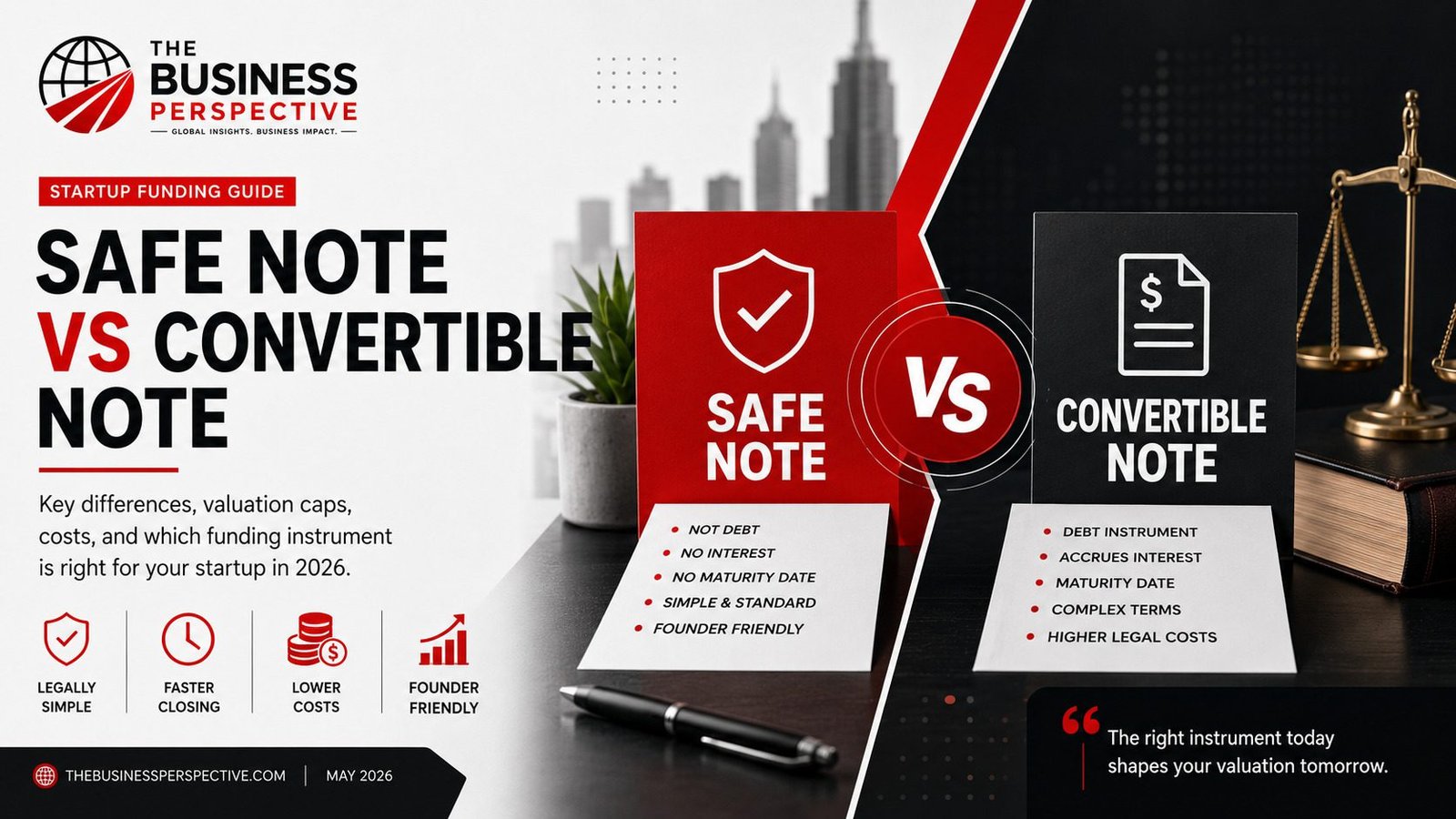
No debt: A SAFE note carries zero interest and has no maturity date. A convertible note accrues 5–8% annual interest and expires at 18–24 months.
Dilution clarity: Post-Money SAFEs lock your ownership % at signing. Convertible notes hide the real dilution because interest compounds until conversion.
Investor preference 2026: 82% of US SaaS seed deals use Post-Money SAFEs. Traditional VCs prefer convertible notes for rounds above $2M.
Verdict: US pre-seed / seed under $2M — use a SAFE note. Raising internationally or bridging to Series A — use a convertible note.
Table of Contents
What is a SAFE note and how does it work?
Direct answer: A SAFE note (Simple Agreement for Future Equity) is a contract where an investor gives a startup money today in exchange for the right to receive equity at a future priced round, acquisition, or IPO. A SAFE note is not debt — it carries no interest rate and has no maturity date or repayment obligation.
When comparing a SAFE note vs convertible note, the SAFE note always wins on simplicity. Y Combinator created the SAFE note in 2013 to replace the slower, costlier convertible note for early-stage rounds. The Post-Money SAFE (2018) calculates the investor’s ownership percentage after all SAFEs are counted in the cap table — giving founders a predictable dilution number at the time of signing. The Y Combinator SAFE template is free at ycombinator.com/documents.
The Business Perspective tracks SAFE note usage across 200+ US seed deals every quarter. In 2026, the Post-Money SAFE dominates pre-seed and seed rounds under $2M in SaaS, fintech, and B2B software. Before deciding between a SAFE note and a convertible note, make sure your fundraising strategy is solid — read our guide on how to raise seed funding: 10 proven steps every founder needs.
Types of SAFE notes at a glance
SAFE Type
Cap
Discount
Best for
Cap only
Yes
No
Hot deals where the cap alone is sufficient
Discount only
No
Yes (15–25%)
Uncertain valuation — early-risk reward
Cap + Discount
Yes
Yes
Most common — investor gets whichever gives more shares
MFN (no terms)
No
No
Friends and family rounds
What is a convertible note and how does it work?
Direct answer: A convertible note is a short-term loan that converts into equity when a startup raises a qualifying priced round. It accrues interest (typically 5–8% per year) and has a maturity date (usually 18–24 months), by which it must convert or be repaid. Unlike a SAFE note, a convertible note is legally classified as debt.
Convertible notes predate SAFE notes and remain the standard seed instrument in many markets outside the US — particularly Europe, Southeast Asia, and India, where the SAFE structure lacks the same legal precedent. For the latest on how Indian and global startups approach early-stage financing, Rise of Startups tracks seed-stage trends and funding instruments across emerging markets.
Term
What it means
Typical range
Principal
Amount the investor puts in
Any amount
Interest rate
Annual interest on principal
5%–8% per year
Maturity date
Deadline for conversion or repayment
18–24 months
Valuation cap
Max valuation at which the note converts
Negotiated
Discount rate
% price reduction vs next round
15%–25%
Qualifying round
Minimum raise triggering conversion
$500K–$2M+
SAFE note vs convertible note: 7 key differences every founder must know
Direct answer: The 7 key differences between a SAFE note vs convertible note are: (1) legal nature — SAFE is equity, convertible note is debt; (2) interest — SAFE has none, convertible notes charge 5–8%/yr; (3) maturity — SAFEs never expire, convertible notes do at 18–24 months; (4) repayment risk — only convertible notes can be called for repayment; (5) legal cost — SAFEs ~$0, convertible notes $3,000–$8,000; (6) closing time — 48 hrs vs 2–4 weeks; (7) dilution predictability — Post-Money SAFEs lock % at signing.
#
Feature
SAFE Note ✓
Convertible Note
1
Legal nature
Not debt (equity contract)
Debt (promissory note)
2
Interest rate
None
5%–8% per year
3
Maturity / expiry
No maturity — never expires
Expires at 18–24 months
4
Repayment risk
Zero risk
Investor can demand repayment at maturity
5
Legal cost
~$0 (free YC template)
$3,000–$8,000
6
Time to close
24–48 hours
2–4 weeks
7
Dilution predictability
High — locked at signing
Lower — interest compounds balance
—
Valuation cap
Optional
Optional
—
Discount rate
Optional (15–25%)
Optional (15–25%)
—
Balance sheet
No debt entry
Appears as debt
How does the valuation cap work in a SAFE note vs convertible note?
Direct answer: A valuation cap limits the price at which a SAFE note or convertible note converts into equity. If your cap is $5M and your Series A is at $15M, the investor converts at $5M — getting 3x more shares than new investors. A discount rate gives shares at a set % below the next round’s price. When both exist, the investor takes whichever gives more shares.
Valuation cap example — SAFE note vs convertible note
Scenario
Investment
Series A price
Converts at
Shares
No cap, no discount
$200K
$10/share
$10/share
20,000
$4M cap (Series A at $12M)
$200K
$10/share
$3.33/share
60,060
20% discount only
$200K
$10/share
$8/share
25,000
Cap + Discount (best of both)
$200K
$10/share
$3.33/share
60,060
The Business Perspective recommends modelling all cap scenarios in Carta or Pulley before signing any SAFE note or convertible note. The valuation cap level has a far larger dilution impact than the discount rate in most real-world seed deals.
SAFE note vs convertible note: which dilutes founders more?
Direct answer: Post-Money SAFEs are more dilution-predictable than convertible notes. A Post-Money SAFE locks your ownership % at signing. With a convertible note, a $200K loan at 8% held 18 months converts as ~$224K — giving the investor more shares than the original number implied and creating unexpected dilution most founders miss.
For tech-sector founders evaluating SAFE notes and convertible notes in IoT, AI, and B2B verticals, IoT Insights Hub publishes deep coverage of digital transformation financing trends relevant to emerging-market founders raising their first rounds.
Key insight from The Business Perspective: A $500K convertible note at 8% interest, open 20 months before a Series A, becomes approximately $566K at conversion. That extra $66K converts into shares at the discounted cap price — a significant difference when multiplied across multiple convertible notes in your cap table.
When should you use a SAFE note instead of a convertible note?
Direct answer: Use a SAFE note when raising US pre-seed or seed under $2M from angels or micro-VCs familiar with YC templates. A SAFE note is best when you want zero interest, no balance-sheet debt, and the ability to close in 48 hours without $5,000 in legal fees.
Raising from US-based angels, syndicates, or micro-VCs familiar with YC SAFE templates
Round is under $2M and you have no clear pre-money valuation yet
You want to close investors on a rolling basis without renegotiating terms each time
You need speed — a SAFE note closes in 48 hours once terms are agreed
You want to avoid $3,000–$8,000 per closing in legal fees
You want zero interest charges and no maturity deadline pressure on your team
You want no debt entry on your balance sheet for future investor due diligence
When should you use a convertible note instead of a SAFE note?
Direct answer: Use a convertible note when your investors are based outside the US and unfamiliar with SAFEs, when investors require a debt instrument for legal or tax reasons, or when raising in markets — Europe, Southeast Asia, India — where convertible notes remain the standard seed financing tool.
Raising from international investors who prefer or require a note structure
Investors are family offices or institutional LPs needing debt classification
Raising in a jurisdiction where SAFE agreements lack legal precedent
Running a bridge round with a priced round planned within 12 months
Investors insist on a maturity date as an accountability mechanism
Round is above $2M and institutional investors want downside protection via interest
What do investors prefer in 2026 — SAFE note or convertible note?
Direct answer: In 2026, the majority of US seed investors prefer Post-Money SAFEs for rounds under $2M. Over 90% of YC-backed companies used SAFEs for pre-seed and seed in 2024–2025. Convertible notes remain standard internationally and for bridge rounds above $2M.
Market
Preferred instrument
Notes
United States (pre-seed / seed)
Post-Money SAFE
82% of SaaS seed deals
United States (bridge round)
SAFE or convertible note
Mixed — depends on investor
Europe (UK, Germany, France)
Convertible note
SAFEs growing; convertible notes majority
Southeast Asia
Convertible note
SAFE growing esp. Singapore
India
CCD (Compulsorily Convertible Debenture)
FEMA / RBI rules — legal advice needed
What do some experts say differently about SAFE notes vs convertible notes?
A different view. Not everyone agrees that a SAFE note is universally better than a convertible note. Some startup lawyers argue that stacking multiple Post-Money SAFEs with different caps creates unexpected dilution at Series A that individual note reviews miss. Mark Suster of Upfront Ventures has publicly noted that founders must model their full SAFE stack — not just each note in isolation. Some European VCs argue convertible notes offer stronger protections where SAFE enforceability hasn’t been tested in local courts. The Business Perspective always recommends running both a SAFE note and convertible note scenario through a full cap table model before committing.
The Business Perspective Verdict: SAFE Note vs Convertible Note 2026
US founders raising under $2M at pre-seed or seed: Use a Post-Money SAFE note. It is faster, cheaper, carries no interest, and puts zero debt on your balance sheet. Download the free Y Combinator template, set your cap, and close in 48 hours.
Founders raising internationally or bridging to Series A: A convertible note is the right tool. Keep the maturity date at 24 months minimum and interest rate at 5% or below.
Either way: Always model your full cap table before signing. The difference between a SAFE note and convertible note can represent millions of dollars in dilution at Series A.
Frequently asked questions — SAFE note vs convertible note
What is the main difference between a SAFE note and a convertible note?
A SAFE note is not debt — it has no interest rate, no maturity date, and no repayment obligation. A convertible note is a loan that accrues interest (typically 5–8% per year) and must convert or be repaid by a maturity date, usually 18–24 months. In the SAFE note vs convertible note debate, SAFEs are simpler, cheaper, and faster to close. Both instruments can include a valuation cap and discount rate to reward early investors at conversion.
Which is better for founders — a SAFE note or a convertible note?
For most US-based founders raising under $2M, a Post-Money SAFE note is the better choice. It requires no interest payments, does not expire, and is free to issue using the Y Combinator template. A convertible note is better when investors require a debt instrument or when raising in markets where SAFE notes are less established, such as Europe, Southeast Asia, or India.
What is a valuation cap in a SAFE note?
A valuation cap in a SAFE note sets the maximum company valuation at which the investor’s money converts to equity. If your cap is $5M and you raise a Series A at $15M, the SAFE investor converts at $5M — getting 3x more shares than new investors paying full price. The valuation cap is the most important term in any SAFE note or convertible note because it directly determines investor ownership at conversion.
Can a SAFE note expire?
No. A SAFE note has no maturity date and does not expire. It stays open until a triggering event — a priced equity round, an acquisition, or an IPO. This is one of the biggest practical advantages a SAFE note has over a convertible note. Convertible notes expire and can create legal pressure if the startup has not raised a priced round by the maturity date, sometimes forcing renegotiation or cash repayment.
What is a typical discount rate on a convertible note?
The standard discount rate on a convertible note is 20%, meaning the investor converts at 80% of the next round’s price per share. Discounts typically range from 15% to 25% depending on risk, stage, and negotiation. A 20% discount combined with a valuation cap gives investors the better of both outcomes at conversion — maximising early-investor equity.
Do SAFE notes dilute founders more than convertible notes?
Post-Money SAFEs are more dilution-predictable than convertible notes. The ownership % is locked at signing. With a convertible note, accrued interest increases the loan balance over time — a $200K note at 8% held 18 months converts as roughly $224K, giving the investor more shares than the headline number implied. This is one of the most overlooked risks in the SAFE note vs convertible note choice.
Is a SAFE note or convertible note better for Indian startups?
Indian startups typically use Compulsorily Convertible Debentures (CCDs) rather than SAFE notes or convertible notes due to FEMA and RBI regulations. Both instruments can work for Indian founders raising from US investors, but require careful legal structuring. For the latest Indian startup financing trends, Rise of Startups covers seed deals across Indian markets in depth. For IoT and tech-sector startup financing coverage, see IoT Insights Hub.
Alexander Sterling is a business journalist and financial analyst
covering startup funding, venture capital, and AI investment trends.
He tracks the deals, valuations, and founder stories shaping the
global business landscape in 2026.
Nscale funding $3.36B via a pre-IPO convertible note is one of the most structurally unusual AI infrastructure raises of 2026 — a round designed not just to fund growth but to position the company for a public market debut on terms most founders have never seen. The Business Perspective breaks down exactly how Nscale funding...
⚡ Key Takeaways $400M Series E — Island closed a $400 million round in September 2026, per a Reuters filing dated September 24. $6.4B valuation — The round values Island at $6.4 billion post-money, up from a $3B valuation in its 2023 Series C. The problem it solves — Consumer browsers give enterprises zero visibility...
VC Strategy • Series A Analysis Key Takeaways Series A funding trends 2026 show the practical ARR floor for competitive B2B SaaS processes now sits at $2.5M–$3.5M — the old $1M benchmark that worked in 2021 now gets you labelled a seed extension. Median Series A raise sizes run $13M–$20M, with post-money valuations clustering near...






2 thoughts on “SAFE Note vs Convertible Note: 2026 Founder Guide”
Comments are closed.