
“Founders treat angel investors and venture capitalists like two versions of the same thing — one writes a smaller check, the other writes a bigger one. That framing costs founders equity, control, and sometimes the company itself. They are not two versions of the same thing. They are two completely different relationships with completely different expectations.”
The question is not which investor writes the bigger check. The question is which investor fits the stage of evidence your company has actually earned — and what you are willing to give up to get the capital you need.
This guide gives you the honest, unfiltered comparison between angel investors vs venture capital — check sizes, equity expectations, control dynamics, speed, and the decision framework that tells you exactly which door to knock on first.
$491M
Angel investments reported in 2025 — up 12% year-over-year (Angel Capital Association)
81%
Of US VC funding in H1 2026 went to $100M+ mega-rounds — not early-stage startups
30–45
Days average to close an angel round vs 3–6 months for a VC round
1. The Core Difference Nobody Explains Clearly
Most comparisons focus on check size. That is the least important difference. The real difference is whose money it is, and what they need to do with it.
An angel investor is spending their own money. They can say yes over a single coffee meeting because no committee sits between their conviction and the wire transfer. They are risking their own net worth — and because of that, they can back founders on instinct, move in days, and support ideas that have no metrics yet.
A venture capitalist is spending someone else’s money — capital pooled from pension funds, university endowments, and family offices called Limited Partners (LPs). Every investment must be justified to an investment committee, reviewed by partners, and ultimately defended to LPs who expect fund-level returns. That structural fact explains almost every difference in how angels vs VCs behave.
💡 The One-Line Summary
Angels fund the period when the only proof is the founder and an idea. VCs fund the period when that idea already looks like a business and needs fuel to scale. Mixing up the order is how good companies end up overpriced, over-governed, or simply passed on.
2. Angel Investors — What They Are and How They Think
An angel investor is a high-net-worth individual — usually an accredited investor — who invests their own personal capital into early-stage startups in exchange for equity or a convertible instrument like a SAFE note.
Who Angels Typically Are
Most angels are former founders, senior executives, or domain specialists who built wealth in their own careers and now back the next generation. They invest in what they understand — and they bring more than money. Their network, their experience surviving the early chaos of building a company, and their personal introductions are often worth more than the check itself.
👼 The Angel Investor Profile
💰
Check Size
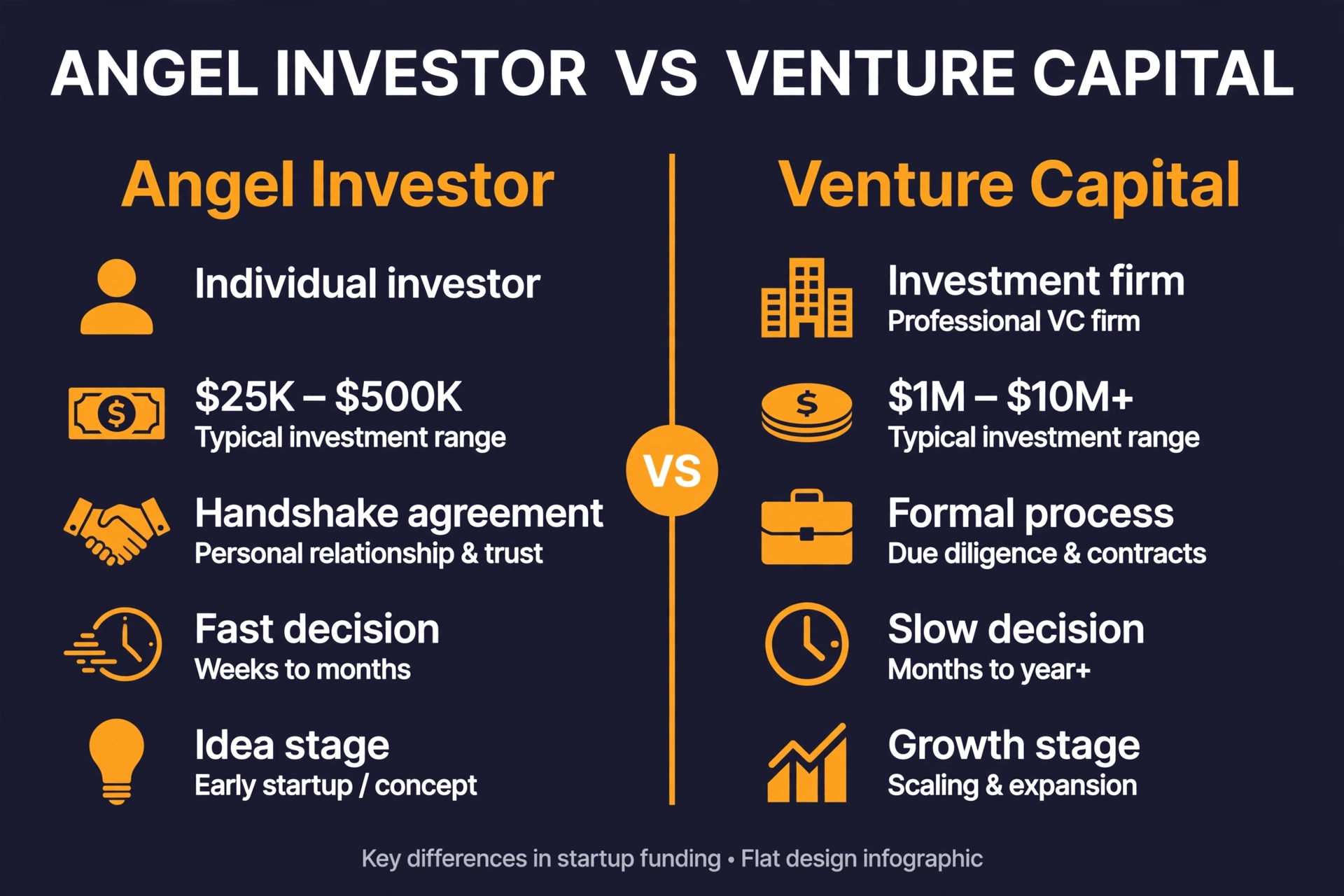
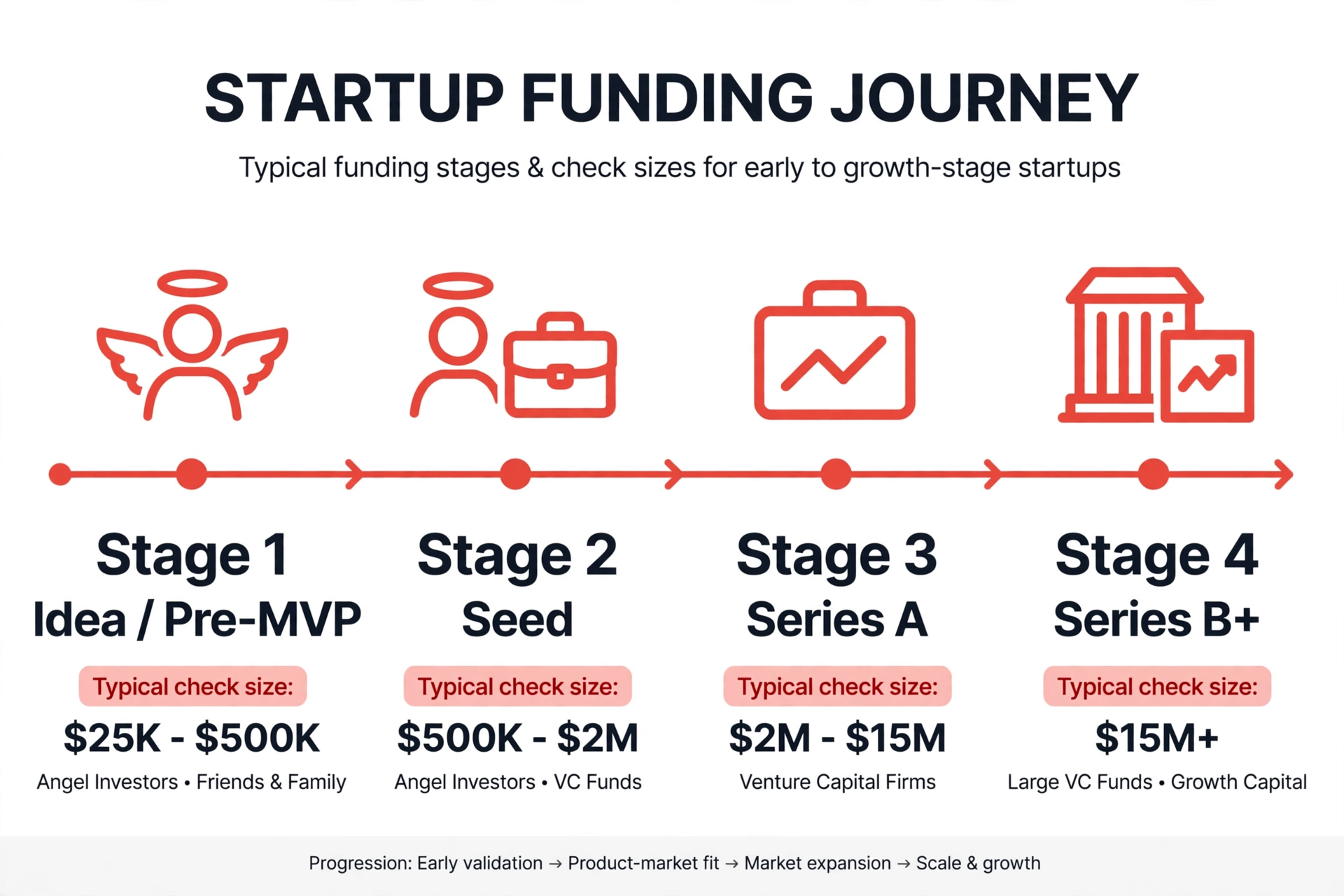
$25K–$500K per angel. Syndicates pool multiple angels for $250K–$2M rounds.
📅
Stage
Idea, pre-seed, and early seed. Before product-market fit is proven.
⚡
Speed
2–4 weeks from first meeting to wire transfer. No committee approvals needed.
🪑
Board Control
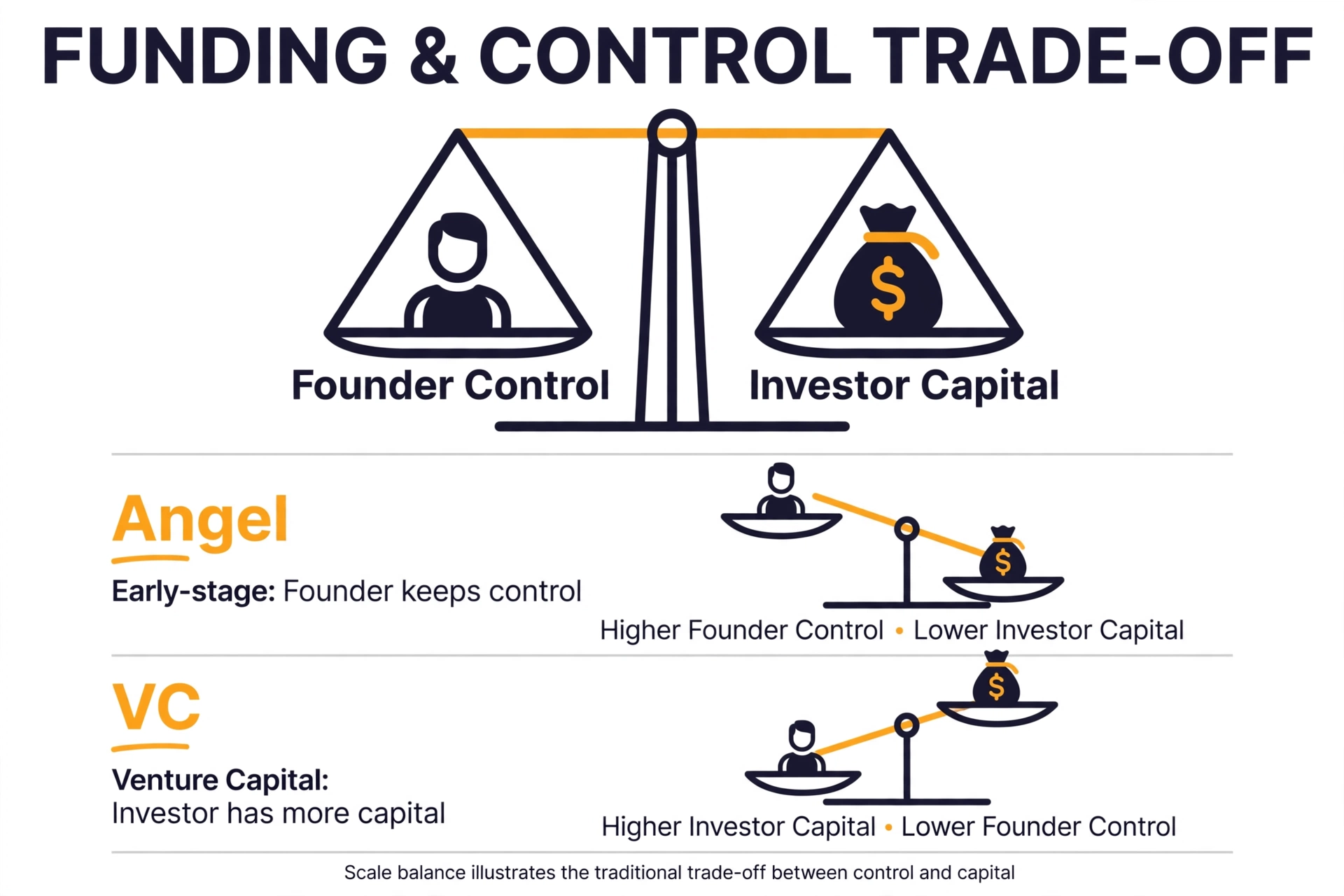
Rarely take formal board seats. Usually observer rights or monthly updates only.
📊
Equity Taken
2%–15% depending on stage, valuation, and check size. Negotiable.
🤝
What They Bet On
Founder quality, domain insight, and the size of the problem — not metrics.
The Angel Advantage Most Founders Undervalue
Angels who are former operators in your industry can open doors that no amount of VC money can buy. A single warm introduction from the right angel to a potential enterprise customer, a future Series A lead, or a key hire can change the trajectory of your company in ways that dwarf the financial value of their check.
🔍 What Nobody Tells You About Angels
The best angel investors are not the ones writing the biggest checks — they are the ones with the most relevant network for your specific problem. A $50K check from a founder who built and exited in your exact vertical is worth more than a $500K check from a wealthy individual with no industry connections. Vet your angels as carefully as they vet you.
3. Venture Capital — What They Are and How They Think
A venture capitalist is a partner at a firm that pools capital from limited partners — pension funds, university endowments, sovereign wealth funds, family offices — and deploys it into high-growth startups in exchange for equity. Unlike angels, VCs are not spending their own money. They are fiduciaries with a legal obligation to generate returns for their LPs.
The Fund Math Every Founder Must Understand
This is the most important thing to understand about VCs — and almost no one explains it clearly to founders. VC funds run on a model called “power law returns.” In a typical portfolio of 20–30 investments, they expect 15–20 to fail, 5–8 to return modest capital, and 1–2 to return the entire fund by themselves.
That means every single investment must be capable of returning the entire fund — not just generating a decent profit. A $300M fund needs at least one company in their portfolio to be worth $3B+ at exit. If your market cannot support a billion-dollar outcome, they will pass — not because you are not good enough, but because the math does not work for their fund structure.
🏦 The Venture Capital Profile
💰
Check Size
$500K–$15M at seed/Series A. Rarely write checks below $1M — too inefficient for fund size.
📅
Stage
Seed to Series C+. Prefer post-PMF companies with proven traction and unit economics.
🐢
Speed
3–6 months from first meeting to close. Investment committees, due diligence, legal docs.
🪑
Board Control
Typically require 1–2 board seats and protective provisions on major decisions.
📊
Equity Taken
15%–30% per round depending on stage and valuation. Non-negotiable floor for fund math.
📈
What They Need
Proven PMF, strong growth curve, large TAM, defensible moat, and a credible billion-dollar exit path.
💡
The VC Advantage Beyond the Check
Leading VCs bring institutional credibility, follow-on capital reserves, portfolio company intros, and dedicated operating partners. A Sequoia or Elevation Capital logo on your cap table signals quality to future investors, enterprise customers, and senior hires in ways that individual angels cannot match.
4. Head-to-Head Comparison: Every Factor That Matters
| Factor | Angel Investor | Venture Capital |
|---|
| Whose money | Their own personal capital | LP money — pension funds, endowments |
| Typical check size | $25K – $500K | $500K – $15M+ |
| Best stage | Idea, pre-seed, early seed | Seed, Series A, Series B+ |
| Revenue required | None — bets on team and vision | Typically $500K+ ARR or strong traction |
| Decision speed | 2–4 weeks | 3–6 months |
| Due diligence | Light — references, background check | Heavy — legal, financial, technical audit |
| Equity taken | 2% – 15% | 15% – 30% per round |
| Board seats | Rarely — observer rights only | 1–2 formal board seats standard |
| Governance | Minimal — founder stays in full control | Formal — protective provisions, approval rights |
| Follow-on capital | Limited — angels rarely lead future rounds | Strong — VCs often reserve 2–3x for follow-ons |
| Network value | Personal — operator contacts, warm intros | Institutional — portfolio companies, enterprise access |
| Exit pressure | Low — patient capital, no fixed timeline | High — fund lifecycle forces exit within 7–10 years |
| Investment instrument | SAFE note or convertible note usually | Priced equity round with term sheet |
5. The Decision Framework — Which One Is Right for You
Stop asking “angel or VC?” Start asking: “What stage of evidence does my company have right now — and which investor type funds companies at that stage?” That single reframe eliminates 80% of the confusion.
Choose Angel Investors If…
👼 Go Angel If You…
- Are pre-revenue or pre-product-market fit
- Need less than $1M to reach your next major milestone
- Want to maintain full operational control without board oversight
- Need to move fast — runway is short or a market window is closing
- Are still testing your business model and may need to pivot
- Want operator mentorship more than institutional credibility
- Have a strong personal network that connects you to the right angels
- Are raising a pre-seed round to build your MVP and find early users
Choose Venture Capital If…
🏦 Go VC If You…
- Have proven product-market fit with repeatable revenue or strong user retention
- Need $1M+ to scale what is already working — not to find what works
- Are in a capital-intensive category where large checks are table stakes
- Have a realistic path to a $500M+ exit that justifies fund-level returns
- Are comfortable with formal governance, board seats, and reporting obligations
- Want institutional credibility to attract enterprise customers and senior talent
- Have a growth rate (15%+ MoM) that a VC can confidently back with follow-on reserves
- Are ready to operate on a defined 7–10 year timeline toward an exit or IPO
🎯 The Quick Decision Checklist
1
Do you have $500K+ ARR or 10,000+ active engaged users? No → Angel first. Yes → VC is now viable.
2
Do you need more than $1.5M in this round? No → Angels or a syndicate can cover it. Yes → You need a VC to lead.
3
Are you comfortable giving up a board seat and formal governance? No → Stick with angels. Yes → VC terms are manageable.
4
Can your market realistically produce a $500M+ exit? No → Angels are your path. Yes → VCs can get excited about you.
5
Do you need to close in less than 60 days? Yes → Only angels can move that fast. No → A VC process is manageable.
🔗
Understand Your Instruments Before You Decide
Angels typically invest via SAFE notes or convertible notes — instruments that delay equity pricing until a later priced round. VCs lead priced equity rounds with formal term sheets. Understanding the difference is critical before you sign anything. Read our full breakdown: SAFE Note vs Convertible Note: 2026 Founder Guide →
6. The India Context — How It Works Differently Here
The angel vs VC dynamic in India in 2026 has its own unique characteristics that global comparisons often miss. Understanding them saves Indian founders significant time and equity.
The Indian Angel Ecosystem
India has a sophisticated and growing angel network. Key platforms and networks include Indian Angel Network (IAN), LetsVenture, AngelList India, Mumbai Angels, and LEAD Angels. Angel check sizes in India typically run lower than US comparables — $10K–$100K per individual angel — but syndicates on platforms like LetsVenture can pool $500K–$2M in a single close.
Indian angels tend to take 5%–10% equity at pre-seed — slightly higher than the US average — reflecting smaller check sizes and earlier-stage risk. Any angel asking for more than 20% at pre-seed is a structural red flag that will make future VC rounds harder to close.
The Indian VC Landscape in 2026
India’s VC ecosystem has matured significantly. Key players active at seed and Series A include Sequoia Surge, Elevation Capital, Accel India, Blume Ventures, Lightspeed India, and Kalaari Capital. Most Indian VCs now require $300K–$1M ARR at seed stage — a threshold that has moved upward since the 2022–2023 correction.
🇮🇳 India-Specific Insight
The Indian startup ecosystem in 2026 is seeing strong momentum in agritech, B2B SaaS, and fintech — sectors where angel capital is particularly active because domain-expert angels can assess market fit faster than generalist VCs. If you are building in one of these verticals, an angel-first strategy is not just viable — it is often optimal. For the latest on where Indian VC capital is flowing: How to Get Startup Funding in India →
7. Five Mistakes Founders Make When Choosing Between the Two
❌
Mistake 1: Pitching VCs Before You Have Traction
Approaching a $200M VC fund with a pre-revenue idea is not ambitious — it is a mismatch that wastes your time and theirs. Worse, it burns the relationship. When you come back 18 months later with real traction, the “we passed early” memory works against you. Get your angel round done first. Build proof. Then approach VCs from a position of strength, not need.
❌
Mistake 2: Taking Angel Money at VC-Style Valuations
Some founders push for very high pre-seed valuations to minimise dilution from angels. This creates a “valuation trap” — your next round needs to be significantly higher to avoid a down round, which means your metrics need to justify it. Price your angel round fairly. The goal is to reach your next milestone, not to win a valuation competition. Read more: How to Value a Startup the Way Investors Do →
❌
Mistake 3: Giving Too Many Angels Too Much Equity Too Early
A cap table with 15 angels each holding 3–5% is a nightmare when you approach a lead VC for your Series A. VCs will see a fragmented, messy cap table and worry about getting pro-rata rights signed off, shepherding a large group of passive investors, and future governance complexity. Keep your angel round clean — fewer investors, cleaner terms, ideally on a SAFE to avoid complexity.
❌
Mistake 4: Assuming VC Money Validates Your Business
VC funding is not proof your business model works. It is proof that a small group of investors believes in a future version of your company. Founders who confuse investment for validation stop pushing for product-market fit and start optimising for the next fundraise. The goal is always the business, never the round. For a grounded look at what real traction looks like: 10 Secrets VCs Won’t Tell You About Raising Funding →
❌
Mistake 5: Not Understanding What You Are Giving Up Beyond Equity
Equity is visible and easy to calculate. What founders often miss are the invisible costs — board seat dynamics, protective provisions that require investor approval for major decisions, anti-dilution clauses, and liquidation preferences that determine who gets paid first at exit. Read every clause of your term sheet before you sign, not after. Our guide on what investors want to see covers these: Startup Pitch Deck Template: What Investors Want to See →
8. Can You Have Both? The Angel-First Strategy
The most successful early-stage funding sequences are not angel-only or VC-only. They are angel-first, then VC — and understanding why changes how you plan your entire fundraising roadmap.
👼
Months 0–12: Angel Phase
Raise $300K–$1M from 3–6 angels on a SAFE. Build MVP. Find first paying customers. Prove the core hypothesis. Establish traction metrics.
🏦
Months 12–24: VC Phase
Approach VCs with your angel cap table, your traction data, and your growth curve. Raise $2–5M Series A to scale what is already working.
A strong angel cap table actually increases your credibility when you approach VCs. It signals that smart, experienced operators already believed in you enough to write personal checks — and that you used that capital to build something real. VCs call this “social proof from operators,” and it moves faster through their internal decision process than cold outreach ever can.
🔍 The Sequence That Works Best in 2026
Data from AngelBacked’s 2026 dataset shows the strongest early-stage rounds are angel-first, not angel-only or VC-only. Months 0–3: pre-seed angel checks fund a working prototype and first users. Months 4–9: a blended round of angels and micro-funds extends runway and builds traction. Months 10–18: metrics exist, and a VC firm leads a priced Series A on what the angel money proved. The angel round is not a consolation prize. It is the foundation that makes the VC round possible.
Frequently Asked Questions
What is the difference between angel investors and venture capital?
Angel investors are high-net-worth individuals who invest their own personal money into early-stage startups — typically writing checks of $25K–$500K at pre-seed or seed stage with minimal governance requirements. Venture capitalists manage institutional funds pooled from limited partners and write larger checks of $1M–$15M+ at seed to Series A and beyond, with formal board seats, protective provisions, and defined return mandates. The core difference is whose money it is — and that single fact explains every other behavioural difference between the two.
Should I approach angel investors or VCs first?
Approach angel investors first if you are pre-revenue or pre-product-market fit. Angels fund the idea and MVP stage when VCs will not consider you. Once you have traction — typically $300K–$500K ARR or strong month-over-month user growth — approach VCs who can write the larger checks needed to scale what is already working. Going to VCs too early is one of the most common and costly mistakes early-stage founders make.
How much equity do angel investors take?
Angel investors typically take 2%–15% equity depending on investment size, startup stage, and valuation. In India, angels commonly take 5%–10% at pre-seed. Any individual angel asking for more than 20% at pre-seed is a red flag — it will compress future VC rounds and signal poor deal structuring to institutional investors who review your cap table later.
Do angel investors take board seats?
Angel investors rarely require formal board seats at pre-seed stage. Most settle for observer rights — the ability to attend board meetings without a vote — or simply a monthly email update on key metrics. Venture capitalists, by contrast, typically require at least one formal board seat as a standard condition of any priced seed or Series A round, along with protective provisions and approval rights on major decisions.
Can a startup have both angel investors and VCs?
Yes — and this is actually the most common and successful pattern for high-growth startups. Angels fund the pre-seed and seed stage to prove the concept. VCs come in at Series A once traction is established. A strong angel cap table with recognisable operator names actually increases your credibility when approaching VCs, signalling that experienced founders already bet their own money on you.
How long does it take to close funding from an angel vs a VC?
Angel investors can move from first meeting to wire transfer in 2–4 weeks. There is no investment committee, no formal legal due diligence process, and no LP reporting requirement — just personal conviction. Venture capital firms typically take 3–6 months from first meeting to close, due to internal investment committee approvals, formal financial and legal due diligence, and complex shareholder agreement drafting.
What do VCs look for that angels don’t require?
VCs require evidence of product-market fit, a scalable and repeatable business model, strong unit economics (positive contribution margin, healthy CAC/LTV ratio), and a clear path to $10M+ ARR within 3–5 years. They also need to see a realistic billion-dollar exit scenario to justify fund-level returns. Angels are far more willing to bet on team quality and vision alone — before any of these metrics exist.
What is an angel syndicate and how does it work?
An angel syndicate is a group of individual angels who pool their capital together — led by a single lead angel — to write a combined check that is larger than any one of them would write alone. Platforms like AngelList, LetsVenture, and Mumbai Angels facilitate syndicates in India. A syndicate can raise $500K–$2M in a single close, bridging the gap between individual angel checks and institutional VC rounds. This makes syndicates a powerful option for founders who need more than one angel can provide but are not yet VC-ready.
Know Which Investor You Need. Now Build the Pitch.
Your investor decision is made. The next step is building a pitch that makes them say yes. Use our free startup pitch deck template — built around what investors actually want to see.
Get the Pitch Deck Template →The Bottom Line
Angel investors vs venture capital is not a competition. It is a sequence. Angels fund the period when you need proof. VCs fund the period when you already have proof and need scale. Getting the order right — and understanding the trade-offs of each — is one of the most important strategic decisions you will make as a founder.
If you are pre-revenue or pre-PMF: find the right angels who understand your market, take clean terms on a SAFE, and build something undeniable. If you are past PMF with a growing revenue curve: approach VCs with data, with a credible exit story, and with a cap table that shows you have been disciplined about who you let in.
The money follows the evidence. Your job is to build the evidence — and know exactly which investor type funds the stage you are at right now.






One thought on “Angel Investors vs Venture Capital: The Founder’s Decision”
Comments are closed.