The Waymo funding round 2026 closed at $16 billion — the largest autonomous vehicle funding round ever recorded.
Waymo’s valuation hit $126 billion — nearly tripling from $45B in just 18 months.
Round led by Sequoia Capital, DST Global, and Dragoneer — with Alphabet anchoring at ~$13B.
Waymo completed 15 million trips in 2025 and is targeting 1 million trips per week by end of 2026.
Alphabet CEO Sundar Pichai says Waymo will meaningfully contribute to Alphabet’s revenue by 2027 — IPO speculation is building.
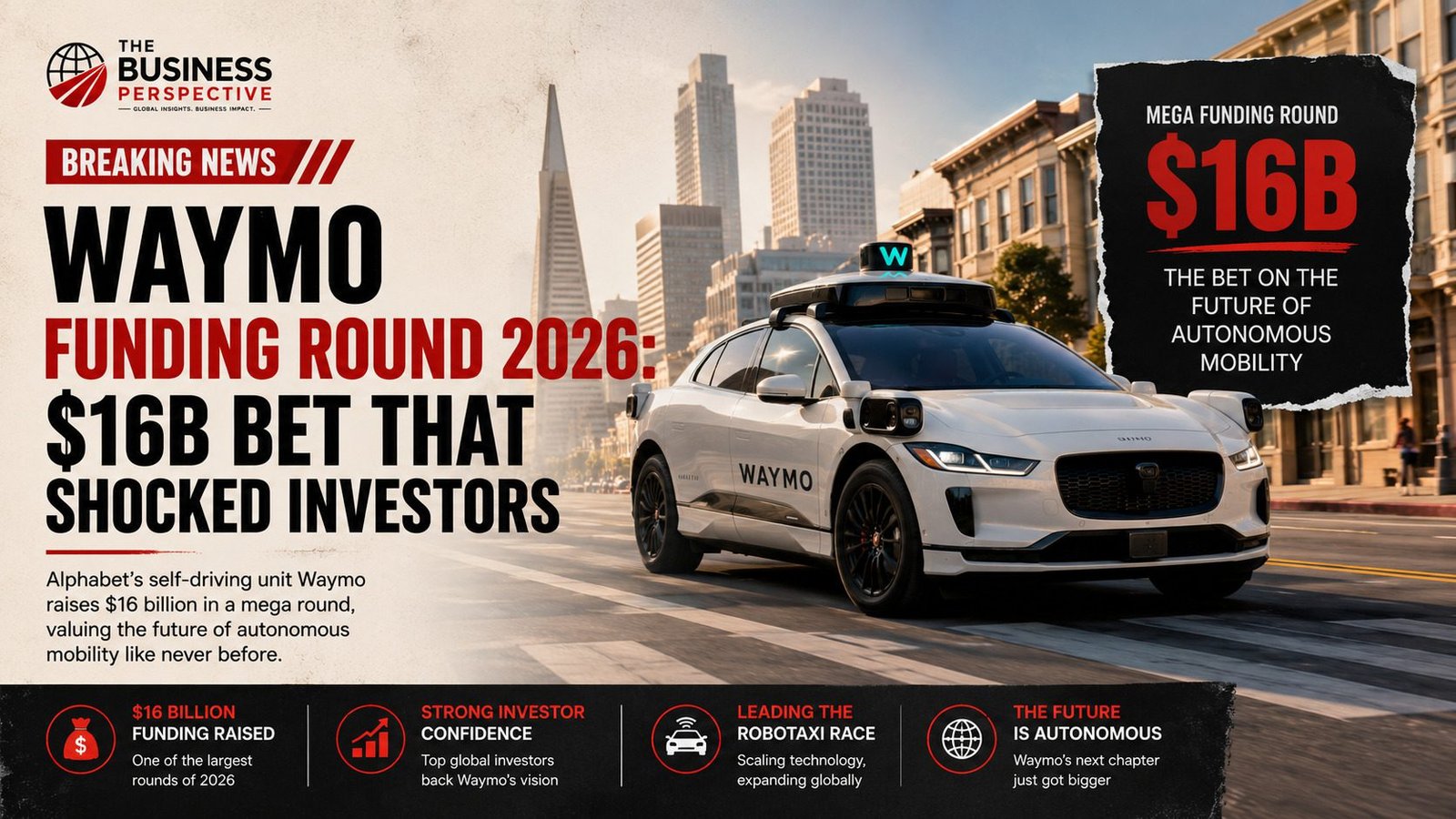
Waymo closed a record $16B funding round in 2026, valuing the robotaxi company at $126B. (Image: The Business Perspective)
Funding NewsAugust 12, 2026•6 min read•The Business Perspective Editorial Team
Imagine a company that did not exist as an independent entity a decade ago — now valued at $126 billion, backed by the world’s biggest venture funds, and quietly building the infrastructure that could make human-driven taxis obsolete. That is exactly what Waymo just pulled off with its 2026 funding round. And the numbers tell a story that every investor needs to read carefully.
$16BTotal raised in the Waymo funding round 2026
$126BPost-money valuation — up from $45B in 18 months
15MTrips completed by Waymo in 2025 alone
What Just Happened With Waymo?
In February 2026, Waymo — Alphabet’s self-driving car unit — closed the largest autonomous vehicle funding round in history. The Waymo funding round 2026 raised $16 billion and valued the company at $126 billion post-money. That is not a typo. A company that was valued at $45 billion just 18 months ago is now worth nearly three times that.
Waymo co-CEOs Tekedra Mawakana and Dmitri Dolgov did not hold back in their announcement. According to CNBC’s coverage of the funding round, they wrote: “We are no longer proving a concept — we are scaling a commercial reality.” That one line tells you everything about where Waymo’s ambitions are headed in 2026 and beyond.
The Waymo funding round 2026 is not just a milestone for one company. It is a signal to the entire autonomous vehicle industry — and to every investor watching — that the robotaxi era is no longer a future bet. It is happening right now, one city at a time.
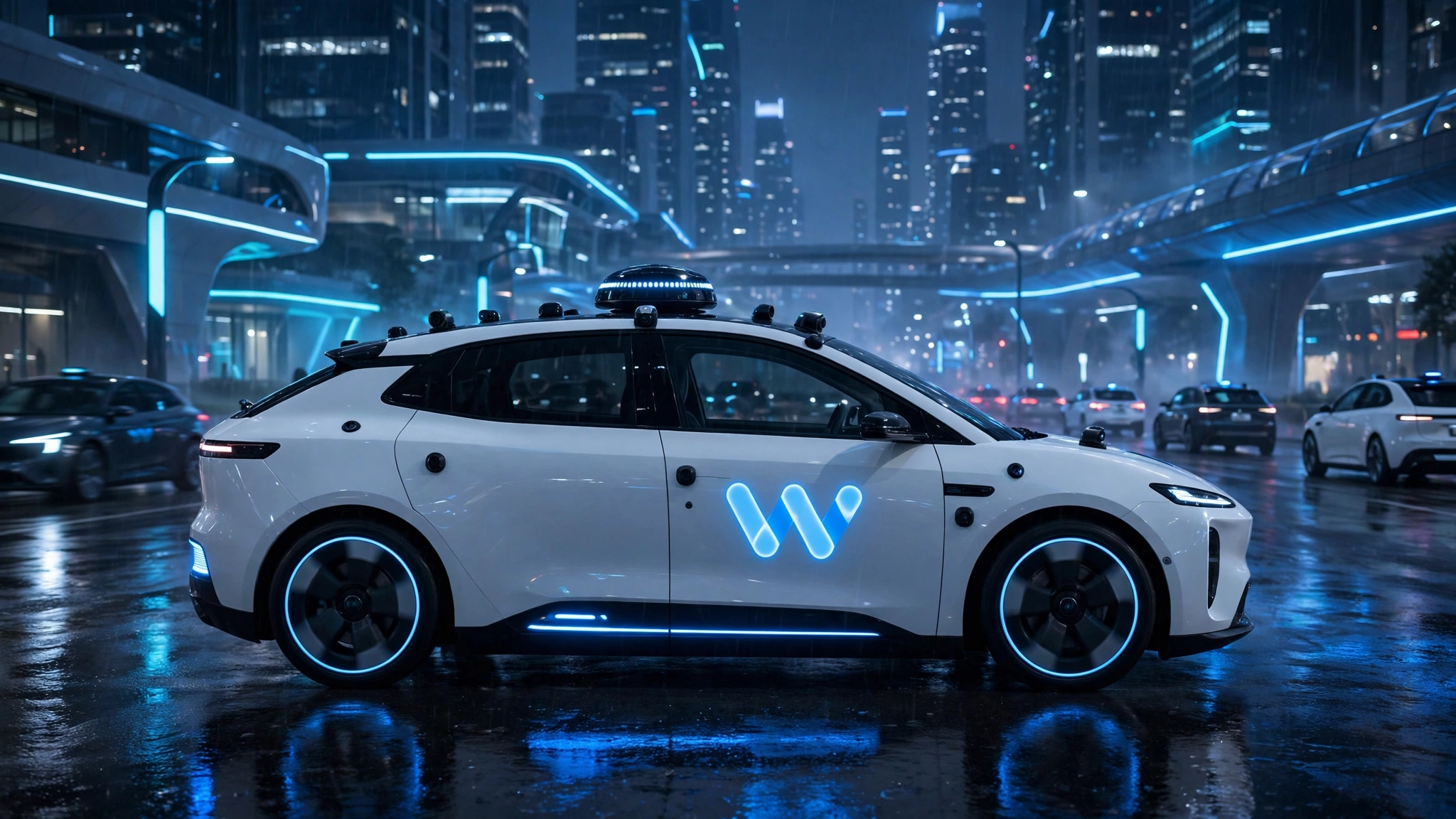
A Waymo robotaxi navigating city streets — the company completed 15 million trips in 2025 alone. (Image: The Business Perspective)
How Did Waymo’s Valuation Triple in 18 Months?
The Waymo funding round 2026 did not happen in isolation. It is the result of a valuation trajectory that has been building for years — accelerating sharply as the robotaxi model proved itself in real cities with real paying passengers.
Here is the full picture of how Waymo got from nothing to $126 billion:
📈 Waymo Valuation Journey — From Concept to $126B
~$30B
2020 Early Est.
$45B
Oct 2024 Series C
$110B
Dec 2025 Talks
$126B ✓
Feb 2026 Series D
What drove this? Three things happened simultaneously. First, Waymo’s trip volume exploded — the company tripled its rides to 15 million in 2025, providing 400,000 rides weekly across six US cities. Second, its safety record became statistically impossible to ignore — 82 to 90% fewer serious-injury crashes compared to human drivers, per Waymo’s own data. Third, the AI investment supercycle made autonomous vehicles look like one of the most defensible AI plays available to large funds.
According to Bloomberg’s reporting on the round, the financing reflects Waymo’s rapid ascent as a robotaxi pioneer and its ability to attract both strategic and financial capital at scale.
The Waymo funding round 2026 is the largest autonomous vehicle fundraise ever — backed by top-tier Silicon Valley and global funds. (Image: The Business Perspective)
Who Put Money Into This Round?
The Waymo funding round 2026 attracted an elite investor list. Alphabet anchored the deal with approximately $13 billion, but what makes this round genuinely significant is the quality of the outside capital that came in alongside it.
💰 Who Backed the Waymo Funding Round 2026
🔺
Sequoia Capital Lead
Silicon Valley’s most storied VC firm
🌐
DST Global Lead
Global tech growth investor
🐉
Dragoneer Lead
Growth equity, major tech bets
🏛️
Alphabet (Google)
Anchor investor — ~$13B committed
🅰️
Andreessen Horowitz
Repeat investor from Series C
🕌
Mubadala Capital
UAE sovereign wealth fund
🐯
Tiger Global
Repeat investor, global tech focus
💎
T. Rowe Price + Fidelity
Large institutional asset managers
The presence of sovereign wealth money from Mubadala, institutional money from T. Rowe Price and Fidelity, and growth equity from Dragoneer alongside venture capital from Sequoia tells a clear story — the Waymo funding round 2026 was not a typical startup fundraise. It was a structured bet by the world’s most sophisticated capital allocators that the robotaxi market is real, large, and Waymo-shaped.
Where Is Waymo Taking Its Robotaxis Next?
The Waymo funding round 2026 exists for one core reason: expansion. The $16 billion will fund a city-by-city rollout that — if successful — will make Waymo the dominant robotaxi operator across the United States and beyond before any serious competitor can catch up.
🗺️ Waymo’s Expansion Plan — 2026 and Beyond
San Francisco
Los Angeles
Phoenix
Austin
Atlanta
Miami
Dallas
Houston
Denver
Las Vegas
Washington DC
Nashville
London 🇬🇧
San Diego
Orlando
Live now
Launching 2026
International
The London launch is particularly significant. It is Waymo’s first move outside the United States — and it opens the door to European regulatory frameworks that, once cracked, could unlock dozens of additional cities. Waymo’s target of 1 million trips per week by end of 2026 would represent a 2.5x increase from its current 400,000 weekly rides. That is an aggressive target. But with $16 billion in the bank, it is not an unrealistic one.
Waymo’s valuation grew 180% in 18 months — the fastest valuation ramp in autonomous vehicle history. (Image: The Business Perspective)
Key Number to Remember: Goldman Sachs projects the US robotaxi market will reach $48 billion by 2035. If Waymo captures even 30% of that market — a conservative estimate given its current lead — today’s $126B valuation could look cheap in hindsight.
How Does Waymo Compare to Tesla and Zoox?
The Waymo funding round 2026 lands at a moment when the autonomous vehicle competition is heating up fast. Tesla is pivoting hard toward robotaxis with its Cybercab. Amazon’s Zoox has started offering free public rides in Las Vegas and San Francisco. And Chinese players like Baidu’s Apollo Go are rapidly scaling in Asia.
Metric
Waymo
Tesla (Cybercab)
Amazon Zoox
2026 Valuation
$126B
Part of Tesla
Undisclosed
Funding Raised
$42B+ total
Tesla-funded
Amazon-funded
Autonomous Miles Logged
127M+ driverless miles
FSD (supervised)
Limited public data
Live Paid Service Cities
6 cities
Not yet live
Las Vegas + SF
Safety Record
82-90% fewer injuries vs humans
Active investigation
Limited data
2026 Target
1M trips/week
Cybercab launch
Expand markets
International Markets
London launch 2026
US only (planned)
US only
The table shows what Waymo’s real competitive advantage is — it is not just the money. It is the 127 million driverless miles already logged, the live paying customers in 6 cities, and the safety data that regulators can actually point to. Tesla’s Full Self-Driving is still supervised. Zoox is still in its early public rollout phase. Waymo is already operating at commercial scale.
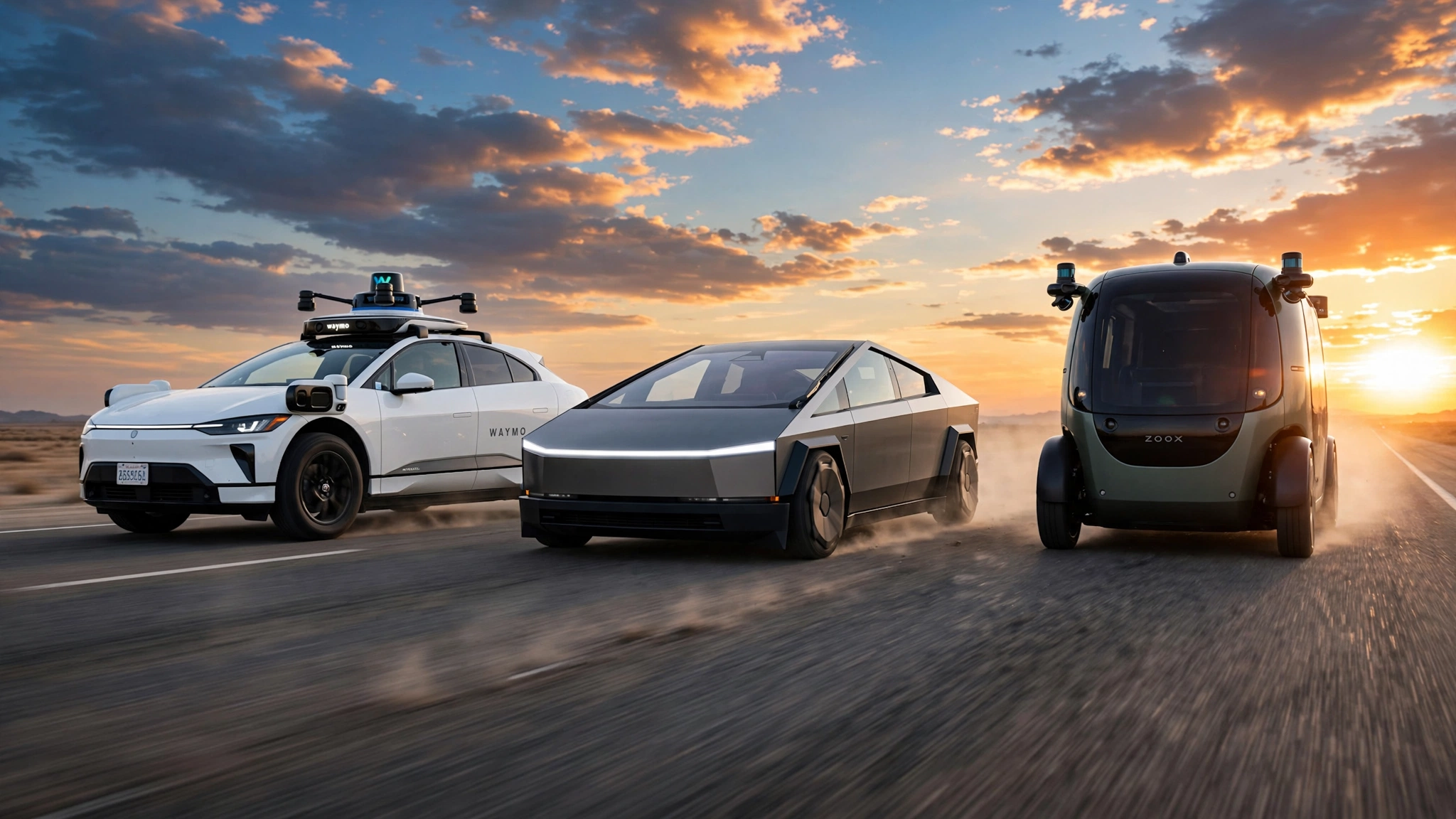
The robotaxi race in 2026 — Waymo leads, but Tesla and Zoox are accelerating fast. (Image: The Business Perspective)
What Does the Waymo Funding Round 2026 Mean for Investors?
The Waymo funding round 2026 carries a clear message for anyone tracking the autonomous vehicle space — the window for early positioning is narrowing fast.
For Alphabet (GOOGL) shareholders: Waymo is no longer a money-burning “other bet.” Alphabet CEO Sundar Pichai has publicly stated that Waymo will meaningfully contribute to Alphabet’s financials by 2027. With annualised revenue hitting $355 million in February 2026 and growing at 127% year over year, that timeline is credible. Every Alphabet share is a partial bet on Waymo’s success.
For venture and growth investors: The Waymo funding round 2026 was oversubscribed. The quality of investors who got in — Sequoia, DST, Dragoneer, Mubadala — is a strong validation signal. Secondary market access via platforms like Forge Global and Hiive is available for accredited investors, typically with a $50,000 minimum.
For retail investors: Direct Waymo investment is not publicly available yet. The clearest proxy is Alphabet stock — which gives you indirect exposure to Waymo’s growth. The Business Perspective recommends watching Alphabet’s Q3 2026 earnings closely for Waymo-specific revenue disclosures, which Sundar Pichai has hinted are coming.
For startup founders: The Waymo funding round 2026 signals that AI-powered mobility infrastructure is one of the hottest sectors for large-scale venture capital in 2026. Startups building complementary technology — fleet management, autonomous insurance, vehicle-to-infrastructure communication — are positioned in an adjacent boom.
⚖️ What Some Analysts Say Differently
Not all market watchers are bullish on the Waymo funding round 2026 valuation. Some analysts argue that $126 billion is difficult to justify when annualised revenue is $355 million — a price-to-sales ratio above 350x. Safety concerns have also emerged: the NHTSA opened an investigation after a Waymo vehicle struck a child near a California school in early 2026. And Waymo faces pressure from Alphabet to eventually run independently, which could create management and capital allocation challenges that external investors are not yet pricing in. The bull case is strong, but it requires Waymo to execute flawlessly in dozens of new markets simultaneously — a tall order for any company, regardless of its balance sheet.
Is a Waymo IPO Coming — And When?
No confirmed Waymo IPO date exists as of August 2026. But the signals are building. The Waymo funding round 2026 brought total external capital raised since 2020 to over $42 billion. Alphabet has allowed Waymo to take outside capital specifically to prepare it for eventual independence. Sundar Pichai’s 2027 revenue contribution comment was unusually specific for a company that never discusses Waymo financials publicly.
The most likely IPO window, based on current growth trajectory and market conditions, is 2027 to 2028. By then, Waymo should be operating in 20+ cities, generating meaningful revenue, and carrying the kind of public market story — autonomous miles driven, safety record, trip growth — that makes for a compelling S-1.
For now, Alphabet remains the only public market vehicle to own a piece of the Waymo funding round 2026 story. The Business Perspective will track every Waymo earnings disclosure and any IPO filing as it emerges.
How much did Waymo raise in its 2026 funding round?
The Waymo funding round 2026 raised $16 billion, led by Sequoia Capital, DST Global, and Dragoneer Investment Group. Alphabet contributed approximately $13 billion as the anchor investor. The round valued Waymo at $126 billion post-money — nearly tripling its $45 billion valuation from October 2024 in just 18 months.
What is Waymo’s valuation in 2026?
Waymo’s post-money valuation following the February 2026 funding round is $126 billion. This is up 180% from its $45 billion Series C valuation in October 2024. Goldman Sachs projects the US robotaxi market to reach $48 billion by 2035, making Waymo’s current valuation a bet on capturing a large share of that market.
Who invested in the Waymo funding round 2026?
The Waymo funding round 2026 was led by Sequoia Capital, DST Global, and Dragoneer Investment Group. Additional investors included Mubadala Capital, Andreessen Horowitz, T. Rowe Price, Fidelity, Silver Lake, Tiger Global, and Bessemer Venture Partners. Alphabet, Waymo’s parent company, was the anchor investor at approximately $13 billion.
Where does Waymo currently operate its robotaxi service?
As of August 2026, Waymo operates paid robotaxi service in San Francisco Bay Area, Phoenix, Los Angeles, Austin, Atlanta, and Miami. The company plans to launch in 11 additional US cities in 2026 — including Dallas, Houston, Las Vegas, and Washington DC — and has announced its first international launch in London.
When will Waymo have an IPO?
No confirmed Waymo IPO date exists as of August 2026. Based on current growth trajectory — $355 million in annualised revenue growing at 127% year over year — analysts expect a likely IPO window of 2027 to 2028. Alphabet CEO Sundar Pichai said Waymo will meaningfully contribute to Alphabet’s financials by 2027, which analysts see as a signal that public markets are on the roadmap.
Global startup funding September 2026 produced some of the most structurally significant rounds of the year — from Harvey’s $550M legal AI raise to Cognition’s $2B round at a $48 billion valuation and Nvidia’s $12.9 billion acquisition of Hugging Face in the first eight days of the month alone. The Business Perspective tracks global startup...
Nscale funding $3.36B via a pre-IPO convertible note is one of the most structurally unusual AI infrastructure raises of 2026 — a round designed not just to fund growth but to position the company for a public market debut on terms most founders have never seen. The Business Perspective breaks down exactly how Nscale funding...
⚡ Key Takeaways $400M Series E — Island closed a $400 million round in September 2026, per a Reuters filing dated September 24. $6.4B valuation — The round values Island at $6.4 billion post-money, up from a $3B valuation in its 2023 Series C. The problem it solves — Consumer browsers give enterprises zero visibility...







One thought on “Waymo Funding Round 2026: $16B Bet That Shocked Investors”
Comments are closed.