The SpaceX Nvidia AI chip deal made Nvidia the exclusive supplier for the $15.8B Starmind orbital compute program — AMD was shut out completely.
AMD stock dropped nearly 7% on the news despite posting record quarterly revenue of $11.54B.
Elon Musk called Nvidia’s Vera Rubin architecture “the best available” — sealing the deal.
SpaceX’s total Q2 capex hit $18.37B, more than double Q1 and far above analyst estimates.
Nvidia’s next earnings report is on August 26, 2026 — the Starmind deal will be the top talking point.
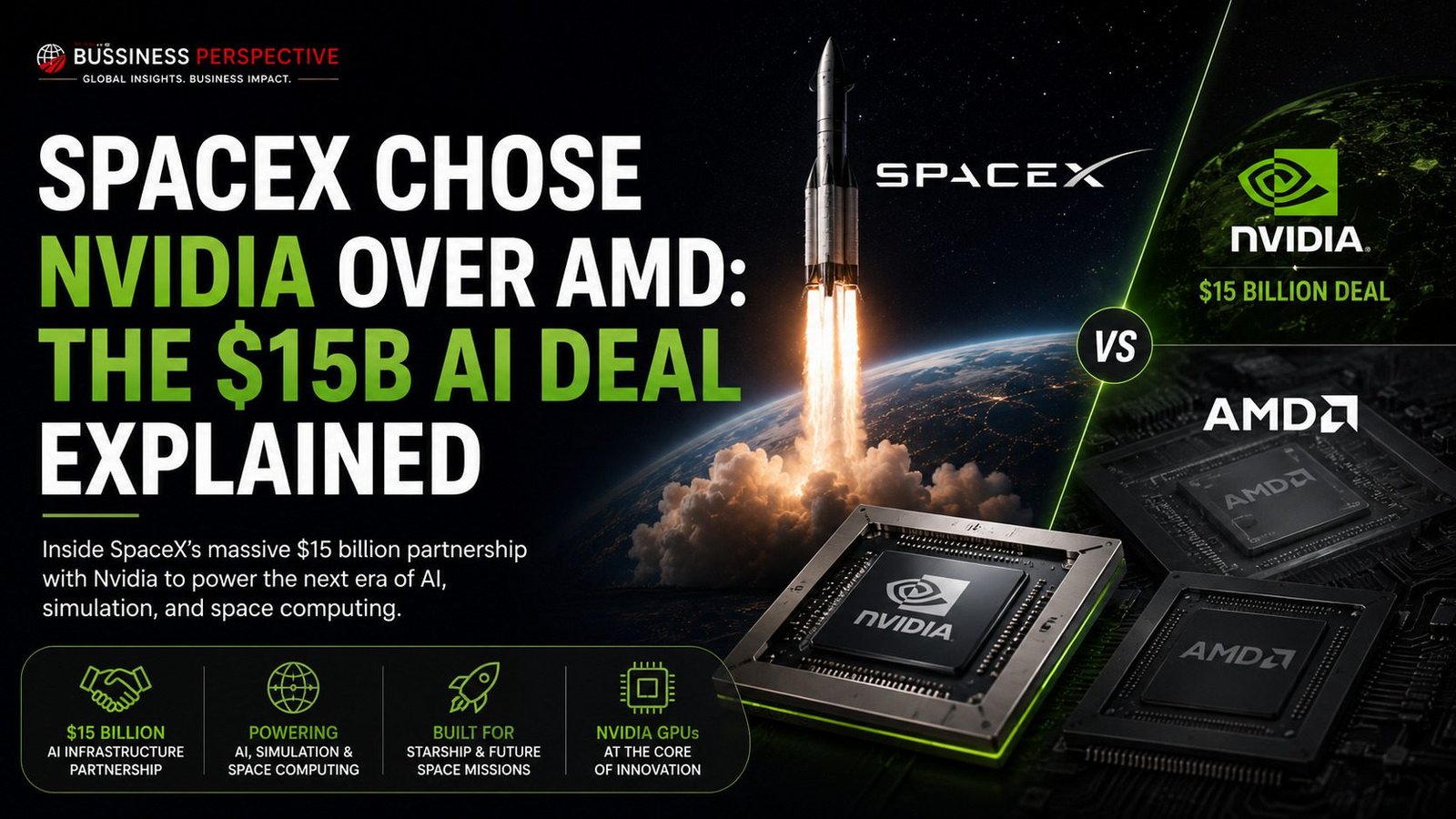
SpaceX chose Nvidia over AMD for its $15.8B Starmind AI program. (Image: The Business Perspective)
Tech NewsAugust 12, 2026•5 min read•The Business Perspective Editorial Team
The SpaceX Nvidia AI chip deal just changed how the entire market looks at AI hardware. In one announcement, Elon Musk handed Nvidia a $15.8 billion exclusive contract — and left AMD out in the cold, even as the chipmaker posted its best revenue quarter ever. Here is everything investors need to know about this deal and what it means for the AI chip race in 2026.
$15.8BSpaceX AI spend in Q2 2026 — all going to Nvidia
$7.81BSpaceX Q2 revenue — 92% year-on-year growth
−7%AMD stock drop despite record $11.54B revenue
What Is the SpaceX Nvidia AI Chip Deal?
The SpaceX Nvidia AI chip deal is an exclusive supplier agreement that names Nvidia as the sole provider of AI chips for SpaceX’s new Starmind orbital compute program. SpaceX announced this deal alongside its very first quarterly earnings report since going public in June 2026.
Elon Musk made the call personally. On the earnings call, he said Nvidia’s Vera Rubin architecture is the best available platform for running AI at the scale SpaceX needs. That one line ended AMD’s chance of getting any part of the Starmind contract. According to CNBC’s earnings coverage, Musk described the Starmind program as a core pillar of SpaceX’s long-term infrastructure strategy.
So what exactly is Starmind? It is SpaceX’s plan to build AI compute infrastructure in orbit — essentially data centres in space, powered by the Starlink satellite network. It is one of the most ambitious AI infrastructure projects ever announced by a private company. The SpaceX Nvidia AI chip deal gives Nvidia the entire contract to supply the chips that will power it.
For investors following the AI hardware space, this is not just a supply deal. It is a statement of confidence — SpaceX chose Nvidia exclusively when it had every reason and the money to split the contract between suppliers.
The SpaceX Nvidia AI chip deal tips the AI hardware balance firmly toward Nvidia. (Image: The Business Perspective)
Why Did AMD Lose the SpaceX Contract?
AMD did not get any part of the SpaceX Nvidia AI chip deal. That is the short answer. SpaceX evaluated both platforms and went exclusively with Nvidia’s Vera Rubin. AMD was shut out completely — not a split contract, not a secondary supplier role, nothing.
What makes this particularly damaging is the context. AMD had just reported its strongest quarter ever — $11.54 billion in revenue, up 50.1% year over year, with data centre revenue more than doubling to $6.72 billion. CEO Lisa Su called it a record-setting quarter on every metric. The fundamentals looked genuinely strong.
The market did not care. AMD’s stock fell nearly 7% to $482.57 on the day the SpaceX Nvidia AI chip deal was announced. Investors made a cold calculation: losing a $15.8 billion flagship AI contract to a competitor is a bigger story than one good quarter. It tells you something about where the technology pecking order actually stands.
As reported by Yahoo Finance, a top post on Reddit’s r/stocks overnight captured the frustration: “AMD’s revenue climbs 50% and data center sales doubled, but the stock is down.” The community understood the result, even if it stung. Losing the Starmind socket to Nvidia is the market’s verdict on where AMD stands in the highest-stakes AI deals right now.
Metric
Nvidia (NVDA)
AMD
Q2 2026 Revenue
$81.61B
$11.54B (record)
Data Centre Revenue
Dominant position
$6.72B (+100% YoY)
SpaceX Starmind Contract
✅ Exclusive supplier
❌ Completely locked out
Stock Move on Deal Day
+3.12% to $218.56
−6.94% to $482.57
Next Quarter Guidance
$91B
~$13B
AI Architecture Chosen
Vera Rubin ✅
Not selected ❌
How Much Did SpaceX Spend on AI — and Why Does It Matter?
SpaceX spent $15.83 billion on AI compute infrastructure in Q2 2026 alone. Total capital expenditure for the quarter came to $18.37 billion. To put that in perspective, the entire quarterly revenue of AMD was $11.54 billion. SpaceX spent more on Nvidia chips than AMD earned in total revenue that quarter.
This was more than double Q1’s $7.7 billion AI spend and significantly above every analyst estimate. The scale of this SpaceX Nvidia AI chip deal spend is not normal. It signals something important: SpaceX is not testing AI infrastructure. It is building it at full speed, right now.
Nvidia CEO Jensen Huang has described the current period as “the largest infrastructure expansion in human history,” according to investor call transcripts. The SpaceX Q2 AI spend number is direct evidence of that. Companies at the cutting edge of AI — SpaceX, Alphabet, Meta, Microsoft, Amazon — are all spending at record levels, and Nvidia is the primary beneficiary.
Bank of America analysts, in their August 2026 research note, maintained a buy rating on Nvidia with a $320 price target, calling it a top sector pick and noting that concerns about memory costs and chip competition are overblown. The SpaceX Nvidia AI chip deal strengthens that thesis heading into Nvidia’s next earnings on August 26, 2026, where revenue is expected to exceed $91 billion.
SpaceX’s Starmind program will build AI compute infrastructure in orbit using Nvidia’s Vera Rubin chips. (Image: The Business Perspective)
Watch This Date: Nvidia’s earnings report lands on August 26, 2026. The SpaceX Nvidia AI chip deal is expected to be front and centre on that call. Bank of America has a $320 price target on NVDA with a buy rating — analysts expect another revenue beat.
What Does the SpaceX Nvidia AI Chip Deal Mean for Investors?
The SpaceX Nvidia AI chip deal sends a clear signal to the market — Nvidia is the default choice when companies with serious money are making serious AI infrastructure decisions in 2026. Here is what it means for each type of investor.
If you hold Nvidia: This deal validates the bull case completely. SpaceX could have split the Starmind contract or chosen AMD for cost savings. It chose neither. Exclusivity with a company spending $15.8B on chips in one quarter is about as strong a demand signal as you will ever see. The SpaceX Nvidia AI chip deal is not just one contract — it sets a precedent for how other major buyers evaluate their AI chip suppliers.
If you hold AMD: The fundamentals are genuinely strong. Data centre revenue doubled. But the SpaceX Nvidia AI chip deal shows the market that AMD keeps missing the flagship deals when it matters most. Until AMD wins one of these headline contracts, strong earnings alone will not push the stock consistently higher. The market is pricing in that risk.
If you are watching the broader AI trade: The AI infrastructure build-out is real and it is accelerating sharply. Every major tech company — Alphabet, Meta, Microsoft, Amazon, and now SpaceX — posted record AI capex in 2026. The companies supplying that infrastructure are the most direct beneficiaries. Nvidia sits at the top of that list right now, and the SpaceX Nvidia AI chip deal only reinforces that position.
The Business Perspective will keep tracking this story as Nvidia’s August 26 earnings approach and as SpaceX ramps the Starmind program through Q3 2026.
⚖️ What Some Analysts Say Differently
Not everyone believes Nvidia’s lead is permanent. Some market analysts point to AMD’s data centre revenue doubling year over year as real evidence of enterprise traction — companies that want an alternative to Nvidia’s pricing power are buying AMD. A few analysts also note that SpaceX’s $18.37B capex quarter may not be sustainable. The $25B bond issuance and the Cursor acquisition integration both add financial pressure that could slow future AI spending. For patient investors, AMD’s current discount to Nvidia may represent a contrarian opportunity if the gap in AI contract wins narrows over the next 18 to 24 months.
Who Won and Who Lost From This Deal?
Three clear outcomes came out of the SpaceX Nvidia AI chip deal announcement, based on reporting from CNBC, Yahoo Finance, and Barchart in August 2026.
Winner — Nvidia (NVDA): Stock gained 3.12% on the day to $218.56. The NVDL leveraged ETF jumped 6.6%. Exclusive AI chip supplier status for a $15.8B program is a landmark result — it tells the market that Nvidia’s Vera Rubin architecture is the top choice for the most demanding AI workloads on earth, and apparently in orbit too.
Loser — AMD: Stock fell 6.94% to $482.57 despite record revenue. AMD reported data centre revenue of $6.72 billion — up 100% year over year — and CEO Lisa Su described it as the company’s best quarter ever. None of that was enough to offset the signal that came from being excluded from the SpaceX Nvidia AI chip deal. Markets are forward-looking, and the forward picture looked worse after this announcement.
SpaceX shareholders — Mixed result: Revenue came in at $7.81B, up 92% year over year, beating the $6.82B consensus estimate. But the stock fell 8.24% as investors zeroed in on the $18.37B capex number, the $25B bond issuance, and concerns about whether the Cursor acquisition can be integrated cleanly. The SpaceX Nvidia AI chip deal is a long-term infrastructure bet, not a short-term profit driver, and some shareholders are not yet comfortable with the pace of spending.
Nvidia’s Vera Rubin GPU is at the centre of the SpaceX Starmind AI compute program. (Image: The Business Perspective)
What Should Investors Watch Next?
The SpaceX Nvidia AI chip deal is not the end of this story. It is the beginning of a new phase in the AI chip competition. Here are the three developments The Business Perspective is tracking closely in the weeks ahead.
1. Nvidia earnings on August 26, 2026. The Starmind deal will almost certainly come up on the call. Any update on Vera Rubin chip shipment timelines, new customer wins, or capacity expansion plans could move the stock significantly. Bank of America expects Nvidia to beat its $91B revenue guidance.
2. AMD’s response strategy. Lisa Su has not yet publicly addressed the SpaceX contract loss. AMD’s next major move — whether it competes on price, wins a different flagship AI deal, or doubles down on software-defined AI for enterprise — will shape sentiment for the rest of 2026 and into early 2027.
3. Other major tech AI capex announcements. Alphabet, Meta, and Microsoft have all signalled continued record AI infrastructure spending for Q3 2026. If any of them announce an exclusive Nvidia supplier arrangement for a new program, that could trigger another leg higher in NVDA before the year ends.
The SpaceX Nvidia AI chip deal is an exclusive agreement where SpaceX named Nvidia the sole AI chip supplier for its Starmind orbital compute program. SpaceX committed $15.8 billion to Nvidia’s Vera Rubin architecture in Q2 2026 alone, locking AMD out of the contract entirely. It is the largest single-quarter AI chip spend by any private company in 2026.
Why did AMD stock fall despite record revenue?
AMD posted record Q2 revenue of $11.54 billion and data centre revenue that doubled year over year, but lost the SpaceX Starmind AI chip contract entirely to Nvidia. The market dropped AMD’s stock nearly 7% because investors see losing a $15.8B flagship deal as a sign of deeper competitive weakness — strong quarterly numbers do not cancel that signal.
What is Nvidia’s Vera Rubin architecture?
Vera Rubin is Nvidia’s next-generation AI GPU architecture announced at GTC 2026 in March. Elon Musk called it the best available AI chip platform. SpaceX chose Vera Rubin to power the Starmind orbital compute program, making Nvidia the exclusive supplier and the clear leader in the AI hardware race heading into 2027.
How much did SpaceX spend on AI chips in Q2 2026?
SpaceX spent $15.83 billion on AI compute infrastructure in Q2 2026, out of total capital expenditure of $18.37 billion. That is more than double Q1’s $7.7 billion AI spend and well above analyst expectations. It is also more than AMD’s entire quarterly revenue — making it the largest single-quarter AI chip investment by a private company in 2026.
What does the SpaceX Nvidia AI chip deal mean for investors?
The SpaceX Nvidia AI chip deal confirms Nvidia’s dominance in AI infrastructure and signals accelerating demand for high-end AI compute. For Nvidia investors it is a strong validation of the bull case. For AMD investors it raises serious questions about AMD’s ability to win flagship AI contracts against Nvidia in 2026 and 2027. For general investors it confirms that AI infrastructure spending is not slowing down.
Global startup funding September 2026 produced some of the most structurally significant rounds of the year — from Harvey’s $550M legal AI raise to Cognition’s $2B round at a $48 billion valuation and Nvidia’s $12.9 billion acquisition of Hugging Face in the first eight days of the month alone. The Business Perspective tracks global startup...
Nscale funding $3.36B via a pre-IPO convertible note is one of the most structurally unusual AI infrastructure raises of 2026 — a round designed not just to fund growth but to position the company for a public market debut on terms most founders have never seen. The Business Perspective breaks down exactly how Nscale funding...
⚡ Key Takeaways $400M Series E — Island closed a $400 million round in September 2026, per a Reuters filing dated September 24. $6.4B valuation — The round values Island at $6.4 billion post-money, up from a $3B valuation in its 2023 Series C. The problem it solves — Consumer browsers give enterprises zero visibility...