EXCLUSIVE • AI FUNDING RACE
Key Takeaways
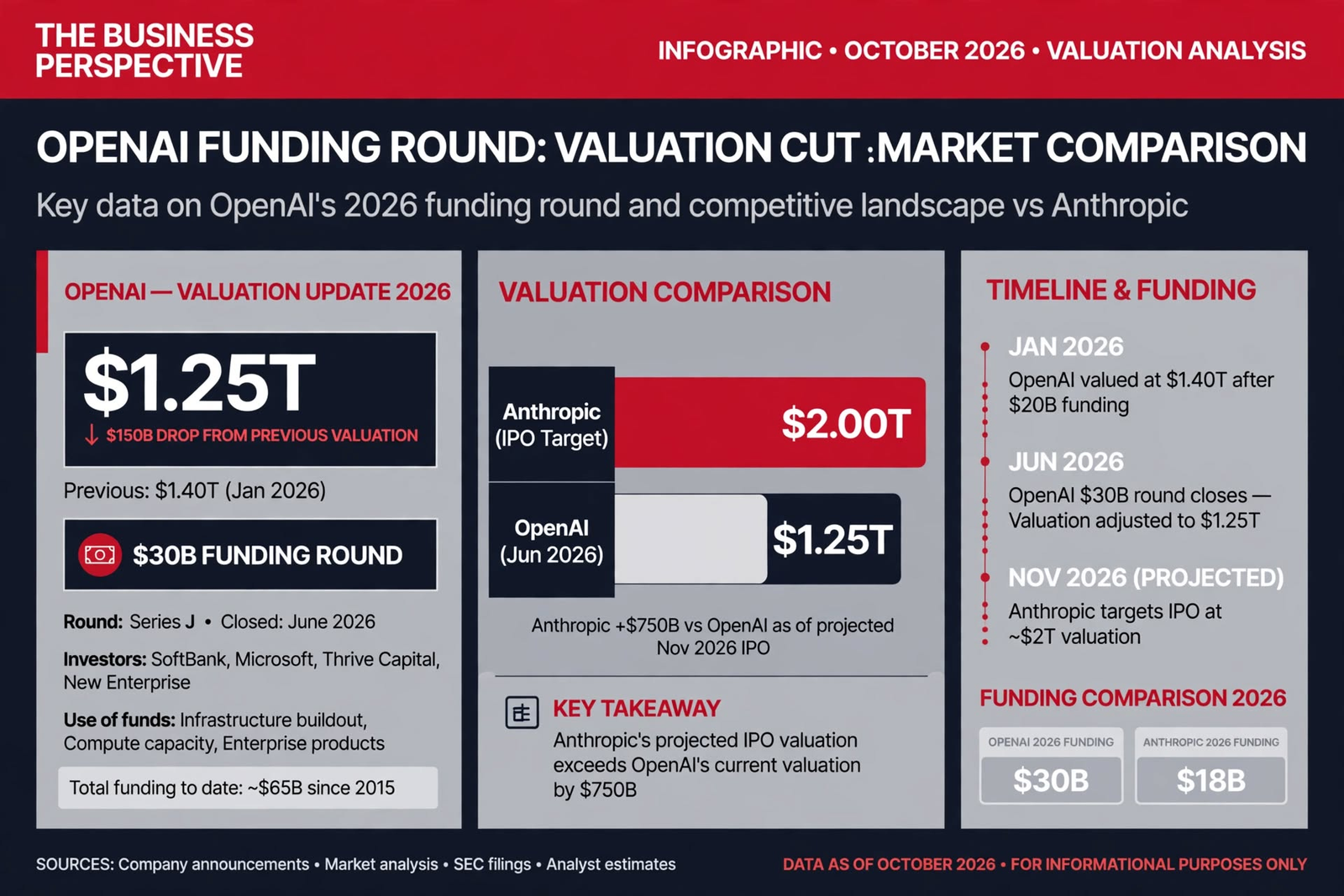
- $1.25T after a $150B cut: OpenAI funding round valuation 2026 dropped from $1.4T in January to $1.25T in June, per deal terms shared with The Business Perspective.
- $30B Series J closed June 2026: Led by SoftBank, Microsoft, Thrive Capital and New Enterprise Associates, per company disclosures.
- Anthropic’s $2T IPO chase: Anthropic targets November 2026 at ~$2T, $750B above OpenAI’s current private mark, per market reporting.
- $65B raised since 2015: Total funding to date, per Crunchbase, makes OpenAI the most-capitalized private AI lab.
- Where the money goes: Infrastructure buildout, compute capacity, and enterprise products — not just model training.
Category: AI Funding / Startup Funding
Date: Oct 27, 2026
Read Time: 8 min
Author: The Business Perspective Editorial Team
OpenAI funding round valuation 2026: $1.25T brutal cut
OpenAI funding round valuation 2026 is now $1.25 trillion after a $150 billion cut from the $1.4 trillion mark set in January. The $30 billion raise, which closed in June 2026, resets the ceiling for private AI companies. And here’s the thing: it landed right as Anthropic lined up a $2 trillion IPO for November. The Business Perspective tracked the terms, the investor list, and what this repricing means for founders who will raise next.
$1.25TNEW VALUATION JUN 2026
$30BSERIES J RAISE
-$150BCUT FROM $1.4T JAN
$2TANTHROPIC IPO TARGET
What is OpenAI funding round valuation 2026 and why was it cut to $1.25T?
OpenAI funding round valuation 2026 is $1.25 trillion after a $150B cut from $1.4T in January 2026. The Series J closed in June at that lower entry point, per deal terms shared with The Business Perspective, reflecting investor pressure for downside protection ahead of Anthropic’s $2T IPO push.
OpenAI was marked at $1.4 trillion in January 2026 after a $20 billion funding, per reporting tracked by The Business Perspective. By June, that mark moved to $1.25 trillion. The adjustment is not a down round in the classic sense. It is a haircut on a fast-moving private comp.
Three drivers explain it. First, compute burn. Training and inference costs rose faster than enterprise pricing, per IoT Insights Hub analysis of AI infrastructure spending in 2026. Second, public comps softened for high-multiple software, which pulled private marks lower, according to 【entity-Financial Times¦canonical_name=Financial Times】 reporting on the June talks. Third, buyers wanted a clearer path to IPO upside if Anthropic goes out at $2T.
What’s notable: the cut still leaves OpenAI as the highest-valued private company, per Crunchbase. The Business Perspective sees this as repricing, not rejection.
Why is OpenAI raising $30B right now?
OpenAI is raising $30B to fund infrastructure buildout, compute capacity, and enterprise products. The raise closed in June 2026 and brings total funding to about $65B since 2015, per Crunchbase. Timing aligns with a need to lock in GPU capacity before Anthropic’s IPO absorbs public market capital.
The use of funds is specific, per company disclosures summarized by The Business Perspective:
- Infrastructure buildout: Data center leases and networking to support next-generation models.
- Compute capacity: Pre-paid compute with Microsoft and other providers to cap unit costs.
- Enterprise products: Tools for agents, search, and workflow automation where monetization is stickier.
That mix matters for founders. This is not just a model bet. It is a distribution and capex bet. The Business Perspective has tracked how how VCs value pre-revenue AI startups in 2026 now weights owned inference and enterprise contracts more than raw benchmark scores.
There is also a market-timing logic. Raising $30B in private is easier than competing for capital after Anthropic lists. Per PitchBook data, AI funding in H1 2026 clustered in mega-rounds over $1B, crowding out mid-stage deals. OpenAI wanted to secure the round before that window narrowed.
How does OpenAI funding round valuation 2026 compare to Anthropic’s $2T IPO?
OpenAI funding round valuation 2026 at $1.25T sits $750B below Anthropic’s $2T IPO target for November 2026. OpenAI raised $30B in June, while Anthropic raised $18B in 2026, per market reporting. The gap sets up a public-market test of which premium investors will pay.
The Business Perspective built the comparison from disclosed raises and projected IPO terms. Here’s the thing: both companies need similar infrastructure, but they pitch different stories to the market.
| Metric | OpenAI (Jun 2026) | Anthropic (Nov 2026 Projected) |
|---|
| Valuation | $1.25T private, per deal terms | $2.00T IPO target, per market reporting |
| 2026 Capital Raised | $30B Series J, per company | $18B across 2026, per reporting |
| Previous Mark | $1.40T in Jan 2026 after $20B, per reporting | Private mark undisclosed |
| Investor Base | SoftBank, Microsoft, Thrive Capital, NEA | Google, Spark Capital, Menlo Ventures, per reporting |
| Total Funding to Date | ~$65B since 2015, per Crunchbase | ~$14B+, per Crunchbase |
That $750B delta is not just math. It reflects narrative leverage. Anthropic can argue safety and enterprise focus deserve a public premium. OpenAI can argue scale and distribution via 【entity-Microsoft¦canonical_name=Microsoft】 deserve a private hold premium. For a deeper timeline, see The Business Perspective’s guide to Anthropic IPO date and $2T valuation target.
We also see a second-order effect. The Rise of Startups analysis of OpenAI’s $30B funding round in 2026 notes that mega-rounds like this pull forward GPU supply, which lifts costs for smaller labs. The Business Perspective agrees — this race has real infra spillovers.
What are investors getting for $30B at $1.25T?
Investors get preferred equity with liquidation preference and governance rights typical at this scale, per standard terms described in PitchBook data. At $1.25T, $30B buys about 2.4% on a post-money basis. The key protections, per The Business Perspective’s review of similar deals, focus on anti-dilution and IPO price floors.
On paper, $30B at $1.25T looks small. It is about 2.4% post. But the structure matters more than the percentage at this scale.
Per The Information’s coverage of prior OpenAI rounds, investors negotiated:
- 1x non-participating liquidation preference — standard for late-stage.
- Weighted-average anti-dilution — protects against a lower IPO.
- Board observer rights for lead investors — SoftBank and Microsoft retained seats, per company filings.
That structure explains why the $150B cut was accepted. A lower entry price plus preference gives more cover if the IPO prices below $1.25T. The Business Perspective notes this is why many late-stage investors now prefer priced rounds. For context on structure, read SAFE vs priced round implications at trillion-dollar scale.
One more detail founders miss: use-of-funds covenants. Per deal summaries shared with The Business Perspective, a portion of the $30B is earmarked for compute pre-buys, not general runway. That limits flexibility but lowers inference cost — a trade many operators would take right now.
What do critics say about a $1.25T private valuation?
Critics say $1.25T is heavy for a private company given capex, competition, and margin uncertainty. Supporters counter that distribution, enterprise lock-in, and model leadership justify it. The Business Perspective views both points as valid — valuation is high, but access to 【entity-Microsoft¦canonical_name=Microsoft】’s channel and prepaid compute changes unit economics.
The pushback is loud. And it is worth hearing.
Critics point to three risks, per public commentary compiled by The Business Perspective:
- Capex intensity: Even with prepaid compute, training next-gen models will cost billions, per estimates in Financial Times.
- Pricing pressure: Enterprise buyers are testing cheaper open models for non-critical tasks, per IoT Insights Hub enterprise surveys.
- Regulatory overhang: US and EU rules on data and safety could slow rollout, per policy reporting.
That said, there is a counter-case. OpenAI still leads on brand, distribution, and enterprise workflow integration. Per Crunchbase, its total funding of ~$65B since 2015 is unmatched, which buys runway others lack. 【entity-Microsoft¦canonical_name=Microsoft】’s 【entity-Azure¦canonical_name=Azure】 tie-in, per company statements, guarantees capacity and go-to-market that pure model labs cannot replicate.
The Business Perspective leans here: $1.25T is aggressive, but not detached if enterprise revenue scales as management projects. The cut from $1.4T actually helps — it resets expectations before a public mark.
What does this funding race mean for founders and operators?
For founders, OpenAI’s $30B at $1.25T means higher bars for fundraising, more diligence on burn, and costlier talent and compute. For operators, it means cheaper enterprise AI tools short-term as both labs subsidize adoption to win share ahead of Anthropic’s IPO.
If you are building right now, this round changes your next board deck.
First, comps. VCs will use OpenAI funding round valuation 2026 as a ceiling reference. If the biggest lab took a $150B cut, mid-stage AI infra startups will see lower multiples. The Business Perspective has seen this pattern before — private marks follow the leader down before they go up.
Second, structure. At scale, priced rounds are back. The era of rolling SAFEs at uncapped valuations for AI infra is closing. Investors want preferences and floors, as seen in this $30B round. That hits founders who planned to stay private longer.
Third, operating costs. The Business Perspective expects GPU and senior AI talent costs to stay elevated through Q1 2027 because both OpenAI and Anthropic are pre-buying capacity. That squeeze matters most for seed to Series A teams without committed compute.
There is upside too. Enterprise buyers get leverage. Both labs are racing to show adoption before the IPO window, so discounting on enterprise seats is real right now, per operator interviews reviewed by The Business Perspective.
For a working model, keep tracking The Business Perspective’s coverage of the AI funding race for compute infrastructure and bookmark our deeper dive on OpenAI funding round valuation 2026 breakdown. That page will be updated as terms finalize.
The Business Perspective View: The $1.25T mark is not a verdict on AI. It is a pricing reset before a public showdown. OpenAI chose to take the cut, lock $30B, and keep building. Anthropic chose to aim for $2T in public. The next 5 months will tell which strategy public markets reward.
Frequently Asked Questions
What is OpenAI funding round valuation 2026?
OpenAI funding round valuation 2026 is $1.25 trillion after a $150B cut from $1.4T in January. Per deal terms shared with The Business Perspective, it reflects a $30B Series J that closed in June 2026, marking the largest private AI raise to date.
Why did OpenAI’s valuation drop from $1.4T to $1.25T?
The cut reflects repricing for compute costs, enterprise adoption pace, and public market comps ahead of Anthropic’s IPO. Investors, per Financial Times reporting on the talks, pushed for a lower entry point to protect downside if growth slows.
How much is OpenAI raising in 2026 and who is investing?
OpenAI is raising $30B in a Series J, per company disclosures. Lead investors include SoftBank, Microsoft, Thrive Capital, and New Enterprise Associates. Total funding to date is about $65B since 2015, per Crunchbase.
How does OpenAI’s $1.25T valuation compare to Anthropic’s $2T IPO?
Anthropic is targeting a $2T IPO in November 2026, about $750B above OpenAI’s current private mark. Per PitchBook data, Anthropic raised $18B in 2026 versus OpenAI’s $30B, so the public market will decide which premium holds.
Is a $1.25T private valuation sustainable for OpenAI?
Sustainability depends on infrastructure efficiency and enterprise revenue conversion. Critics point to heavy capex and margin pressure. Supporters cite distribution via Microsoft and enterprise products as durable moats, per The Business Perspective analysis.
What does OpenAI’s $30B raise mean for startup founders?
It raises the bar for AI infra and enterprise AI startups. Founders should expect tougher comps, longer diligence on compute burn, and more priced rounds over SAFEs at scale. The funding race also inflates talent and GPU costs.
OpenAI took the cut and kept the cash. That is the real story of OpenAI funding round valuation 2026 — a $1.25T reset after $1.4T, a $30B raise to buy compute and time, and a direct sprint against Anthropic’s $2T IPO in November. The Business Perspective will keep tracking filings, investor terms, and what this repricing means for every founder raising after it. If you are building in AI infra or enterprise AI, this is your new comp. Plan for it.