Pre-Seed vs Seed Round: What Changes, What Doesn’t in 2026
Pre-seed vs seed round — what actually changes between the two? Stage, valuation, investors, equity, and what VCs expect. Full 2026 breakdown with numbers every founder needs.
The difference between a pre-seed vs seed round confuses most first-time founders. In a pre-seed vs seed round comparison, the stage, investors, valuation, and equity all shift dramatically. This guide breaks down pre-seed vs seed round expectations for 2026 so you raise at the right time. Understanding the pre-seed vs seed round distinction is critical before you approach any investor. At the pre-seed vs seed round stage, founders make decisions that affect their cap table for years. The pre-seed vs seed round gap is wider than most people think — in terms of check size, investor expectations, and what you need to show. Whether you’re evaluating a pre-seed vs seed round raise, this complete 2026 breakdown covers everything: valuation ranges, equity dilution, who writes checks, and the exact traction metrics each stage demands. Get the pre-seed vs seed round comparison right before you pitch.
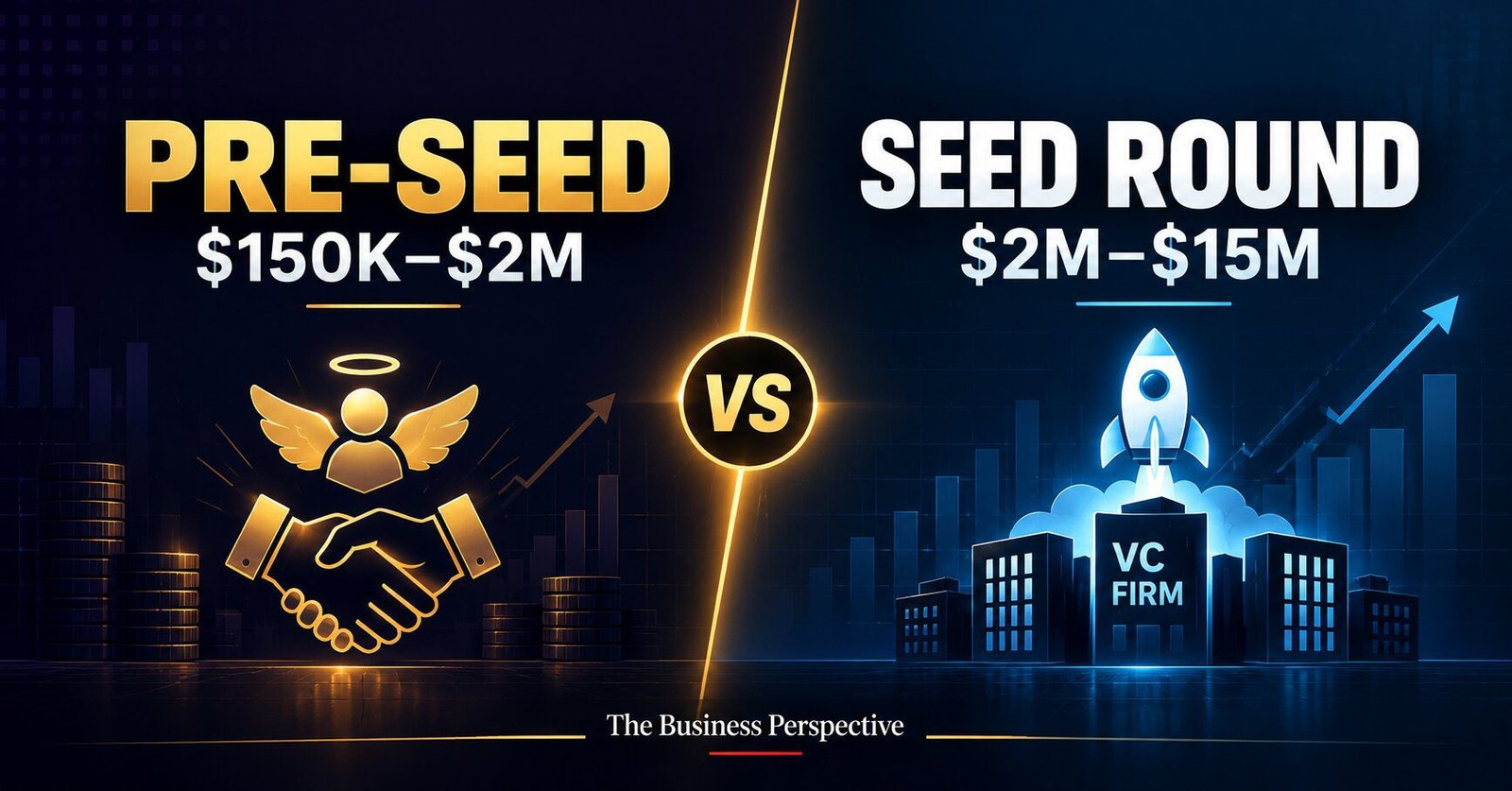
A pre-seed round is the first external capital a startup raises — usually before there’s a product, paying customers, or proof of market demand. The name says it all: you’re planting the seed before you plant the seed.
At the pre-seed stage, investors are betting almost entirely on the founder — your background, your insight into the problem, your ability to execute. The company might be just an idea, a prototype, or a very early MVP with a handful of test users.
Pre-seed funding typically goes toward: hiring the first engineer or designer, building an MVP, getting the first 50–100 beta users, and covering founder salaries for 12–18 months of runway.
A B2B SaaS founder raising pre-seed in 2026 might have: a working demo, 3 LOIs from potential customers, and no revenue. That’s enough to raise $500K–$1M from angels at a $3M–$4M cap SAFE note.
A seed round is the first institutional funding round — where dedicated VC firms and seed funds come in. By this stage, you’re expected to have evidence: not necessarily a lot of revenue, but proof that the market wants what you’re building.
Seed rounds in 2026 are more competitive than they were in 2021. The bar has moved. Investors who used to write seed checks on a pitch deck now want to see some combination of MRR, user growth, enterprise pilots, or a clear path to product-market fit.
Seed funding typically goes toward: building the full product, making first sales hires, expanding from 5 customers to 50, and establishing repeatable go-to-market motion.
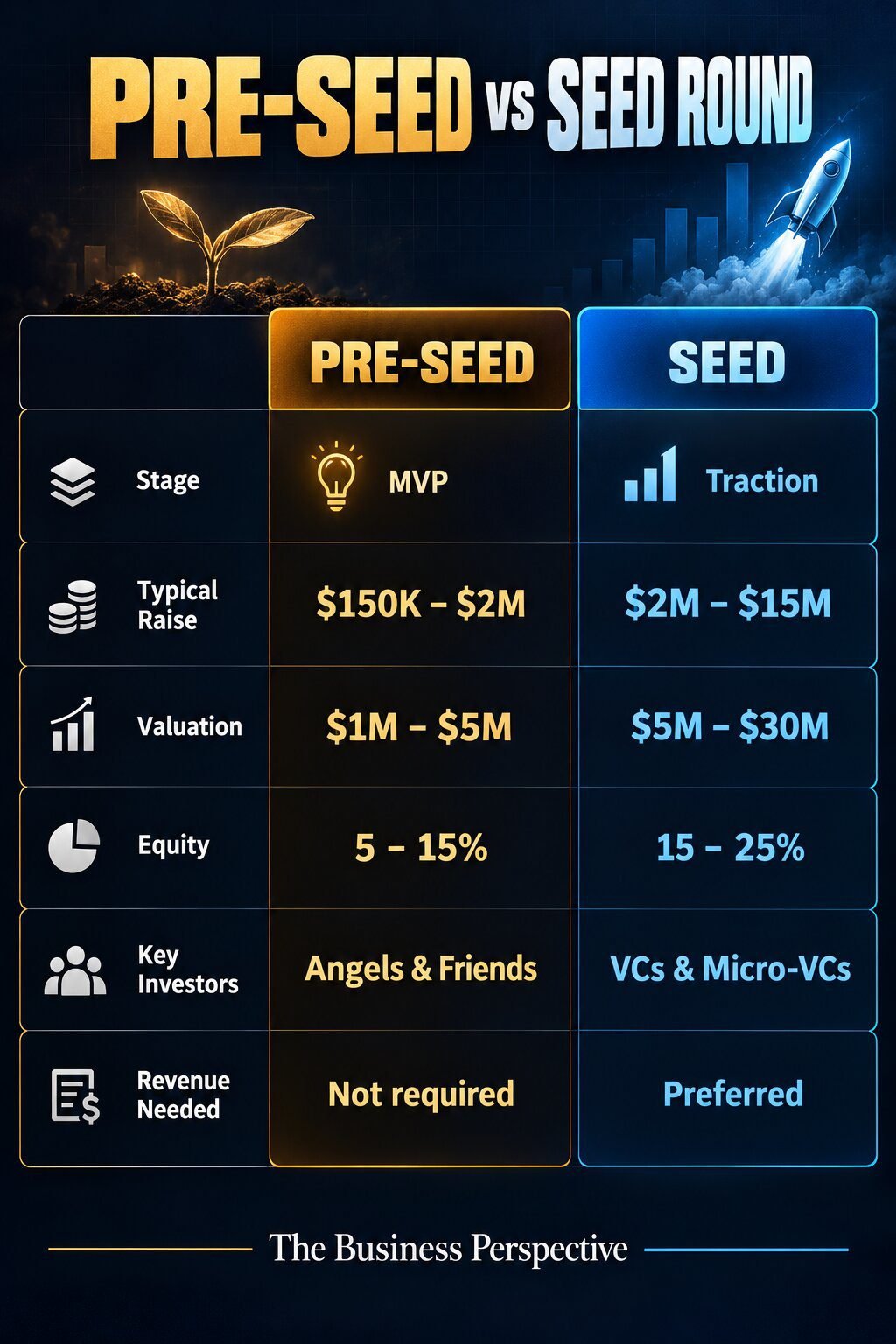
The pre-seed vs seed round comparison below covers every factor that changes between the two stages — from check size and valuation to investor type and what you need to show.
| Factor | 🌱 Pre-Seed | 🚀 Seed Round |
|---|---|---|
| Stage | Idea / MVP | Traction / Early PMF |
| Typical Raise | $150K – $2M | $2M – $15M |
| Valuation (2026) | $1M – $5M | $5M – $30M |
| Equity Given Up | 5% – 15% | 15% – 25% |
| Instrument | SAFE Note / Convertible Note | Priced Equity Round |
| Lead Investors | Angels, Friends & Family | Seed VCs, Micro-VCs |
| Revenue Required | None (idea/MVP is fine) | Preferred (some MRR or pilots) |
| Deck Required | Vision / Concept Deck | Full Deck + Data Room |
| Board Seats | Usually no board formed | Lead investor typically takes a seat |
| Timeline to Close | 4–8 weeks | 2–4 months |
| Due Diligence | Light (mostly founder calls) | Heavy (financials, cap table, legal) |
One of the biggest pre-seed vs seed round differences is who actually writes the check. The investor profile changes completely between the two stages.
In India specifically, the pre-seed ecosystem is growing fast — platforms like LetsVenture, AngelList India, and the Indian Angel Network give founders access to hundreds of angels in a single pitch. The seed market is dominated by Sequoia Surge, Accel, Elevation Capital, and Blume Ventures.
The biggest practical difference between pre-seed and seed is what your company is worth at the time of raise — and how much of it you’re selling. When founders evaluate a pre-seed vs seed round decision, valuation is usually what tips the scales.
At pre-seed, most deals are done as SAFE notes (Simple Agreement for Future Equity) with a valuation cap of $1M–$5M. You’re not technically setting a valuation — you’re setting a ceiling for the price early investors pay when the next round happens.
At seed, rounds are usually priced — meaning a specific pre-money valuation is set. A $3M seed on a $12M pre-money valuation means investors own 20% of the post-money company ($15M).
$500K on a $4M cap — angels own ~12.5% when seed round closes and the note converts
$3M on $12M pre-money — VC owns 20%; post-money cap table includes SAFE conversions from pre-seed
After pre-seed + seed, founders typically own 55–70% depending on how much was raised and at what valuations
Raising too much at pre-seed on a low cap means heavy dilution when the note converts at seed. A $1M SAFE on a $2M cap means 50% dilution on that note alone. Keep pre-seed caps realistic but not punishing — $3M–$5M is the 2026 sweet spot for most B2B SaaS pre-seeds.
At pre-seed, investors are buying the team and the vision. You don’t need revenue — but you need to show you understand the problem deeply and have the right to solve it.
At seed, you need evidence of demand. The deck gets heavier and the due diligence gets real. This is where the pre-seed vs seed round difference becomes most visible to founders in the room.
Yes — and it happens more often than you’d think. Some founders bypass the pre-seed vs seed round sequence entirely and raise a seed round as their first external capital. Founders who skip pre-seed usually have one or more of the following:
Skipping pre-seed means less dilution early but more pressure to hit seed metrics without that first tranche of cash. It’s a calculated risk — right for some founders, wrong for most.
1. Pitching seed investors too early. Walking into a VC with no traction and asking for $5M is the fastest way to burn a relationship. In the pre-seed vs seed round process, sequencing matters. Pre-seed VCs and angels are your audience first — build the proof, then come back.
2. Setting the pre-seed SAFE cap too low. A $1M cap feels founder-friendly (less dilution if the company doesn’t work). But if you raise $500K on a $1M cap, that’s 50% gone before you’ve started. Aim for a cap that reflects your upside case, not your fear case.
3. Treating seed like pre-seed in terms of prep. Pre-seed can close on a great conversation. Seed needs a data room, clean cap table, auditable financials, and a legal team that’s done this before. Under-preparing kills deals in due diligence.
Pre-seed is the earliest stage — founders raise $150K–$2M from angels or family to build an MVP. Seed is the next round, typically $2M–$15M from VC firms, once the product exists and shows early traction.
At pre-seed, founders typically give up 5–15% equity. At seed, that jumps to 15–25% depending on valuation, lead investor, and round size.
Not always — but in 2026, most seed investors expect some signal of demand: early MRR, waitlist traction, LOIs, or a strong pilot. Zero revenue is still possible for deep-tech or B2B enterprise startups.
Pre-seed valuations typically range from $1M–$5M. Seed valuations range from $5M–$30M in 2026, depending on sector, team pedigree, and traction metrics.
Pre-seed investors are usually friends, family, angel investors, and micro-VCs. Seed investors are primarily dedicated seed funds, micro-VCs, and early-stage arms of larger VC firms.
Yes — if you have strong early traction, a well-known founding team, or came out of a top accelerator like YC or Antler, some founders skip pre-seed entirely and raise a seed round directly.
Share this pre-seed vs seed round breakdown with anyone figuring out which round to raise next.
Read All Startup Funding Guides →