Finance & FundingOct 31, 20268 min readBy The Business Perspective Editorial Team
Ramp Valuation Beats Its Own $44B Mark by $16B
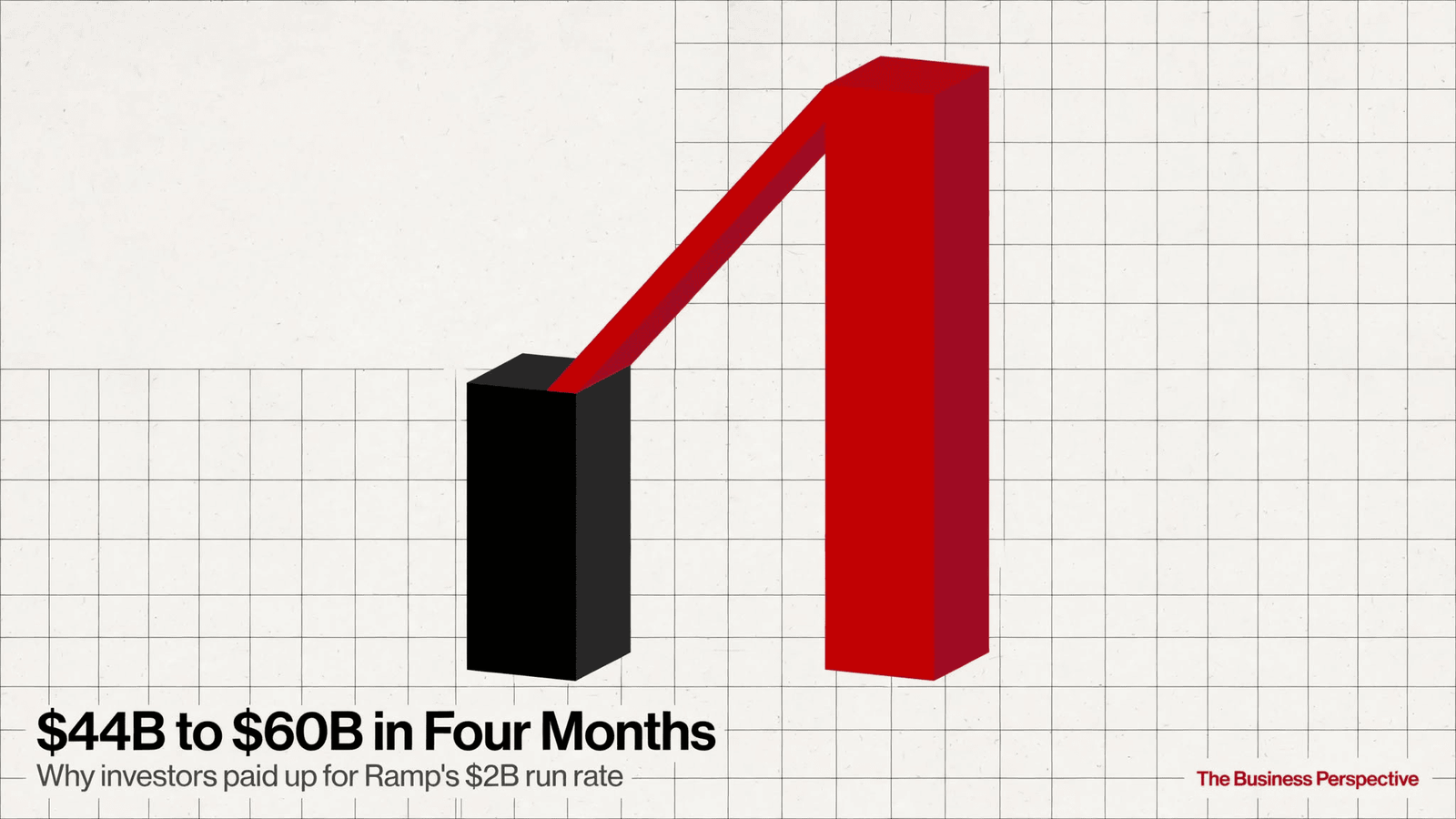
The Ramp valuation just did something few late-stage startups manage: it beat its own mark from four months earlier by $16 billion. On October 15, 2026, the corporate card and spend-management company said it had raised $1.85 billion at a $60 billion valuation, per its release on PR Newswire.
At The Business Perspective, we wanted to know whether that jump reflects real growth or just a hot funding market. The short version: revenue grew almost as fast as the price tag. That matters, and so do the caveats.
This The Business Perspective breakdown covers the numbers, the investors, the AI push and the questions a skeptic would ask.
$60BValuation, Oct 2026
+$16BGain in four months (+36%)
$2B+Annualized revenue
85,000Customers as of Oct 1
What is the Ramp valuation after the $1.85B round?
The Ramp valuation is $60 billion after a $1.85 billion round announced on October 15, 2026. Dragoneer Investment Group led it, with Thrive Capital, Founders Fund, Sands Capital and Avenir as co-leads. Bloomberg reported the $60 billion as a pre-money figure, so the post-money number would be roughly $61.85 billion by simple addition.
Ramp’s own release says “$60 billion valuation” and stops there. Bloomberg’s Rebecca Torrence reported on October 9 that the figure was “before the new money is counted,” as summarized by The Next Web. That is why the pre-money label matters.
The $61.85 billion post-money number is our arithmetic, not a reported figure. If you want the mechanics behind that gap, our startup valuation guide explains the math behind a Ramp valuation step by step.
Ramp was founded in 2019 and is based in New York, with Eric Glyman as co-CEO. The company says it has raised about $5 billion in equity in total, including this round. Here is how the two latest rounds compare.
Ramp valuation: last two rounds, side by side
Metric
June 2026
October 2026
Valuation
$44B
$60B (pre-money per Bloomberg)
Round size
$750M
$1.85B
Annualized revenue
More than $1.5B
More than $2B
Customers
About 70,000
More than 85,000 (as of Oct 1)
Implied multiple (our math)
About 29x
About 30x
Sources: TechCrunch (Oct 15, 2026), Ramp press release via PR Newswire (Oct 15, 2026), Bloomberg via The Next Web (Oct 10, 2026). Multiples are The Business Perspective calculations from those figures.
Why did Ramp valuation jump $16B in four months?
Revenue and customers grew almost as fast as the price. Annualized revenue rose from about $1.5 billion in June to over $2 billion, and customers from roughly 70,000 to 85,000. By our arithmetic the valuation multiple stayed near 30 times revenue, so the step-up mostly tracks growth, not hype alone.
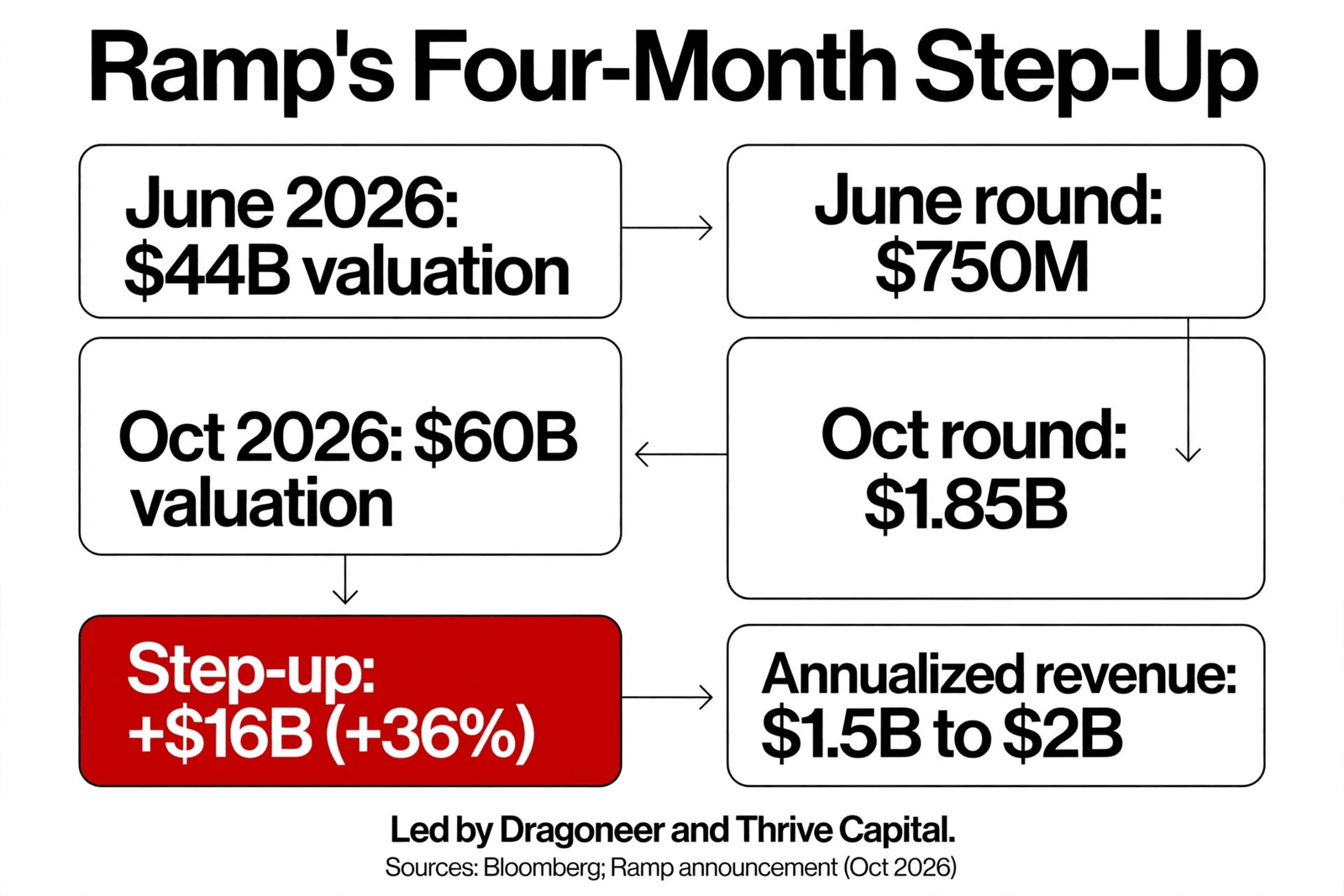
Start with the pace. The Ramp valuation went from $44 billion in June to $60 billion in October, a gain of about 36%. Revenue over the same stretch grew roughly a third, which is why the multiple held steady.
Ramp’s step-up in one view. Source: Ramp, TechCrunch, Bloomberg.
Ramp’s own numbers, all company-reported, show the engine underneath. Annualized purchase volume passed $275 billion, up 175% year over year, per the company’s release. The number of customers paying Ramp more than $100,000 a year rose 113%.
The company also says revenue growth is running 25% faster than at the same point last year, and that it is cash-flow positive. Treat those as claims until audited numbers appear.
Then there is the AI angle, which is where the story gets interesting. Ramp now sells tools that track what teams spend on AI models, plus a router that sends requests to cheaper models and cuts inference costs by up to 40%, per the company. TechCrunch also reports a corporate card built for AI agents.
Glass: a model-agnostic AI workspace where employees share prompts and automations.
AI token spend management: controls AI spend by provider, team, model and API key.
Router: sends requests to the best-value model for each task.
Accounts receivable: automates invoicing, follow-ups and cash application.
Is a $60B Ramp valuation too high for $2B in revenue?
It is about 30 times annualized revenue by our math, steep next to the roughly 3.8x median our SaaS valuation report cites for venture-backed software. But Ramp earns from interchange, subscriptions and interest, not pure software, and it is growing fast. Whether 30x holds depends on growth staying high.
Headline multiples can mislead, so here is the honest comparison for the Ramp valuation. Our SaaS valuation multiples report puts the median for venture-backed B2B software near 3.8x ARR, attributed to Battery Ventures and Bessemer Venture Partners tracking. Ramp is not a typical software company, which makes that yardstick imperfect.
Ramp’s revenue, per its release, includes interchange, subscription, interest and other income, and excludes customer incentives. The company hasn’t published a split between those lines.
Valuation yardsticks, October 2026
Reference point
Valuation
Revenue multiple
Ramp, October 2026
$60B
About 30x annualized revenue
Ramp, June 2026
$44B
About 29x annualized revenue
Typical venture-backed B2B SaaS
Varies
About 3.8x ARR (median)
Brex sale to Capital One
$5.15B
Not disclosed in the coverage
Sources: Ramp release, TechCrunch, Bloomberg via The Next Web, The Business Perspective SaaS report. Ramp multiples are our arithmetic.
One more way to size it: $60 billion is roughly 11.6 times what Capital One paid for Brex, according to Bloomberg’s reporting on that deal. That ratio is ours, and it says more about Ramp’s lead than about fair value.
Who backed the round, and what do they get?
Dragoneer led, with Thrive Capital, Founders Fund, Sands Capital and Avenir as co-leads. Fidelity, T. Rowe Price, Coatue, GIC and Khosla Ventures are among about two dozen other participants. They get a stake in a company reporting positive cash flow, but at a price that already assumes years of strong growth.
The cap table behind the Ramp valuation reads like a late-stage who’s who. Christian Jensen of Dragoneer said, “Ramp is the kind of company we love to back at Dragoneer,” per the company’s release. Sands Capital’s Barron Martin said the firm first invested in 2023 and finds the opportunity more compelling now.
Fidelity, T. Rowe Price, Capital International, D1 Capital, Coatue, GIC, ICONIQ, Greenoaks, General Catalyst, Khosla Ventures, Lightspeed
Source: Ramp press release via PR Newswire, October 15, 2026. The full participant list is longer.
Bloomberg’s earlier report named only Dragoneer and Thrive as leads, so the co-lead structure was confirmed by Ramp, not by the leak. Mutual-fund and sovereign money like Fidelity, T. Rowe Price and GIC tends to show up in later-stage rounds, which fits how mature Ramp now looks. For a wider look at who else raised, see fintech startups that raised funding in August 2026.
How does Ramp compare with Brex and Rippling?
Brex, once Ramp’s closest rival, sold to Capital One for $5.15 billion earlier this year, per Bloomberg. Rippling, the HR and payroll platform, now sells corporate cards and expense tools to the same finance budgets, according to TechCrunch. Bloomberg calls Ramp the most valuable startup in business spending.
The rivalry map around the Ramp valuation has changed fast. Brex is no longer an independent startup, and the threat now comes from software suites that bundle spend tools with everything else a company runs.
Ramp valuation versus its main competitors
Company
Position
Source
Ramp
$60B valuation, 85,000+ customers
Ramp, TechCrunch
Brex
Sold to Capital One for $5.15B
Bloomberg via The Next Web
Rippling
Expanded from HR and payroll into cards, expenses and bill pay
TechCrunch
Keith Rabois, an early investor through Founders Fund and Khosla Ventures, told TechCrunch in September that “Ramp is not worried about Rippling.” That is a confident line, and it comes from someone with money on the outcome.
What do critics say about the Ramp valuation?
No independent skeptic is quoted in the coverage we reviewed, so these are the questions a careful investor would raise. Most figures are company-reported, Bloomberg’s numbers rely on anonymous sources, and revenue includes interest and interchange income. Competition from Rippling is the one business risk coverage names.
Here is where we stay honest with readers at The Business Perspective: this round has strong signals and thin independent verification. The points below are our questions, not quotes from named critics.
Open questions behind the $60B figure
Concern
What the record shows
What is missing
Company-reported metrics
TechCrunch notes the figures are largely company claims, including $275B purchase volume.
No audited financials are public.
Revenue mix
Ramp counts interchange, subscription, interest and other revenue.
No split between lines, so rate and spending sensitivity is unclear.
Anonymous sourcing
Bloomberg relied on people familiar, and Ramp declined to comment at the time.
Ramp confirmed the round on October 15, but not the pre/post-money detail.
AI product revenue
Router launched in August 2026 and Glass in October, per TechCrunch.
No revenue from these products has been disclosed.
Rival pressure
Rippling is moving into cards and expenses.
Rabois’s “not worried” view comes from an investor.
Our read: the growth supports a premium, but not automatically this one. A 30x multiple leaves little room if growth slows. That said, the multiple holding steady from June to October is a point in Ramp’s favor.
What else do readers ask about the Ramp valuation?
Readers ask six things most often about the Ramp valuation: the headline price, the round size, the lead investor, revenue, profitability and customer count. Short, sourced answers follow, and each one points back to the sections above for the full context behind the numbers.
What is the current Ramp valuation?
Ramp is valued at $60 billion after a round announced on October 15, 2026, per its release on PR Newswire. Bloomberg describes that figure as pre-money, which would make the post-money number roughly $61.85 billion by simple addition. That is $16 billion above the $44 billion set in June 2026.
How much did Ramp raise in its latest funding round?
Ramp raised $1.85 billion, according to its October 15, 2026 announcement. That compares with a $750 million raise in June 2026, per TechCrunch. The company says it has now raised about $5 billion in total equity, counting this round, which makes it one of the best-funded startups in business finance.
Who led Ramp’s $60 billion funding round?
Dragoneer Investment Group led the round, per Ramp’s release. Thrive Capital, Founders Fund, Sands Capital and Avenir Growth are named as co-leads. Bloomberg’s earlier report named only Dragoneer and Thrive as leaders, with Founders Fund also investing a large amount, so Ramp’s release gives the fuller picture.
What is Ramp’s annual revenue?
Ramp says annualized revenue now exceeds $2 billion, up from more than $1.5 billion in June 2026, per Bloomberg. The figure includes interchange, subscription, interest and other revenue, and excludes customer incentives. These numbers are company-reported, so they reflect management’s own accounting and have not been independently audited.
Is Ramp profitable?
Ramp says it is cash-flow positive, per its October 2026 release. That is not the same as net profit under accounting rules, and the company has not published a net income figure or a profit margin. Treat the claim as management’s own statement until audited financials are available.
How many customers does Ramp have?
Ramp reports more than 85,000 customer companies as of October 1, 2026, per its release. TechCrunch reports roughly 70,000 in June 2026, and Bloomberg says about 50,000 at the start of the year. Named customers include Visa, Uber, Shopify, Robinhood and Notion, which points to growing enterprise adoption.
What does the Ramp valuation mean for founders and investors?
It shows late-stage money still pays up for fast growth with real revenue. For founders, the lesson is that growth and a clear AI story moved Ramp’s price, not buzz alone. For investors, the open question is whether a 30x multiple survives a slowdown. Watch revenue growth first.
Zoom out and the picture is clear. The Ramp valuation grew $16 billion in four months while it also added roughly $500 million of annualized revenue and about 15,000 customers. Price followed performance, at least on the numbers Ramp has shared.
The risk is a familiar one. Multiples this high work while growth stays strong, and punish any stumble. If you track the wider market, our global venture funding Q3 2026 breakdown shows how much late-stage capital is chasing the same story.
We will update this analysis as Ramp discloses more. Until then, the Ramp valuation is best read as a bet on compounding growth, backed by credible investors and company-reported momentum. The Business Perspective will keep tracking whether the revenue catches the price tag.
Sources: Ramp press release (PR Newswire, Oct 15, 2026); TechCrunch (Oct 15, 2026); Bloomberg via The Next Web (Oct 10, 2026); Dealroom; The Business Perspective research. Related reading on our network: AI agent startup funding in September 2026.
Alexander Sterling is a business journalist and financial analyst
covering startup funding, venture capital, and AI investment trends.
He tracks the deals, valuations, and founder stories shaping the
global business landscape in 2026.
Key Takeaways The Ramp valuation hit $60B after a $1.85B round, announced October 15, 2026, per Ramp’s release on PR Newswire. That is $16B (about 36%) above the $44B set in June 2026, when Ramp raised $750M, according to TechCrunch. Annualized revenue passed $2B, up from about $1.5B in June, per Ramp and Bloomberg. By...
Why startups fail is rarely explained by the famous 90% claim, and the real causes are easier to spot than most founders think. This guide from The Business Perspective shows why startups fail using official survival data and post-mortem studies. Key Takeaways The 90% figure is narrower than it sounds. One review says its origin...
Key Takeaways A share count alone tells you nothing. Carta’s Peter Walker wrote in January 2026 that an offer of “5,000 shares” means you “don’t know anything.” Before you negotiate startup equity, get the strike price and your ownership percentage. The 90-day window is the standard trap. Per Carta, 80% of terminated option grants in...