Key Takeaways
- Solo-founded startups now make up 36.3% of new ventures, up from 23.7% in 2019, per Carta.
- Yet solo founders still receive only 14.7% of venture capital, despite representing about 30% of new companies.
- A full AI agent stack costs $3,000–$12,000 a year, versus $80,000–$120,000 a month for an equivalent human team, Forbes reports.
- Polsia raised $30 million at a $250 million valuation with one founder and no full-time employees.
- The trap is not building alone. It is assuming that operational leverage automatically translates into investability.

AI & Founder Economy
October 28, 2026
9 min read
By The Business Perspective
One Person Company AI Startup: 1 Trap Shocks Founders
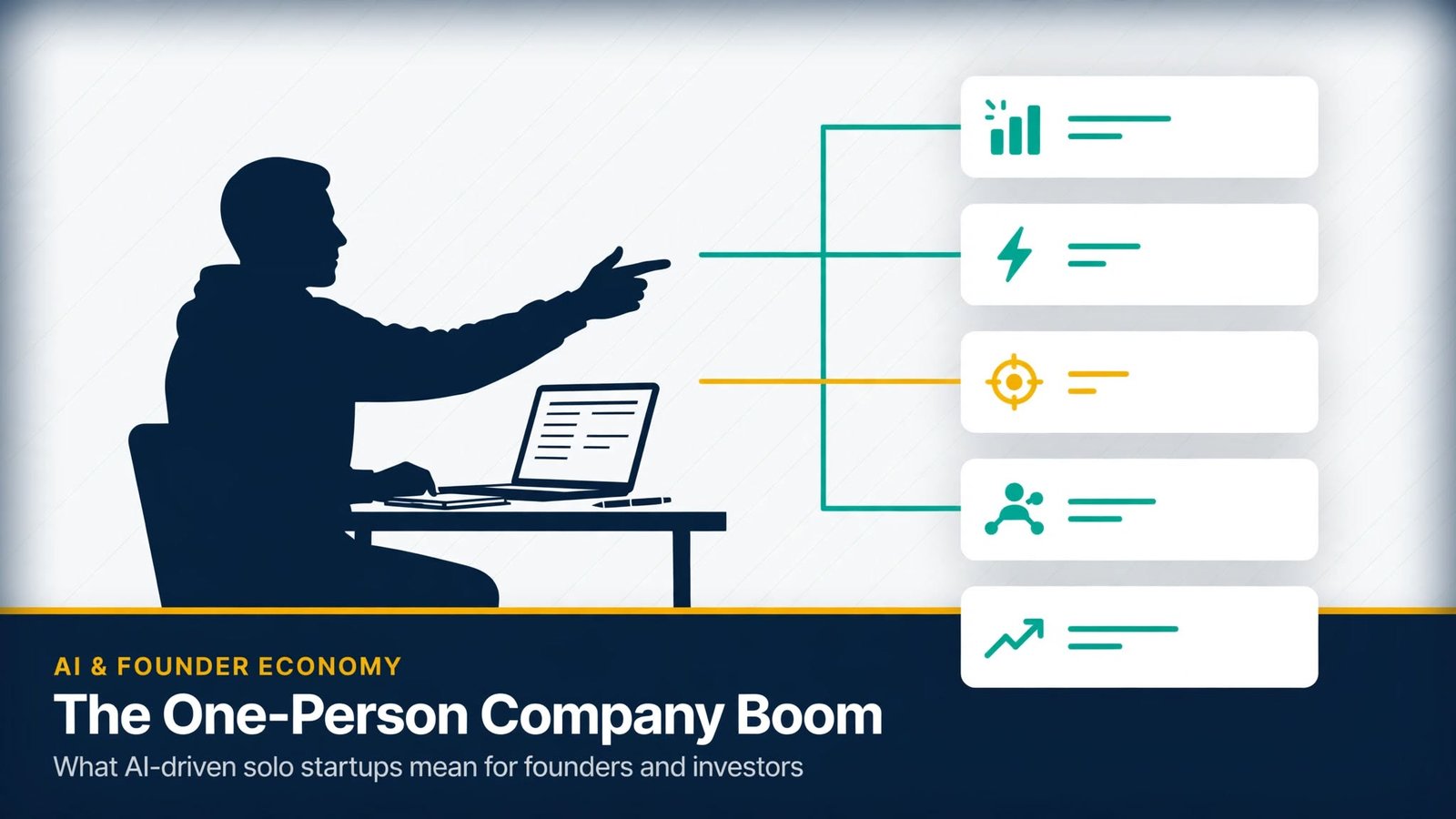
The one person company AI startup is the most seductive story in venture capital right now. A single founder, a stack of AI agents, and a product that ships in weeks instead of quarters. No co-founder equity split. No hiring plan. No office lease. The pitch writes itself.
And the numbers are real. Carta data shows solo-founded startups have climbed to 36.3% of all new ventures, more than double the 17% recorded in 2017[reference:0]. Y Combinator’s latest cohort saw solo founders jump from roughly 5% to nearly 20%, according to David Burt, Director of Entrepreneurship at UNSW Sydney[reference:1]. On paper, the one-person company has arrived.
But here is where the story gets uncomfortable. The same data set shows solo founders still capture only 14.7% of venture capital, even though they represent about 30% of new startups[reference:2]. That gap is the trap. Not the building part. The funding part.
This is The Business Perspective’s breakdown of what the OPC boom actually means, where the leverage is real, where the hype outruns the evidence, and what founders and investors should do with the numbers.
36.3%of new startups are solo-founded
14.7%of VC dollars go to solo founders
$3K–$12Kannual cost of a full AI agent stack
$250Mvaluation of solo-founded Polsia
What is a one person company AI startup?
Direct answer: A one person company AI startup is a business run by a single founder who uses AI tools and agents to handle product, marketing, support, and operations. It is not a freelancer with a laptop. It is a company designed to ship and scale with minimal human headcount.
The definition matters because the label gets applied too loosely. A solo consultant using ChatGPT to draft proposals is not running an OPC. The model that investors and researchers are tracking is more specific: a founder who has replaced entire functional departments with a coordinated stack of AI agents, automation, and outsourced specialist partners.
Ryan Carson, a founder who has built companies for 25 years, runs what he calls a “one-person code factory,” with agents doing the work of a full engineering team[reference:3]. The operating logic is simple. If code generation, content production, customer support, and operational automation can be handled at 95–98% lower cost than human headcount, the question shifts from “how do I hire?” to “what do I actually need to hire for?”[reference:4].
That shift is why the model has moved from niche experiment to mainstream playbook. It is also why the funding conversation has become so charged.
How big is the solo founder boom in 2026?
Direct answer: The boom is measurable. Solo-founded startups reached 36.3% of new ventures by mid-2025, up from 23.7% in 2019, according to Carta’s Solo Founders Report. In China, AI-powered one-person companies saw what Xinhua called “explosive growth” in early 2026, with government action plans and dedicated OPC hubs.
Two data sets tell the story from different angles. In the US, Carta’s founder report shows solo founding has more than doubled in under a decade, with Peter Walker, Carta’s head of insights, calling it “a 13-point rise in about five years — a big shift”[reference:5]. In China, the OPC model became a policy priority. The central government issued an action plan in June 2026 calling for accelerated cultivation of AI-powered OPCs, and Xiongan New Area released its first batch of accredited OPC communities[reference:6].
The cost math explains the acceleration. A complete solo founder AI agent stack now runs $3,000 to $12,000 per year, according to Forbes. The equivalent human team — a junior engineer, a marketer, a designer, and a support rep — costs $80,000 to $120,000 per month[reference:7]. That is not a marginal efficiency gain. It is a structural change in what one person can attempt.
For a deeper look at how these economics are reshaping early-stage fundraising, see The Business Perspective’s guide to founder fundraising in 2026.
Why do solo founders still struggle to raise venture capital?
Direct answer: Because institutional investors still default to teams. Solo founders make up roughly 30% of new startups but receive only 14.7% of priced-round capital, per Carta. The gap is not about capability. It is about risk concentration, succession, and the way venture partnerships underwrite uncertainty.
This is the part of the OPC story that gets buried under the celebration. The share of solo-founded companies has climbed sharply. The share of venture dollars going to them has barely moved. From 2015 to 2024, solo founders went from 17% to 35% of new startups, while their VC-funded share moved from about 15% to 17%[reference:8].
David Burt at UNSW puts the investor logic plainly. “You still need a couple of other humans,” he said. “No one human can take responsibility for everything, especially if you’re taking on investment cash. As an investor, it’s pretty risky if you’re worth a billion dollars and it’s just you. You might get hit by a bus”[reference:9].
That is not sentimentality. It is underwriting. Venture capital is a portfolio business built on outlier outcomes, and outliers require durability. A solo founder can build a remarkable product. The question investors ask is whether the company survives the founder’s vacation, illness, or burnout. The data says most partnerships are not yet convinced.
Angel investors are moving faster. Seed-stage solo founders with strong distribution and capital efficiency are finding checks. But the Series A and B gatekeepers remain the bottleneck, especially in regulated industries and enterprise sales where a second brain and a succession plan matter more than shipping speed.
What does a real one-person unicorn look like?
Direct answer: No confirmed one-person billion-dollar company exists yet. The closest cases are Polsia, a solo-founded AI co-founder platform valued at $250 million, and Medvi, a telehealth startup launched with $20,000 and no employees that posted $401 million in first-year sales. Both stretch the definition of “solo.”
Polsia is the purest test case. Founded at the end of 2025, the company raised $30 million at a $250 million valuation with founder Ben Broca as the sole full-time employee. Its AI co-founder builds product, fixes bugs, handles support, and runs marketing campaigns autonomously[reference:10][reference:11]. Broca has said Polsia hit a $4.5 million revenue run rate, though Fortune’s Allie Garfinkle noted she is “famously skeptical of any and all revenue-related startup claims in the AI era”[reference:12].
Medvi is the revenue outlier. Matthew Gallagher launched the GLP-1 telehealth company from his Los Angeles home in September 2024 with $20,000, no employees, and more than a dozen AI tools. PYMNTS reported that Medvi posted $401 million in sales in its first full year, amassed 250,000 customers, and produced a 16.2% net profit margin. The company is tracking toward $1.8 billion in 2026 revenue[reference:13].
But look closely. Gallagher brought on his brother as the company’s only hire. He outsourced regulated components — licensed physicians, prescription processing, pharmacy fulfillment — to partners. And his AI chatbot initially fabricated drug prices and hallucinated product lines, forcing manual correction[reference:14]. The model works, but it works because humans and partners absorb the parts AI cannot safely own.
| Company | Founder model | Headcount | Key number | What it proves |
|---|
| Polsia | Solo founder + AI co-founder | 1 | $250M valuation | Investors will price AI leverage |
| Medvi | Solo founder + AI stack + outsourced partners | 2 | $401M first-year sales | Revenue scale is possible without a team |
| Base44 | Solo founder, AI-built product | 8 at exit | $80M Wix acquisition | Exit velocity, not necessarily solo permanence |
For more on how investors are pricing AI-native companies at the early stage, see The Business Perspective’s analysis of how VCs value pre-revenue AI startups.
What is the hidden trap of the one-person company model?
Direct answer: The trap is mistaking operational leverage for institutional investability. Solo founders can now build products that look like teams, but capital markets have not repriced the risk of one-person ownership. The founder becomes the single point of failure, and every system error lands on one desk.
This is the trap that shocks founders. The AI stack removes the hiring bottleneck. It does not remove the underwriting bottleneck. A founder can ship a v1 in weeks, sign ten customers, and hit a revenue run rate that would have required a seed round five years ago. Then they walk into a VC meeting and discover that the goalposts have moved.
The second half of the trap is operational. When the server crashes at 3 AM, there is no one else to wake up. When a major deal falls through, the stress has nowhere to go but inward. When Medvi’s chatbot fabricated drug prices, Gallagher was the sole human backstop, at any hour and at any scale[reference:15]. Leverage cuts both ways.
There is also a strategic ceiling. Andrew Chen at a16z has argued that AI may let a solo founder ship a v1, but a team of co-founders multiplied by AI can still out-progress a solo founder multiplied by AI. “Maybe coding was never the main bottleneck for startups in the first place,” he wrote[reference:16]. If distribution, customer trust, and enterprise relationships are the real constraints, solo leverage helps less than the headline suggests.
The trap, in one line: the OPC model moves risk from payroll to the founder’s nervous system and from the team to the cap table. Neither risk disappears. It just becomes harder to see until it surfaces.
What do critics say about the solo founder hype?
Direct answer: Critics argue that one-person unicorns are unlikely to produce durable products or companies. They point to the lack of diverse perspectives, the absence of succession planning, and the risk of polished-but-brittle AI-generated code. Even Base44, the celebrated solo exit, had eight employees at acquisition.
The strongest critique is not that solo founders cannot build. It is that companies are more than products. Entrepreneur UK put it bluntly: “A business is more than its product. It is about culture, leadership, and the ability to inspire people to rally behind a mission. A founder with no team cannot build resilience, succession planning, or trust with investors, partners, or customers”[reference:17].
There is also the product-quality question. A solo founder leaning too heavily on AI tools may generate products that look polished at first glance but lack depth and scalability. Innovation, the argument goes, happens through collaboration, iteration, and healthy debate — the friction that a one-person company deliberately removes[reference:18].
And then there is the definitional sleight of hand. Base44 is often cited as proof of the solo founder era. Maor Shlomo built it alone, launched in February 2025, hit $1.5 million in monthly revenue within 30 days, and sold to Wix for $80 million six months later[reference:19]. But Wix confirmed Shlomo had eight employees at the time of the deal[reference:20]. The headline says solo. The cap table and the org chart say something more nuanced.
This does not invalidate the model. It clarifies it. The OPC is a powerful starting form, not necessarily an ending form. The founders who treat it as a permanent identity may find themselves explaining the funding gap to investors who have seen the movie before.
Will one-person companies replace traditional startups?
Direct answer: No. They will become a larger and more normal part of the startup menu, especially in software-only, low-regulation sectors. But the evidence does not support the idea that one-person companies will replace team-built companies at the top of the market. The future is more likely a barbell: many more solo starts, and still very few solo unicorns.
The barbell is already visible. On one end, solo founders are starting companies at record rates and raising angel checks with capital efficiency that team-built startups struggle to match. On the other end, the largest outcomes still require a team, a succession plan, and the kind of institutional trust that a single person cannot underwrite alone.
China’s OPC boom shows what the first end of the barbell looks like at scale. The country’s one-person limited liability companies exceeded 16 million, with new registrations in the first half of 2025 surging 47% year on year[reference:21]. Ninety-two percent of highly profitable OPCs deeply integrate AI tools, according to Xinhua[reference:22]. That is a real entrepreneurial shift. It is not the same thing as a venture-capital shift.
For founders, the practical implication is to treat the OPC as a launch strategy, not a religion. Build alone if the leverage is real. Add humans when the constraint moves from code to trust, from product to distribution, or from speed to durability. For investors, the implication is to underwrite the founder’s systems and delegation plan, not just their headcount. The solo founder who can show a documented operating model is a different bet from the solo founder who insists they will never hire.
For more on how AI agents are changing the operating stack, see The Business Perspective’s coverage of AI agents for startups.
FAQ
What is a one person company AI startup?
A one person company AI startup is a business run by a single founder who uses AI tools and agents to handle product, marketing, support and operations. It is not a freelancer with a laptop. It is a company designed to ship and scale with minimal human headcount.
How many startups are solo-founded in 2026?
Carta’s Solo Founders Report puts solo-founded startups at 36.3% of all new ventures by mid-2025, up from 23.7% in 2019. Y Combinator’s latest cohort saw solo founders rise from about 5% to nearly 20% of the batch, according to UNSW’s David Burt.
Do solo founders raise less venture capital?
Yes. Solo founders represent roughly 30% of new startups but receive only 14.7% of priced-round venture capital, per Carta data. The funding gap has held steady even as the number of solo-founded companies has climbed, because institutional investors still default to backing teams.
What is the biggest risk of running a one person AI company?
The founder becomes the single point of failure. Every system failure, customer escalation and compliance issue lands on one person. Medvi’s AI chatbot fabricated drug prices in its first year, and the solo founder had to manually correct every error. Leverage cuts both ways.
Has a one-person billion-dollar company happened yet?
Not yet. Sam Altman and other tech leaders have a betting pool on when it will happen, and some experts expect it between 2026 and 2028. But UNSW’s David Burt says a billion-dollar company run by one person is “not realistic” and unlikely to appear soon, because investors want a team behind the cap table.
Are one person companies good for investors?
It depends on the stage and sector. Angel investors increasingly back solo founders with strong distribution and capital efficiency. Traditional VCs remain cautious, especially for regulated industries, enterprise sales and long-horizon bets where a second brain and succession plan matter more than speed.
What this means for founders and investors
The one person company AI startup is not a fad. The cost math is too compelling, and the startup data confirms that solo founding has moved from exception to normal. But the funding data tells a more cautious story. Solo founders are building more, and raising less, than the headlines suggest.
That gap is the opportunity. Founders who understand it can design for it: document their systems, show a delegation plan, and treat the OPC as a stage rather than an identity. Investors who understand it can price it: back the solo founder with distribution and a second-brain plan, not just the one with the lowest burn.
The trap is not building alone. The trap is believing that leverage alone closes the gap. For more on the capital side of that equation, explore The Business Perspective’s AI startup funding coverage and our startup funding analysis at Rise of Startups.
Sources: Carta Solo Founders Report, cited via Forbes and SeedScope; UNSW Business School; PYMNTS; Fortune; Xinhua; 311 Institute; Entrepreneur UK; TechCrunch. Figures are as reported by those outlets and should be independently verified before citation in investment decisions.