
$15/1M Output: Gemini 4 Neon Price Trap in 3 Workloads
At the Standard Gemini 4 Neon price, a million tokens can cost $1.92 or $9.00. The Business Perspective calculated both using Google’s rates. The smaller bill comes from answering questions about a shared document. The larger bill comes from drafting reports.
Look at what goes into the million. The document example assumes most of its input hits the cache. The report example spends half its tokens on output at $15 per million. A support team and a research desk can use the same model and face very different bills.
- $3.00
- Fresh input
- $0.15
- Cached input
- $15.00
- Output, including thinking
USD per 1 million tokens. Source: Google’s Gemini Developer API pricing, checked November 29, 2026.
What is the Gemini 4 Neon price per million tokens?
Google charges $3 for fresh input, $0.15 for cached input and $15 for output on its Standard Developer API tier. All three prices are per million tokens. Thinking counts as output. Those are the rates Google quoted when it announced Neon on November 18, 2026. Batch, Flex and Priority have their own rates.
| Tier | Fresh input | Cached input | Output |
|---|---|---|---|
| Standard | $3.00 | $0.15 | $15.00 |
| Batch or Flex | $1.50 | $0.075 | $7.50 |
| Priority | $5.40 | $0.27 | $27.00 |
Gemini 4 Neon price by tier from Google’s Gemini Developer API pricing.
Batch is worth pricing for a queue of overnight jobs. The team waiting for a response during a live support call has a different decision. Check the rate for the tier and provider you actually use. If the choice is still between model families, see The Business Perspective’s enterprise comparison of Claude, ChatGPT and Gemini.
How does the Gemini 4 Neon price change across three workloads?
Report drafting comes out highest at $9.00. Ticket tagging costs $4.20, and document Q&A costs $1.92 if most of its input comes from the cache. The Business Perspective put one million tokens into each example and priced them at Google’s Standard rates. These are model-token costs based on assumed usage.
| Workload | Fresh input | Cached input | Output | Cost |
|---|---|---|---|---|
| Ticket tagging | 900,000 | 0 | 100,000 | $4.20 |
| Document Q&A | 100,000 | 800,000 | 100,000 | $1.92 |
| Report drafting | 500,000 | 0 | 500,000 | $9.00 |
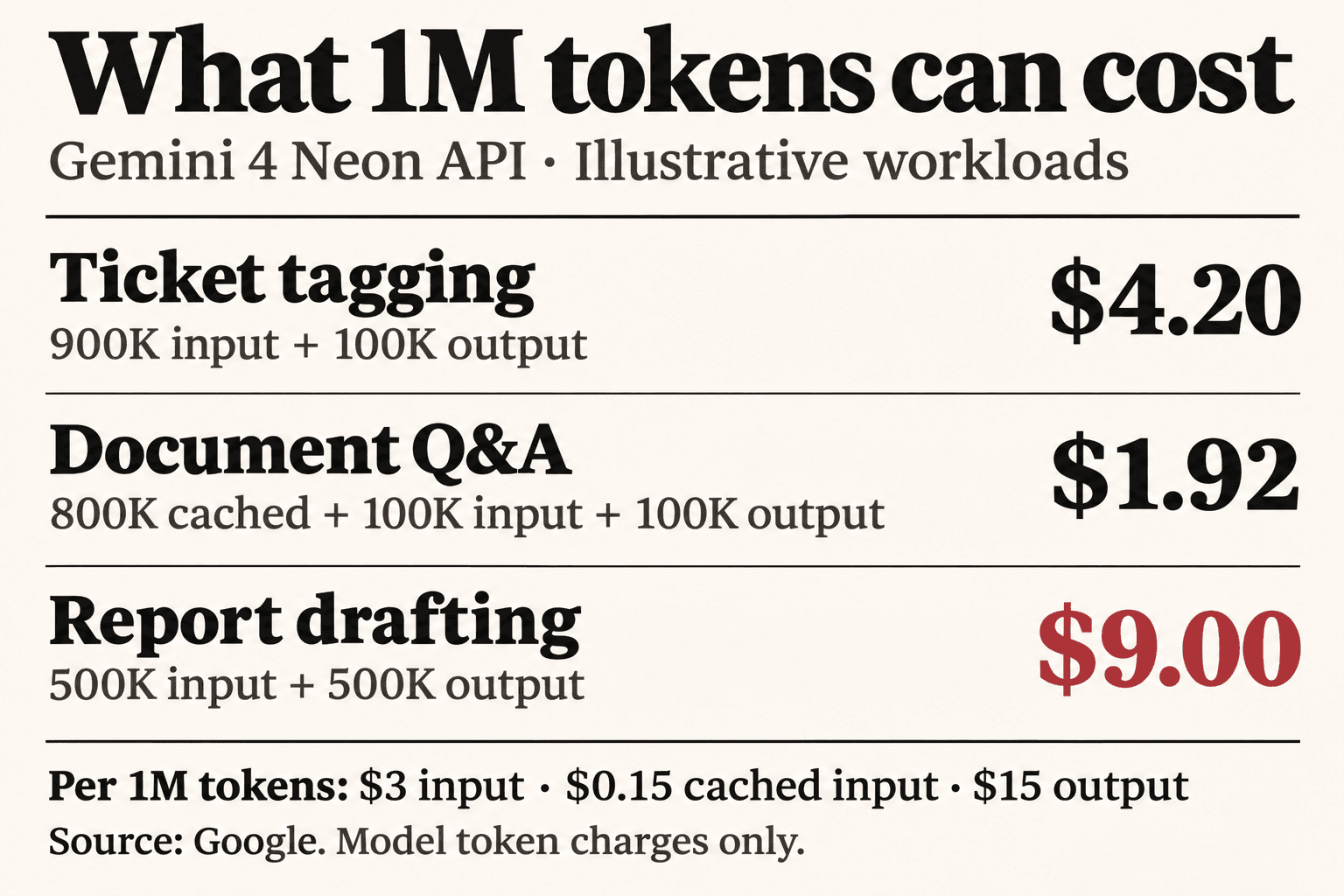
Gemini 4 Neon price estimate in USD = (fresh input × $3 + cached input × $0.15 + billable output × $15) ÷ 1,000,000.
Look at the report line. Fresh input and output each make up half the tokens, yet output alone costs $7.50 of the $9.00 total. If someone asks for a longer draft, that’s the line to watch.
Document Q&A has a different risk. In this example, 800,000 input tokens hit the cache. If every one of those reads bills at the fresh Gemini 4 Neon price, the total rises to $4.20. That is the same bill as ticket tagging, and you get there without changing the number of questions or the length of the answers.
When does context caching actually cut the bill?
Caching pays when Google recognizes text at the start of a prompt that it has recently processed. A cache hit cuts the Standard Gemini 4 Neon price for those input tokens by 95%. Google’s caching guide gives Neon a 4,096-token minimum and describes the process as implicit. Google handles it automatically.
Say a support team sends the same returns policy with each question. Put the policy first and the customer’s question last. Google’s Context caching guide also suggests sending requests with the same opening text close together. A queue that jumps between different manuals gives the model less text to reuse.
What would a bad week do to the budget? In The Business Perspective’s document example, missing every assumed cache hit adds $2.28 per million total tokens. Use the actual cache hits in your request logs to decide how much of that discount to put in the forecast.
A support team can start with routine questions and route exceptions to people, an approach covered in IoT Insights Hub’s guide to AI-driven support workflows.
Do thinking tokens and tool calls add to the API bill?
Yes. Google charges for thinking at the same rate as the text you get back. The visible reply can be short and still use substantial output. Search grounding has its own meter, too. Google’s rate card explains that a single request to the model can trigger more than one billable search query.
Google lists a shared allowance of 5,000 Search queries a month across Gemini 3 and newer models. After that, its Standard grounding rate is $14 per 1,000 queries. If your report pulls material from Search, put those queries on a separate budget line. The three workload examples cover model tokens only.
A tag that takes two attempts is still one usable tag. Try stricter output limits and check whether the team can still use the labels. For work beyond the API bill, including integration and human review, see The Business Perspective’s AI agent cost breakdown.
How should a startup budget for Neon before rollout?
Start with the jobs people already do. Send Neon a sample of real tickets, documents or report briefs, then have the team judge the results. Add up the token and tool charges, including failed attempts. Divide that spend by the number of results the team would actually use and forecast from there.
- Decide what you’d keep. A tag has to send the ticket to the right queue. A report should be ready for its intended reader after the usual review.
- Keep the failed calls in the bill. Record fresh input, cached input, billed output and tool calls for each attempt. A retry belongs on the original job.
- Try a busy month on paper. Start from the Gemini 4 Neon price and rerun the budget with more requests, longer answers and fewer cache hits.
- Give overnight jobs their own trial. Google’s Batch and Flex token rates are half the Standard rates. Check whether each tier finishes the queue before people need it.
Give the first pilot to whoever checks the work. That can fall to the founder at a one-person AI startup, as The Business Perspective has reported.
Training and review time belong in the rollout budget too. For a broader checklist, see Rise of Startups’ guide to testing AI tools for business growth.
What do skeptics say about judging AI models by token price?
Suppose the cheaper model drafts a report that needs another pass. The more expensive model could still finish the job for less. Artificial Analysis tracks cost and time per benchmark task alongside token rates for this reason. Your own ranking depends on the requests you send and what your reviewers will accept.
Read the date on a quote, too. Google’s Standard rate card lists Gemini 4 Carbon at $2 for fresh input and $10 for output through November 30, 2026, per million tokens. It lists $4 and $20 from December 1. That switches which model has the lower listed rates when you compare Carbon with the Gemini 4 Neon price.
Give both models the same awkward tickets and incomplete briefs. Keep the review criteria fixed. If one model gets the straightforward work right and repeatedly comes unstuck on a small group of jobs, you’ve found a reason to route that group separately.
What else do people ask about Gemini 4 Neon pricing?
Begin with the request your application sends and the usage record Google returns. Those tell you whether a big prompt hit the cache and how much output the model used. The questions below cover the other decisions you’ll face, from picking a tier to working out what one ordinary request costs.
Is the Gemini 4 Neon API free?
Neon requires a paid Gemini Developer API tier, according to Google. If you already use Neon in the Gemini app, check your API project separately. The Standard Gemini 4 Neon price is $3 per million fresh input tokens and $15 per million output tokens, including thinking.
How much does one Gemini 4 Neon API request cost?
Six cents, if you send 10,000 fresh input tokens and Neon bills 2,000 output tokens. At Google’s Standard Gemini 4 Neon price, those two charges come to three cents apiece. That example covers model tokens only. A cache hit or a paid tool call would change what appears on the bill.
Does Batch or Flex lower the Gemini 4 Neon price?
Both cost half as much as Standard at the same token counts. Google lists $1.50 for fresh input, $0.075 for cached input and $7.50 for output, each per million tokens. An overnight tagging queue gives you room to try those rates and see how long the whole queue takes.
How much do cached tokens cost on Gemini 4 Neon?
Google charges $0.15 per million cached input tokens on Standard. Fresh input costs $3 per million. If every request starts with the same policy manual, look in the usage record for the tokens Google actually read from cache. Apply the 95% discount to those tokens when estimating savings.
Does Gemini 4 Neon charge for thinking tokens?
Yes. Google bills thinking at Neon’s output rate of $15 per million tokens on Standard. Say the model returns a single label after weighing two close categories. The label can be short while the billed output is larger. Look at the usage record when you compare different reasoning settings.
Does a 1 million-token context window cost $15 to use?
The window tells you how much the model can handle. The bill follows the token counts Google records for the request. At the Standard Gemini 4 Neon price, a million fresh input tokens would cost $3 in input charges. The $15 rate applies to a million billable output tokens.
Is Gemini 4 Neon worth budgeting for?
Start with one job where a better answer saves someone time. For a research desk, that might be a first draft that needs fewer corrections. For support, it could be an answer drawn from a long policy manual. Compare the spend per usable result with the model you already have.
The Business Perspective would budget document Q&A at the fresh-input rate until the logs show what gets reused. For reports, count all the output it takes to get a draft people keep. Apply the Gemini 4 Neon price to each job. If the higher output bill buys fewer rewrites, you have a case for using Neon on reports first.

Leave a Reply