
- The standard Gemini 4 Neon price is $3 input, $0.15 cached and $15 output per million tokens, per Google.
- Report drafting is the costliest example at $9.00 per million total tokens.
- Ticket tagging costs $4.20; document Q&A costs $1.92 with 800,000 cached tokens.
- Thinking tokens are billed as output, and high is the default thinking level.
- Batch and Flex list input and output at half the standard rates; Priority costs more.
Two AI features can each process one million tokens and produce very different bills. In our examples, one costs $1.92. Another costs $9.00.
That gap is why the Gemini 4 Neon price deserves a closer look than its $3 input rate. Google charges $15 per million output tokens, including thinking tokens. The Business Perspective ran three illustrative workloads to show where the money goes, what caching changes and which assumptions could wreck an early budget.
Sources: Google Gemini API pricing page, changelog and model documentation, checked November 29, 2026. Totals: The Business Perspective calculations.
What is the Gemini 4 Neon price per million tokens?
The standard Gemini 4 Neon price is $3 per million input tokens and $15 per million output tokens, per Google’s Gemini API pricing page. Cached input costs $0.15. Output charges include thinking tokens, so the words your user sees are only part of what you may pay for.
Google’s changelog lists the model, ID gemini-4-neon, as generally available on November 18, 2026. The pricing page showed no higher rate for long prompts and no free API tier when The Business Perspective checked it on November 29.
| Service tier | Input | Cached input | Output |
|---|---|---|---|
| Standard | $3.00 | $0.15 | $15.00 |
| Batch | $1.50 | $0.075 | $7.50 |
| Flex | $1.50 | $0.075 | $7.50 |
| Priority | $5.40 | $0.27 | $27.00 |
Per million tokens, according to Google. Check each service option’s conditions.
Which of the 3 API workloads costs the most?
Report drafting costs the most in our three examples: $9.00 for one million tokens split evenly between input and output. Ticket tagging comes to $4.20. Document Q&A costs $1.92 when 800,000 input tokens are served from cache. All three totals cover model token charges only.
Each example processes exactly one million tokens. The only thing that changes is the mix. These are illustrations from The Business Perspective using standard rates, not live measurements.
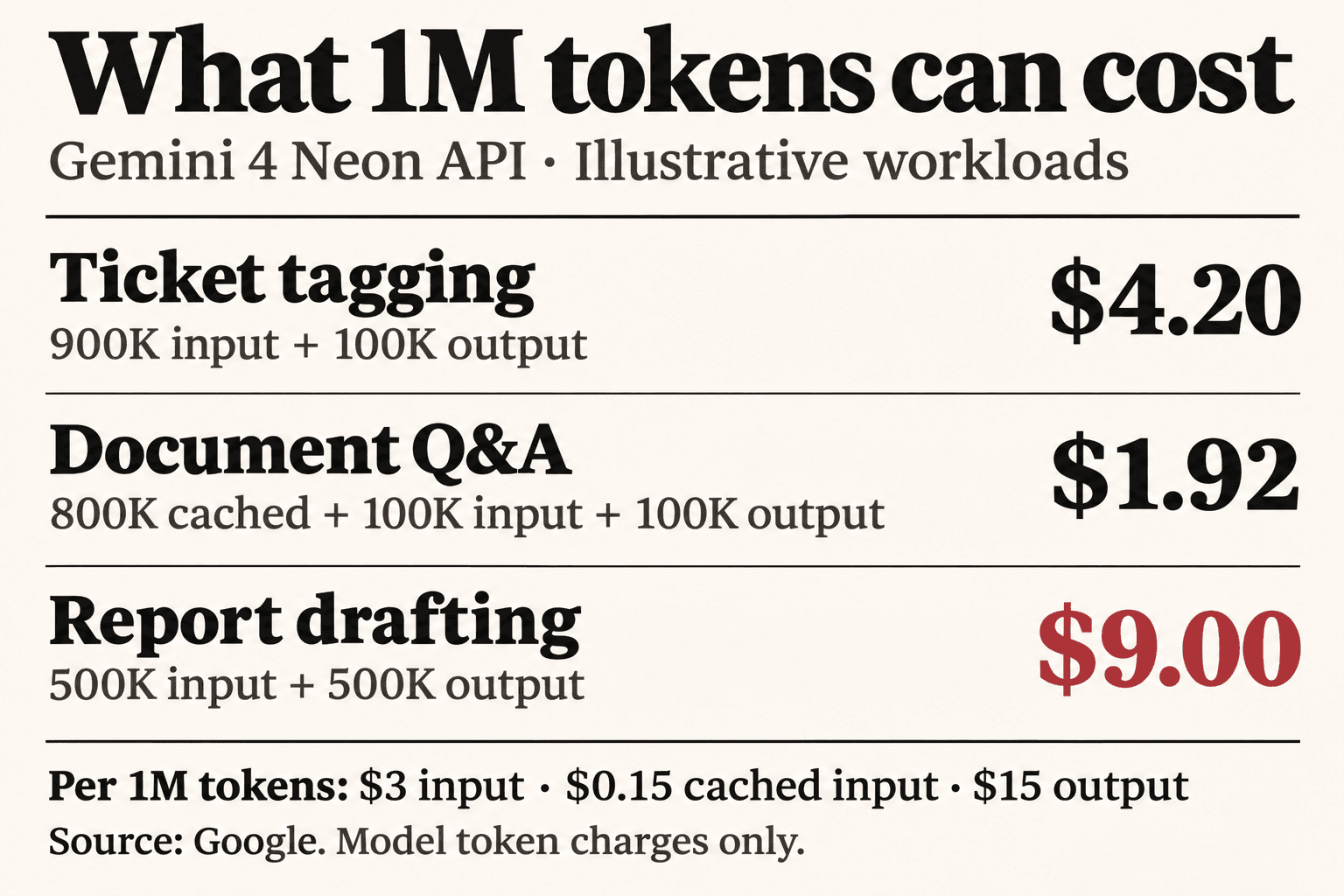
| Workload | Token mix | The math | Total |
|---|---|---|---|
| Ticket tagging | 900K input + 100K output | $2.70 + $1.50 | $4.20 |
| Document Q&A | 800K cached + 100K input + 100K output | $0.12 + $0.30 + $1.50 | $1.92 |
| Report drafting | 500K input + 500K output | $1.50 + $7.50 | $9.00 |
At 100 million tokens, the totals become $420, $192 and $900.
Why can the Gemini 4 Neon price become a trap?
The trap is budgeting from the $3 input rate or from total token volume. Output costs five times as much as standard input, and thinking tokens are billed as output. In the ticket-tagging example, output is only 10% of tokens but accounts for about 36% of the model bill.
Here’s the thing: a million tokens is not a unit of cost. What matters is which kind of token you’re buying.
| Workload | Output share of tokens | Output share of cost |
|---|---|---|
| Ticket tagging | 10% | About 36% |
| Document Q&A | 10% | About 78% |
| Report drafting | 50% | About 83% |
Document Q&A is the surprise. With cheap cached input, the $1.50 output charge becomes most of the bill.
Our wider guide to how the Gemini 4 Neon price fits into AI agent costs matters too, because agents can make many model calls for one task.
How do thinking tokens change your bill?
Google includes thinking tokens in the $15 output rate. Neon offers low, medium, high and xhigh thinking levels, with high as the default. If a job uses an extra 100,000 thinking tokens at standard pricing, the model bill rises by $1.50, even when the visible answer stays the same length.
Take the ticket-tagging mix. If billed output doubled from 100,000 to 200,000 tokens while input stayed at 900,000, the total would climb from $4.20 to $5.70. That increase is hypothetical, not a forecast for any thinking level.
Google’s model documentation describes the low setting as using the fewest tokens with the lowest latency. It also says max_output_tokens limits thinking and visible output combined. A tight cap can squeeze the answer.
So run the same real examples at two settings and compare the cost of an acceptable result. Google also says Neon rejects the minimal setting with an error.
How much can caching reduce the cost?
In the document Q&A example, caching 800,000 input tokens cuts the total from $4.20 to $1.92. That saves $2.28, or about 54%. The saving depends on those tokens actually registering as cache hits. Google lists implicit caching only for Neon, so do not assume every repeated prompt qualifies.
Cached input is 95% cheaper than standard input: $0.15 against $3.00. According to Google’s documentation, implicit caching runs by default on prompts of at least 4,096 tokens. Explicit caching isn’t supported for this model.
| Document Q&A scenario | Model token cost |
|---|---|
| 800K cache hits | $1.92 |
| 400K cache hits, 500K standard input | $3.06 |
| No cache hits | $4.20 |
The Business Perspective suggests budgeting from the no-hit case until usage data shows a stable cache rate.
How does Neon compare with other Gemini models on price?
The Gemini 4 Neon price is not Google’s lowest: Hydrogen lists $1.50 input and $7.50 output. Carbon and Argon cost $2 and $10 through November 30, 2026, then $4 and $20 from December 1. Price alone does not show which performs better.
That December change flips the comparison, so November spreadsheets will soon be wrong.
| Model | Standard input / output | Report drafting mix |
|---|---|---|
| Gemini 4 Neon | $3 / $15 | $9.00 |
| Carbon or Argon, through Nov. 30 | $2 / $10 | $6.00 |
| Carbon or Argon, from Dec. 1 | $4 / $20 | $12.00 |
| Gemini 4 Hydrogen | $1.50 / $7.50 | $4.50 |
This assumes identical token use, which real models may not deliver. For choosing between providers, see our Claude, ChatGPT and Gemini enterprise comparison.
What would critics say about calling it a price trap?
A fair objection to calling the Gemini 4 Neon price a trap is that separate rates are openly published. A higher token price may also pay off if a model needs fewer retries on difficult work. The risk comes from weak budgeting assumptions, not proof that Google misleads customers.
That objection has force. Google positions Neon for complex software engineering, knowledge work and science workflows. It also describes leaner token use and faster end-to-end completion, although the pages we checked gave no figure for that efficiency claim.
For a simple job such as tagging tickets, you may not need this model at all. Only a test on your own data can settle that.
Our view at The Business Perspective: calling it a trap makes sense only as a warning to buyers. Don’t read one headline rate and assume you know the bill.
How should founders estimate the real cost before launch?
Measure a representative sample before setting your budget. Count standard input, cached input and billed output separately, multiply each by its rate, then add tool charges. Divide the total by successful tasks, not by requests. That figure reflects what your product actually pays to deliver a useful result.
The core formula is short:
(standard input millions × $3) + (cached input millions × $0.15) + (billed output millions × $15)
Then add what the three workload totals leave out. Google lists Search grounding with 5,000 free requests a month, shared across Gemini 3 and later models, then $14 per 1,000. Hosting, monitoring, taxes and review time cost extra.
| Before you ship | What to record |
|---|---|
| Real tasks | Typical, long and failed cases |
| Token types | Input, cache hits, billed output |
| Quality | Retries and human fixes |
| Stress test | No cache hits, more output |
Small teams should also review overlapping software spend. Rise of Startups offers a founder-focused look at startup tech solutions and tool budgeting. If your use case is workflow automation, IoT Insights Hub explores AI-driven automation that can save time.
Investors may ask how costs grow with usage; see our analysis of AI wrapper and deep tech startup economics. For market background, IoT Mail Bridge, part of our network, tracks AI agent startup funding in October 2026.
What else should you know about Neon’s pricing?
These six answers cover free access, thinking tokens, Batch rates, long prompts, output volume and the Gemini 4 Neon price with caching. Each reflects Google’s pages on November 29, 2026. Prices and terms can change, so confirm them with Google before committing a budget.
Is there a free API tier for Gemini 4 Neon?
No. Google’s Gemini API pricing page says Gemini 4 Neon is not available on the free tier. Google’s model information also mentions access through AI Pro and Ultra plans in AI Studio, which is different from free API use. Check current terms before assuming a subscription covers your application’s traffic.
Are Gemini 4 Neon thinking tokens billed?
Yes. Google’s pricing page labels the Neon output rate as including thinking tokens. At the standard tier, they count toward the $15 per million output charge. Track billed output in your usage data, because estimating from the visible answer alone can leave part of the model’s token use out of your budget.
What does Gemini 4 Neon cost through the Batch API?
Google lists Batch rates of $1.50 per million input tokens, $7.50 per million output tokens and $0.075 per million cached tokens. That is half the standard rate. Batch is a separate service option, so confirm its processing conditions work for your task before moving a time-sensitive product feature to it.
Does Gemini 4 Neon charge more for long prompts?
Google’s pricing page showed no separate long-prompt price tier for Neon when checked on November 29, 2026. A longer prompt still costs more because it contains more billable tokens. The model has a context window of 1,048,576 tokens, but using more of that space does not make those tokens free.
How much would 10 million output tokens cost?
At the standard rate, 10 million billed output tokens would cost $150. That total includes any thinking tokens counted within those 10 million, but excludes input, cached input, tools and other business costs. At Google’s listed Batch or Flex output rate, the same output volume would cost $75.
Will caching always make Neon cheaper?
Caching lowers the input charge only when tokens qualify as cache hits. It does not discount the standard output rate. Google lists implicit caching for Neon and a minimum prompt size of 4,096 tokens for it. Build your first budget without assumed hits, then adjust it using measured results from your application.
What is the bottom line on the Gemini 4 Neon price?
Judge the Gemini 4 Neon price by token mix, not one headline number. In three million-token examples, standard charges ranged from $1.92 to $9.00. Output, thinking use and cache hits shaped the results. Test real tasks, count acceptable outcomes and include every extra charge before deciding whether Neon makes financial sense.
Start with a worst-reasonable case: more billed output and no cache hits. If your margin survives that, you’re on firmer ground.
The Business Perspective’s takeaway is simple. The Gemini 4 Neon price tells you the rates; your workload decides the bill.

Leave a Reply