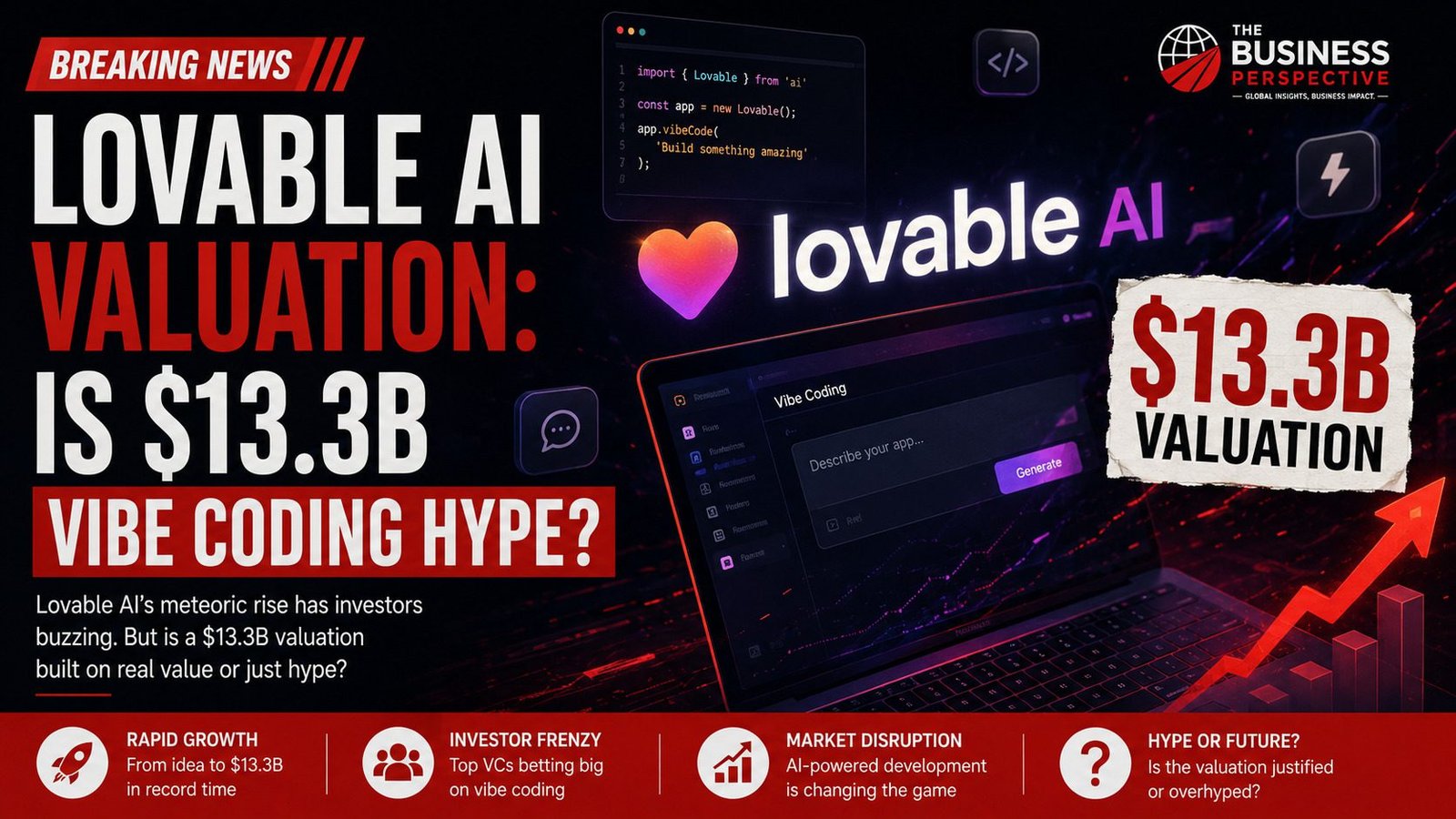
Lovable AI’s valuation hit $13.3 billion after a $400M Series C — double its $6.6B valuation from just 8 months ago.
The company crossed $500M ARR in June 2026 and is on track for $600M by end of August 2026.
Vibe coding is not a fad — 63% of its users are non-developers building real, monetized products.
Developers are not being replaced; they are shifting from syntax writers to AI architects.
For B2B marketers, vibe coding ends the bottleneck of waiting weeks for IT to build campaign tools.
Lovable AI’s $13.3B valuation makes it one of the fastest-growing AI startups in Europe. Image: The Business Perspective
AI StartupsVC FundingAugust 13, 2026By The Business Perspective8 min read
Lovable AI Valuation Hits $13.3B Is Vibe Coding Hype?
Stockholm-based AI startup Lovable just closed a $400 million Series C, pushing its Lovable AI valuation to $13.3 billion — more than double its $6.6 billion valuation from December 2025. In less than eight months, the company’s market value doubled. In less than two years, it crossed $500 million in annual recurring revenue.
The round was co-led by Menlo Ventures and EQT’s Scaleup Europe Fund, with backing from Tencent, Salesforce Ventures, and Balderton Capital. At the center of this story is a concept that is either the future of software — or the most efficiently packaged VC bubble of the decade. That concept is vibe coding.
$13.3B
Lovable AI valuation
$500M
ARR crossed June 2026
60M+
Projects created
900M
Monthly visits to built apps
What Is Vibe Coding?
Vibe coding is a software development approach where users describe what they want in plain English, and AI generates the underlying code. The term was coined by OpenAI co-founder Andrej Karpathy in February 2025. Instead of writing HTML, CSS, or backend logic, users focus on what the software should do — not how to build it.
Before vibe coding, building software required three things: technical fluency, significant capital, and months of time. AI-native platforms like Lovable, Bolt, and Cursor have steadily removed the first two barriers. The Lovable AI valuation is partly a bet that this removal is permanent — and that the company sitting at the center of this shift deserves a market-leading premium.
Lovable was founded in 2023 by Anton Osika and Fabian Hedin. It started as an open-source project called GPT Engineer. By November 2024, the team commercialized it into a product anyone could use. A product manager, a demand generation marketer, a founder with no engineering background — all of them can now ship functional software by describing the “vibe” of what they need.
Vibe coding platforms generate production-ready software from plain English descriptions. Image: The Business Perspective
Is the $13.3B Lovable AI Valuation Justified by Revenue?
The $13.3B Lovable AI valuation is steep at roughly 27x ARR, but it is backed by real revenue metrics. The company crossed $500M ARR in June 2026 and projects $600M by end of August — a pace of revenue growth that very few enterprise software companies have matched at this stage.
When a company doubles its valuation in eight months, skepticism is the right response. But the Lovable AI valuation is not driven purely by narrative — it has a revenue story to match.
Metric
Figure
What It Signals
Series C raise
$400 million
High investor conviction
Lovable AI valuation
$13.3 billion
~27x ARR multiple
Previous valuation (Dec 2025)
$6.6 billion
Doubled in 8 months
ARR (June 2026)
$500M+
Fastest to $500M ARR in AI tools
ARR projection (Aug 2026)
$600M
$100M added in 60 days
Projects created
60 million
Massive product-market fit
Monthly app visits
900 million
Real consumer-facing usage
Fortune 500 penetration
~67% (two-thirds)
Enterprise trust established
The 27x ARR multiple is historically high — but it is not unprecedented for a category-defining AI company in 2026. Per Bessemer Venture Partners’ State of the Cloud 2026 report, the median ARR multiple for top-decile AI-native SaaS companies currently sits between 20x and 35x. Lovable sits in that range, not above it.
“900 million monthly visits to apps built on the platform proves these are not sandbox experiments. They are live, real-world products with users.”
Is Lovable Moving From App Builder to Business Operating System?
Yes. Lovable is actively repositioning itself as all-in-one infrastructure for running a digital business — not just a tool for building apps. The platform now integrates with Stripe, Google Workspace, Microsoft 365, and Salesforce, and has introduced built-in SEO tools and AIUC-1 security certification.
The most important shift in this Series C round is not the dollar figure — it is the strategic pivot. Early vibe coding tools were strong at generating front-end UI. They struggled with backend operations, database security, and payment flows.
Lovable has spent the last six months closing those gaps. The platform now handles Stripe payment routing, enterprise-grade data governance under AIUC-1 certification (the first major security standard for AI-built software), and native integrations with the tools that businesses already run on. Nearly 80% of users on the platform are actively building products they intend to monetize, according to Lovable’s own disclosed metrics.
80% of Lovable users are building products they intend to monetize — shifting vibe coding from experimentation to real business infrastructure. Image: The Business Perspective
Will Vibe Coding Replace Professional Developers?
No. Vibe coding replaces boilerplate execution — not strategic architecture. Developers who adapt by moving from writing syntax to directing AI systems will see their output and earning potential increase, not decrease. The developer role is shifting from “builder” to “director.”
For professional developers, a $13.3 billion AI coding platform feels like a direct threat. If a client can build a custom web application in an afternoon, why hire an agency for three months of development?
The reality is more layered than that framing suggests. The Lovable AI valuation is not a bet against developers — it is a bet that software creation becomes cheaper and faster for everyone, including developers themselves.
Developer Type
Impact of Vibe Coding
Outcome
Basic syntax translators (HTML/CSS templates)
Direct pricing pressure
⚠️ Role commoditized
Full-stack generalists
Speed multiplied 3-5x
✅ Higher output, same team
Architects and system designers
Value increases sharply
✅ Premium pricing justified
Agencies using vibe coding tools
Margin improvement
✅ More projects, less time
An AI can generate a pixel-perfect interface from a prompt. It cannot independently diagnose a client’s revenue bottleneck, design a conversion-optimized user journey, or manage the psychology of enterprise stakeholder buy-in. Those skills — strategy, judgment, communication — are what vibe coding cannot automate.
Lovable’s valuation doubled in 8 months — one of the fastest valuation trajectories in European tech history. Image: The Business Perspective
What Does the Lovable AI Valuation Mean for B2B Marketing?
For B2B demand generation teams, vibe coding eliminates the IT bottleneck. A marketing manager can now build a custom ROI calculator, a lead-capture portal, or an ABM landing page in hours — without a development ticket. This turns content marketing into product-led growth.
Technical bottlenecks have historically been the biggest drag on B2B marketing execution. A performance marketing team with a great campaign idea still had to submit a development request, wait in the IT queue, and watch the news cycle move on before the tool was ready.
Vibe coding breaks that dependency. A B2B marketer can now:
Build a bespoke interactive ROI calculator for a specific enterprise prospect
Launch a logic-based lead qualification assessment tool integrated with their CRM
Deploy a custom ABM landing page personalized to a named account — in hours
Offer functional mini-tools as lead magnets instead of static PDF downloads
This is the shift from content marketing to product-led growth — and it does not require an engineering team to execute. For agencies like ARS B2B Social Bridge, which specializes in B2B demand generation, vibe coding is already changing how client campaigns are scoped and delivered.
B2B teams are using vibe coding to ship campaign tools without IT dependencies — a structural shift in how marketing operates. Image: The Business Perspective
What Do the Skeptics Say About the Lovable AI Valuation?
Critics argue the 27x ARR multiple prices in perfection with no margin for error. Security researchers have flagged that AI-generated code is disproportionately prone to vulnerabilities at scale. And a 2025 METR randomized controlled trial found experienced developers were actually slower when using AI coding tools — without realizing it.
⚠️ The Counterpoint — What Experts Say Differently
Not everyone sees the Lovable AI valuation as justified. Keyhole Software’s Q2 2026 enterprise analysis found that 92% of developers use AI coding tools daily — but only 29% trust the output without review. AI-generated code now makes up the majority of many codebases, which makes governance the defining challenge, not generation. Security firm Veracode’s Spring 2026 GenAI Code Security Report confirmed that AI-generated code carries disproportionately high vulnerability rates compared to human-written code. A fair assessment of vibe coding’s future has to account for both its speed and its security debt.
Related Reading From Our Network
Rise of Startups — Covering the global startup ecosystem, funding rounds, and founder stories
IoT Insights Hub — Deep analysis of AI, blockchain, and emerging technology for enterprise teams
S&R Demand Works — Precision demand generation data and B2B lead intelligence
The Verdict: Is the Lovable AI Valuation Hype or a Paradigm Shift?
Both. The 27x ARR multiple prices in near-perfect execution, which is always a risk. But the underlying technology — vibe coding — is not speculative. With $600M ARR projected, 60 million projects, and two-thirds of the Fortune 500 already inside the platform, Lovable AI has earned a large portion of its valuation. The hype sits in the multiple, not the technology.
The venture capital market is absolutely eager to crown the next generational tech platform, and AI multiples in 2026 are historically elevated. Per Crunchbase Q2 2026 data, top-tier AI companies are raising at 25x-40x ARR multiples — a level last seen during the 2021 SaaS peak.
But the difference between 2021 and 2026 is revenue. In 2021, companies raised at high multiples on growth projections. Lovable is raising at high multiples on $500 million in real, recurring revenue — not projected revenue, not gross merchandise value, not engagement metrics. Actual subscription revenue.
We are entering an era where software is a commodity, not a constraint. For tech professionals, digital agencies, and B2B teams, the most valuable move is not to resist this shift — it is to master directing it. The Lovable AI valuation is a signal. The question is whether your team reads it in time.
The Business Perspective Verdict
The Lovable AI valuation is aggressive but defensible on revenue fundamentals. Vibe coding is a real paradigm shift — not a passing trend. The risk is multiple compression if growth slows. The opportunity is that this is still the earliest stage of software becoming a commodity. Professionals who adapt now will be the ones directing the systems that everyone else is using in 2027.
Frequently Asked Questions
What is Lovable AI and why is its valuation $13.3 billion?
Lovable AI is a Stockholm-based AI app builder founded in 2023. It lets non-developers create software using plain English descriptions. Its $13.3B valuation reflects $500M+ in ARR, 60 million projects created, and adoption inside roughly two-thirds of the Fortune 500 — all within two years of commercial launch.
What exactly is vibe coding?
Vibe coding is a software development approach where users describe what they want in natural language and AI generates the code. The term was coined by OpenAI co-founder Andrej Karpathy in February 2025. It removes the need for technical fluency from the software creation process.
Is Lovable AI’s $13.3 billion valuation a VC bubble?
The valuation is steep at roughly 27x ARR, but it is backed by real revenue — $500M ARR crossed in June 2026, with projections of $600M by end of August 2026. The 27x multiple is elevated but within the range for top-decile AI SaaS companies per Bessemer Venture Partners’ 2026 Cloud State report.
Will vibe coding replace professional developers?
No. Vibe coding replaces boilerplate execution, not strategic architecture. Developers who move from writing syntax to directing AI systems and managing complex integrations will see their value increase. Agencies already using vibe coding tools report 3-5x output improvement per developer.
Who are Lovable AI’s main investors in the Series C?
Lovable’s $400M Series C was co-led by Menlo Ventures and EQT’s Scaleup Europe Fund, with participation from Tencent, Salesforce Ventures, and Balderton Capital. The round pushed Lovable’s valuation from $6.6B to $13.3B.
How does vibe coding affect B2B marketing teams?
Vibe coding eliminates the IT bottleneck for marketing. B2B teams can now build ROI calculators, lead qualification tools, and ABM landing pages in hours — without development tickets or engineering resources. It shifts marketing from content creation to product-led growth execution.
AI App Builder
AI Startups 2026
AI Tools
Generative AI Business
Lovable AI
AI agent startup funding September 2026 reached a new quarterly record — 56 tracked rounds worth approximately $5.25 billion in Q3 alone, as autonomous agent companies attracted capital from sovereign wealth funds, crossover investors, and traditional venture firms simultaneously for the first time. The Business Perspective tracks AI agent startup funding September 2026 and every...
Cognition $2 billion funding closed in September 2026 at a $48 billion valuation — making it one of the most aggressively priced AI coding companies ever backed by institutional capital, with no publicly disclosed revenue to anchor the number. The Business Perspective breaks down what the Cognition $2 billion funding round actually signals about where...
Global startup funding September 2026 produced some of the most structurally significant rounds of the year — from Harvey’s $550M legal AI raise to Cognition’s $2B round at a $48 billion valuation and Nvidia’s $12.9 billion acquisition of Hugging Face in the first eight days of the month alone. The Business Perspective tracks global startup...










One thought on “Lovable AI Valuation Hits $13.3B Is Vibe Coding Hype?”
Comments are closed.