Breaking NewsThe Business Perspective · 10 August 2026 · 7 min read
Key Takeaways
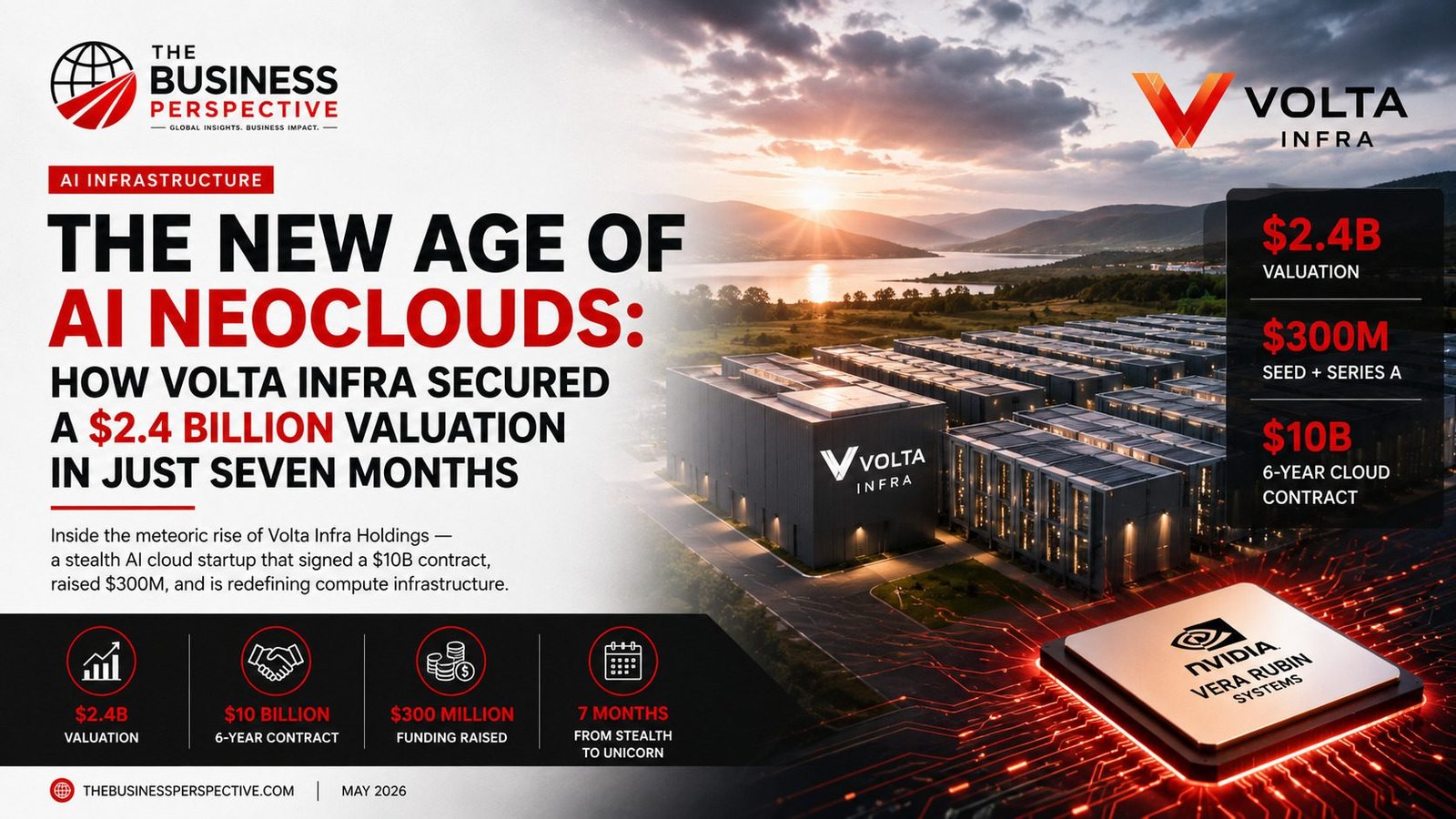
Speed: The Volta Infra AI neocloud reached a $2.4 billion valuation just seven months after founding — before a single live data center was operational at scale.
Funding: $300 million raised in seed and Series A, co-led by a16z and Altimeter Capital, with Nvidia and Michael Dell as strategic investors.
Contract: A reported $10 billion, six-year cloud-computing agreement — reportedly with Anthropic, per Bloomberg and The Times — is the anchor deal.
Infrastructure: 133MW Norway data center via Bitdeer Technologies; 1GW+ pipeline across Europe and North America; multi-gigawatt target by 2030.
Risk: Critics flag “circular financing” concerns — Nvidia simultaneously supplies chips and backs the Volta Infra AI neocloud buying them.
Table of Contents
The Volta Infra AI neocloud did not publicly exist twelve months ago. Today it carries a $2.4 billion valuation, a $300 million funding round, and what is reportedly a $10 billion customer contract. Volta Infra Holdings Ltd., founded just seven months ago, is the latest — and most dramatic — example of capital flooding into AI infrastructure at a pace that would have been unthinkable three years ago.
The Business Perspective breaks down what the Volta Infra AI neocloud actually built, who is backing it, what the risks are, and why this deal matters for every founder watching the AI infrastructure market in 2026.
What is Volta Infra AI neocloud and who founded it?
Direct answer: Volta Infra is an AI neocloud — a GPU-focused cloud infrastructure company — founded in 2026 by Ricard Boada and Sofia Gumuzio, both former executives at Brookfield Asset Management’s infrastructure division. The Volta Infra AI neocloud combines infrastructure project finance expertise with GPU compute supply to serve frontier AI laboratories at scale.
The term neocloud describes GPU-focused cloud providers that rent specialised AI compute hardware directly to developers and AI labs. Unlike traditional hyperscalers — Amazon Web Services, Microsoft Azure, Google Cloud — a neocloud focuses exclusively on AI workloads and competes primarily on raw compute access and power availability. The Volta Infra AI neocloud enters this market with a sharply differentiated pitch: infrastructure project finance skills, not just technology.
Ricard Boada, now CEO, and Sofia Gumuzio both spent years at Brookfield financing large physical infrastructure projects — power plants, pipelines, and real assets at scale. That background is the core pitch. As Boada told investors, the team “saw a massive opportunity and a massive gap in the market” where traditional project finance expertise was entirely absent from AI infrastructure development.
Building a modern AI data center is no longer just about buying servers. It requires complex power contracts, project-level debt financing, and banking relationships capable of backing billion-dollar builds. The Volta Infra AI neocloud’s argument is that most competitors in this space are run by technologists who lack those skills — and the gap is costing AI labs real capacity.
Who funded Volta Infra and why did a16z invest?
Direct answer: The Volta Infra AI neocloud raised $300 million across seed and Series A, co-led by Andreessen Horowitz (a16z) and Altimeter Capital, alongside asset manager Azora. Nvidia and Michael Dell also joined as strategic investors. A16z managing partner Raghu Raghuram said the firm backed Volta because of the founders’ track record in project finance and power procurement — areas where most AI neocloud startups are weak.
The investor list is significant. Andreessen Horowitz had previously avoided data-center startups and neoclouds entirely — a major shift for one of Silicon Valley’s most prominent AI investment firms. Raghu Raghuram stated that a16z was ultimately won over by the Volta Infra founders’ track record in securing electrical power and structuring large-scale infrastructure finance. He emphasised that long-term success in this arena would require mastering “the financial complexities of building and operating new clouds.”
Investor
Role
Strategic value
Andreessen Horowitz (a16z)
Co-lead, Series A
VC credibility; AI portfolio network
Altimeter Capital
Co-lead, Series A
Public/private tech investing; AI infrastructure thesis
Azora
Investor + $5B financing arranger
Asset management; arranged the $5B financing pool
Nvidia
Strategic investor
Hardware supply; Vera Rubin chip access
Michael Dell
Strategic investor
Dell hardware supply for data center sites
For founders tracking how AI startup funding works in 2026, The Business Perspective has a complete guide on how to raise seed funding and what investors look for at each stage. The Volta Infra AI neocloud deal is the extreme end of the spectrum — but the same investor logic applies at every scale.
What is the $10 billion contract — and who is the client?
Direct answer: The Volta Infra AI neocloud has signed a six-year cloud-computing contract valued at $10 billion. Volta declined to name the client, describing them only as a “leading AI developer.” Bloomberg and The Times identified the client as Anthropic. Anthropic declined to comment, and Reuters noted it could not independently verify the report.
The $10 billion figure is the total contract value across six years — not revenue already collected. The Volta Infra AI neocloud must still build the infrastructure, secure the power, install the chips, and operate the facilities reliably before recognising that revenue. The distinction matters: a $10 billion promise and $10 billion of built, operational capacity are very different things.
The reported client, Anthropic, has a history of similar compute supply agreements. Per prior reporting, Anthropic has signed computing and investment deals with SpaceX, AMD, Microsoft, Nvidia, Alphabet, Amazon, and Micron Technology. The Volta Infra agreement, if confirmed, fits a deliberate strategy to diversify compute sources away from traditional hyperscalers.
⚠ Source note
The identification of Anthropic as the $10 billion contract client comes from Bloomberg and The Times. Volta Infra declined to name the client. Anthropic declined to comment. Reuters has not independently verified the report. The Business Perspective reports this as a widely cited but unconfirmed identification.
This deal signals a structural shift in how frontier AI labs secure compute. Labs are no longer solely dependent on Amazon, Microsoft, and Google. Instead, they are locking in multi-year agreements with newly created infrastructure companies — like the Volta Infra AI neocloud — to guarantee electrical power and GPU capacity years in advance. In 2026, compute availability is the primary constraint on AI development, and labs are racing to lock it down before competitors do.
For a broader view of how startups are navigating the AI funding environment, Rise of Startups covers the neocloud and AI infrastructure space alongside startup ecosystem news across global markets.
What is the Norway data center — and why Bitdeer?
Direct answer: The Volta Infra AI neocloud’s first operational project is a 133-megawatt data center in Norway, built in partnership with Bitdeer Technologies — a cryptocurrency mining company turned data-center operator. The site runs on Nvidia’s upcoming Vera Rubin GPU systems and renewable hydroelectric power. It is the first of a stated 1GW+ pipeline across Europe and North America.
The Bitdeer partnership reflects a wider trend: Bitcoin miners are becoming AI landlords. Mining companies own ready-built physical sites with power infrastructure already in place. As mining profitability has compressed, many are pivoting to rent that capacity to AI companies — who pay significantly more per megawatt. For the Volta Infra AI neocloud, Bitdeer provides the “borrowed ground” needed to begin delivering capacity immediately without a years-long site development cycle.
Norway is a smart location. Abundant renewable hydroelectric power, cold ambient temperatures that reduce cooling costs, and political stability make it a prime site for energy-intensive AI workloads. The global AI infrastructure buildout is not exclusively American — Europe is actively competing for the capacity that frontier AI labs will need through the end of this decade.
Site / Region
Capacity
Status
Partner
Norway
133 MW
First project — announced
Bitdeer Technologies
Texas, USA
TBD
Planned — 2030 target
TBA
Wyoming, USA
TBD
Planned — 2030 target
TBA
Europe + North America (pipeline)
1GW+ claimed
Near-term pipeline
Various
What is the $5 billion AI infrastructure financing pool?
Direct answer: Separately from its $300 million equity raise, the Volta Infra AI neocloud launched a $5 billion AI infrastructure financing program arranged by Azora. The pool draws from a mix of banks and is designed to finance Volta’s own data center builds while also helping smaller AI labs afford expensive GPU hardware — making Volta both a lender and an infrastructure builder simultaneously.
The founders’ argument is direct: only the largest tech companies — Meta, Google, Microsoft — can currently afford the upfront cost of cutting-edge GPU clusters. Every other AI lab faces a financing gap that prevents them from staying competitive. The Volta Infra AI neocloud wants to bridge that gap by bankrolling customers’ hardware access through the $5 billion pool, funding what the founders call “AI factories.”
Michael Dell’s participation adds a further dimension. Dell Technologies will act as a hardware supply partner, providing equipment for Volta’s data center sites — giving the Volta Infra AI neocloud a direct line to server and rack supply at a time when hardware lead times remain long across the industry.
What is circular financing in AI — and why do critics care?
Direct answer: Circular financing occurs when a hardware supplier — like Nvidia — simultaneously invests in or finances the very startups buying its products. In the case of the Volta Infra AI neocloud, Nvidia is both a chip supplier and an equity investor. Critics argue this creates an interconnected web where losses amplify across the ecosystem if AI demand slows. Nvidia has invested over $40 billion in AI equity deals in 2026 alone.
The concern is structural. In a scenario where AI revenue growth disappoints, circular financing means that Nvidia’s chip sales, its equity bets, and the debt of the companies it backed all deteriorate simultaneously. The risk is correlated — not diversified — across the entire stack. The Volta Infra AI neocloud is one of many companies caught in this web, alongside competitors backed by Apollo, Blackstone, and Broadcom.
For a broader read on how AI and IoT infrastructure companies are managing capital dynamics in 2026, IoT Insights Hub publishes deep analysis on digital infrastructure financing, cloud spending trends, and AI hardware procurement across global markets.
What some experts say differently about the Volta Infra AI neocloud deal
A different view. Not everyone sees the Volta Infra AI neocloud’s emergence as straightforwardly positive. Jamin Ball of Altimeter Capital — himself a Volta investor — warned publicly: “There’s going to be so many dead bodies and so much consolidation eventually.” That candid statement from someone inside the deal shows that even bulls on AI infrastructure acknowledge the space is dangerously overcrowded.
The bearish case rests on a simple point: the $10 billion contract is a promise, not revenue. The Volta Infra AI neocloud must still secure power at scale across multiple jurisdictions, install next-generation chips, and operate complex infrastructure reliably for six years — without the balance-sheet history that most counterparties would normally require from an infrastructure operator of this claimed scale.
Industry observers also note that GPU supply is tight now — but markets correct. When supply catches up to demand, the pricing power that makes the Volta Infra AI neocloud model viable will compress. Volta is betting that blue-chip partnerships and project finance expertise will keep it profitable when the market matures. A reasonable bet — but still a bet.
The Business Perspective does not take a position on whether the Volta Infra AI neocloud will succeed. What this deal clearly demonstrates is that the market is treating AI infrastructure finance as a category worth enormous capital — and that founders with project finance backgrounds are now as valuable to AI companies as engineers with ML expertise.
The Business Perspective Take: Volta Infra AI Neocloud — August 2026
What makes this real: The founders’ Brookfield infrastructure background is a genuine differentiator. Securing power contracts and project finance are skills the AI neocloud market actually lacks — and a16z backing Volta after previously avoiding the space is a meaningful signal.
What to watch: Whether the Norway site delivers on schedule and whether the reported Anthropic contract holds. A delay or cancellation at this scale would be significant for the entire Volta Infra AI neocloud thesis.
The bigger story: Volta Infra proves that in 2026, AI infrastructure finance is as important as AI research itself. The companies that can build, power, and fund the physical stack for AI will be as valuable as the models running on it.
Frequently asked questions — Volta Infra AI neocloud
What is Volta Infra AI neocloud?
Volta Infra is an AI neocloud — a GPU-focused cloud infrastructure startup founded in 2026 by Ricard Boada and Sofia Gumuzio, former executives at Brookfield Asset Management. The Volta Infra AI neocloud reached a $2.4 billion valuation in seven months by securing $300 million in funding and a reported $10 billion cloud-computing contract. The Business Perspective tracks the neocloud sector as part of its Startups & Venture Capital coverage.
Who invested in Volta Infra?
The Volta Infra AI neocloud’s $300 million seed and Series A round was co-led by Andreessen Horowitz (a16z) and Altimeter Capital, alongside asset manager Azora. Nvidia and Michael Dell also participated as strategic investors. Dell Technologies will supply hardware to Volta’s data center sites as part of the arrangement.
Who is Volta Infra’s $10 billion contract with?
Volta Infra declined to name the client, describing them only as a “leading AI developer.” Bloomberg and The Times identified the client as Anthropic. Anthropic declined to comment and Reuters noted it could not independently verify the identification. The contract covers six years of cloud-computing capacity from the Volta Infra AI neocloud.
What is a neocloud?
A neocloud is a GPU-focused cloud provider that rents specialised AI compute hardware to developers and AI labs. Unlike traditional hyperscalers — AWS, Azure, Google Cloud — an AI neocloud focuses exclusively on AI workloads, competing primarily on power capacity and GPU availability. Volta Infra is among the largest AI neocloud companies to emerge in 2026.
What is circular financing in AI infrastructure?
Circular financing refers to arrangements where hardware suppliers — most notably Nvidia — invest in or financially back the very companies buying their chips. In the Volta Infra AI neocloud deal, Nvidia is simultaneously a chip supplier and an equity investor. Critics argue this creates correlated risk: if AI demand falls, losses amplify across the entire interconnected ecosystem at once.
Where is Volta Infra’s first data center?
The Volta Infra AI neocloud’s first project is a 133-megawatt data center in Norway, operated in partnership with Bitdeer Technologies — a cryptocurrency mining company pivoting to AI data-center operations. The Norway site will run on Nvidia’s upcoming Vera Rubin GPU systems and is powered by renewable hydroelectric energy.
How does Volta Infra’s $5 billion financing pool work?
The $5 billion pool, arranged by Azora from a mix of banks, finances the Volta Infra AI neocloud’s own data center builds and helps smaller AI companies afford expensive GPU hardware. Rather than only renting compute capacity, Volta also acts as a lender — bankrolling customers’ hardware access to keep smaller AI labs competitive against better-capitalised players like Google and Microsoft.
Alexander Sterling is a business journalist and financial analyst
covering startup funding, venture capital, and AI investment trends.
He tracks the deals, valuations, and founder stories shaping the
global business landscape in 2026.
Nscale funding $3.36B via a pre-IPO convertible note is one of the most structurally unusual AI infrastructure raises of 2026 — a round designed not just to fund growth but to position the company for a public market debut on terms most founders have never seen. The Business Perspective breaks down exactly how Nscale funding...
⚡ Key Takeaways $400M Series E — Island closed a $400 million round in September 2026, per a Reuters filing dated September 24. $6.4B valuation — The round values Island at $6.4 billion post-money, up from a $3B valuation in its 2023 Series C. The problem it solves — Consumer browsers give enterprises zero visibility...
VC Strategy • Series A Analysis Key Takeaways Series A funding trends 2026 show the practical ARR floor for competitive B2B SaaS processes now sits at $2.5M–$3.5M — the old $1M benchmark that worked in 2021 now gets you labelled a seed extension. Median Series A raise sizes run $13M–$20M, with post-money valuations clustering near...