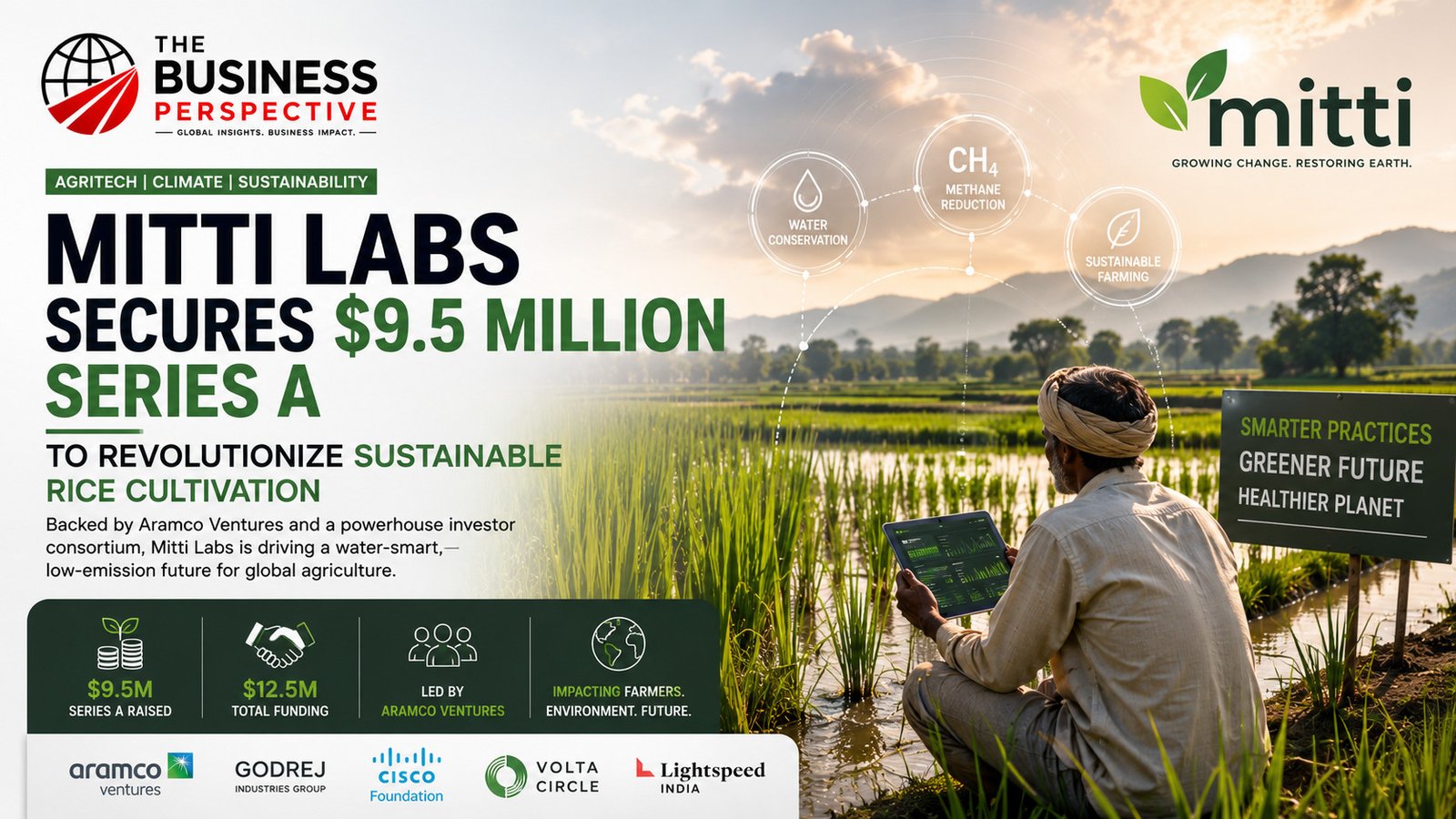
- Mitti Labs Series A closed at $9.5M, led by Aramco Ventures — total funding now $12.5M.
- The startup’s Alternate Wetting and Drying (AWD) method cuts rice paddy methane by 30–50% and water use by 15–30%.
- Rice farming causes 10–12% of all human-caused methane globally — a bigger climate problem than most realise.
- Funds will expand operations in India and launch projects in the Philippines and Indonesia.
- The investor mix — energy giant, tech philanthropy, Indian conglomerate, and VC — signals agritech has become a mainstream climate investment category.
Mitti Labs Series A: Bold $9.5M Bet on Rice Farming
An Indian agritech startup just secured serious backing from Aramco Ventures to scale a farming technique that could become one of agriculture’s most important climate levers.
What Is Mitti Labs and What Did It Just Raise?
Mitti Labs Series A raised $9.5 million led by Aramco Ventures — the corporate venturing arm of global energy company Aramco. Founded in 2023 and already past $12.5 million in total funding, Mitti Labs is an Indian agritech startup built around one specific, high-impact problem: rice farming is one of the largest methane-emitting land uses on Earth, and almost nobody has built a scalable system to fix it.
The three founders — Xavi Laguarta Soler, Devdut Dalal, and Nate Torbick — started from a clear thesis: the practice that makes rice paddies so environmentally damaging (continuous flooding) has a well-understood alternative. The problem was never the science. The problem was adoption. Smallholder farmers have no economic reason to change a method that has always worked, and no support infrastructure to help them do it safely. Mitti Labs built both.
Going from founding to a substantial Series A in roughly 12 months reflects the urgency of the problem and the quality of early execution. The Mitti Labs Series A is not a pre-product bet — it is institutional capital following demonstrated traction.
For founders thinking about how to structure early funding before a round like this, read: SAFE Note vs Convertible Note: 2026 Founder Guide.
Who Invested and Why Does the Mix Matter?
The investor composition in the Mitti Labs Series A tells you something beyond the headline number. Each participant brings a distinct, non-overlapping strategic reason to back this company — and that kind of multi-stakeholder alignment is a different quality of institutional support than a round where five generalist VCs write cheques.
| Investor | Type | Strategic Interest |
|---|---|---|
| Aramco Ventures | Corporate VC (Lead) | Verified methane reduction assets; carbon portfolio diversification beyond energy sector |
| Godrej Industries Group | Indian conglomerate | Agricultural supply chain access; farmer networks across India; rural market intelligence |
| Cisco Foundation | Tech philanthropy | Digital infrastructure in emerging markets; data and connectivity for remote MRV systems |
| Volta Circle | Climate-focused VC | Climate tech portfolio; follow-on capital access |
| Lightspeed India | Returning investor | Proof of execution: returning at Series A means early milestones were met |
Lightspeed India coming back is perhaps the clearest signal in this round. Returning investors do not increase exposure because the narrative sounds compelling. They do it because the numbers showed up between seed and Series A. That Lightspeed India re-entered at this stage indicates the Mitti Labs team delivered against whatever targets it set at inception.
Aramco Ventures leading the Mitti Labs Series A also deserves separate attention. An energy major backing a rice farming startup looks counterintuitive on the surface. It makes complete sense when you understand that corporate carbon strategies are now scrutinised at a level that makes verified agricultural methane reduction a genuine balance-sheet asset — not just a PR footnote.
If you are building in climate tech and working on how to frame your pitch for corporate VCs, see: Startup Pitch Deck Template: What Investors Want to See.
Why Is Rice Farming a Climate Problem?
Rice is the world’s most consumed grain. According to the UN Food and Agriculture Organization (FAO), rice feeds more than half the global population and is cultivated across roughly 165 million hectares of farmland. It is not going away — which is precisely what makes its environmental footprint so difficult to address.
The mechanics are straightforward. Farmers flood their paddies throughout the growing season, primarily because standing water suppresses weeds effectively. Under those flooded conditions, the soil becomes anaerobic. Methanogenic bacteria decompose organic matter and release methane (CH₄) as a byproduct — a process that runs continuously as long as the paddy stays flooded.
Per the IPCC Sixth Assessment Report, methane is over 80 times more potent than CO₂ as a greenhouse gas over a 20-year period. Global rice cultivation accounts for approximately 10–12% of all human-caused methane emissions, per estimates from the Environmental Defense Fund and peer-reviewed research in Nature Food. That puts paddy rice in the same emissions conversation as livestock operations, landfills, and natural gas infrastructure.
How Does Alternate Wetting and Drying Work?
Alternate Wetting and Drying (AWD) is not a new concept in agricultural science. Research from the International Rice Research Institute (IRRI) has documented AWD’s benefits for over two decades. What Mitti Labs built is the repeatable, technology-backed system that makes AWD practical for smallholder farmers who have every rational reason to stick with what they know.
The AWD cycle works as follows:
The paddy is flooded to standard depth to establish the crop and suppress early weed growth.
Water recedes through evaporation and percolation. The field becomes moist but does not crack or dry out completely.
Farmers use a low-cost perforated PVC pipe inserted into the soil to check subsurface water level. No guesswork — one visual check per day.
Once water drops to a scientifically determined threshold (typically 15cm below surface), the field is re-flooded. This cycle repeats throughout the vegetative stage.
Each drying phase reintroduces oxygen into the soil matrix. Oxygen breaks the anaerobic conditions methanogenic bacteria need — effectively pausing methane production for the duration of the dry period. Per studies in Global Change Biology and Nature Food, consistent AWD implementation reduces methane emissions by 30–50% and water use by 15–30%, with no measurable yield loss when correctly implemented.
An additional benefit: rice plants pushed to search for water during dry phases develop deeper, more robust root systems. This improves crop resilience to lodging (falling over during storms) — a real operational benefit in typhoon-exposed regions like the Philippines.
Mitti Labs’ specific contribution is the infrastructure layer above the practice: farmer training, Measurement, Reporting, and Verification (MRV) systems that produce verifiable impact data, and a pathway to connect that verified data to carbon markets — turning a good farming practice into a financially sustainable one for smallholders.
For context on how early-stage startups build funding momentum before rounds like the Mitti Labs Series A, see: How to Raise Seed Funding: 10 Proven Steps Every Founder Needs.
Where Is Mitti Labs Expanding Next?
The $9.5M from the Mitti Labs Series A will primarily fund two strategic moves: deeper India coverage and greenfield launches in Southeast Asia.
India — Deepening Coverage
India is the world’s second-largest rice producer. States like Punjab, Haryana, West Bengal, and Andhra Pradesh contribute enormous volumes to domestic consumption and global rice markets. They also sit on some of Asia’s most severely depleted aquifers — the direct consequence of decades of groundwater-intensive paddy cultivation.
The plan is to expand into additional agricultural states, build partnerships with farmer cooperatives, and refine the deployment model across different micro-climates and soil types. The goal is scale that produces statistically meaningful environmental data — the kind that withstands scrutiny in carbon markets and government reporting frameworks.
Philippines and Indonesia — Greenfield Launch
The Philippines produces roughly 19 million tonnes of paddy rice annually, per the Philippine Statistics Authority (PSA, 2025). The country is also among the world’s most climate-vulnerable nations, where increasingly intense typhoon seasons are already disrupting agricultural calendars. AWD’s water conservation and crop-resilience benefits are especially relevant here.
Indonesia, as the world’s third-largest rice producer per FAO data, presents a similarly high-stakes market. The country’s agricultural sector directly employs around 27% of the working population. Any intervention that reduces input costs and improves crop resilience without disrupting yield has immediate economic relevance to millions of farming households.
For a parallel look at rapid multi-market scaling in a different sector, see: Volta Infra: $2.4B AI Neocloud Valued in 7 Months.
What Some Experts Question About AWD at Scale
Not all researchers are fully convinced that AWD scales smoothly from controlled trials to real-world smallholder farming. Some agronomists at the International Rice Research Institute (IRRI) note that AWD’s methane reduction benefits vary significantly by soil type, climate zone, and local water management infrastructure. In areas where farmers share irrigation channels rather than controlling individual field water levels, implementing precise dry-wet cycles becomes logistically complex. Critics also flag that carbon credit verification in fragmented smallholder settings is expensive and methodologically challenging — raising questions about whether the carbon revenue model that underpins Mitti Labs’ farmer incentive structure will hold at the scale needed to be financially self-sustaining.
These are real challenges. Mitti Labs’ ability to build robust MRV systems that work in fragmented, low-connectivity rural environments will be the defining test of whether the model survives contact with full-scale deployment. The Mitti Labs Series A capital gives it the runway to find out.
The Business Angle: Why This Funding Round Is Different
Most climate tech funding rounds at Series A follow a familiar pattern: plausible thesis, early pilots, credentialed team, institutional lead. The Mitti Labs Series A has all of those — but the structural difference is what each investor actually needs from this company to succeed.
Aramco needs verified methane reduction assets as carbon reporting requirements tighten globally. Godrej needs supply-chain-ready sustainable agriculture partners at scale in India. Cisco wants scalable digital infrastructure opportunities in emerging markets. Lightspeed wants financial returns. That kind of multi-stakeholder alignment — where each party has a distinct strategic reason beyond financial returns to see the company succeed — is a different quality of institutional backing.
For founders watching the climate tech funding landscape: the Mitti Labs Series A suggests agriculture is no longer a second-tier vertical for institutional investors. The combination of water scarcity, methane regulation pressure, and carbon market development has moved sustainable rice farming from a development sector story to a mainstream investment category.
Frequently Asked Questions
What is the Mitti Labs Series A funding amount?
The Mitti Labs Series A raised $9.5 million, led by Aramco Ventures. Other investors include Godrej Industries Group, Cisco Foundation, Volta Circle, and returning investor Lightspeed India. Total funding now stands at $12.5 million.
What is Alternate Wetting and Drying (AWD)?
AWD is a water management method where rice paddies periodically dry out rather than staying continuously flooded. The drying phases reintroduce oxygen into the soil, halting methane production. AWD cuts methane emissions by 30–50% and water use by 15–30% with no yield loss when properly implemented.
Why does rice farming produce so much methane?
Flooded paddies create oxygen-free (anaerobic) soil conditions. Methanogenic bacteria break down organic matter under those conditions and release methane. Per IPCC AR6, methane is over 80 times more potent than CO₂ over a 20-year period. Rice farming accounts for 10–12% of all human-caused methane emissions globally.
Which countries is Mitti Labs expanding to after its Series A?
Following the Mitti Labs Series A, the company is deepening operations across India and launching greenfield projects in the Philippines and Indonesia — three of Asia’s most significant rice-producing nations.
Who founded Mitti Labs?
Mitti Labs was founded in 2023 by Xavi Laguarta Soler, Devdut Dalal, and Nate Torbick. They built a technology-backed AWD adoption platform designed to make sustainable rice farming practical and financially viable for smallholder farmers.
Why did Aramco Ventures lead the Mitti Labs Series A?
Aramco Ventures has a strategic interest in building a portfolio of verified emission-reduction assets as global carbon reporting requirements tighten. A scalable agricultural methane reduction platform with verifiable MRV data fits naturally into a corporate VC portfolio looking to diversify its climate holdings beyond energy-sector plays.
The Bottom Line
The Mitti Labs Series A is a data point worth watching. A startup less than two years old, working on rice paddy water management, has raised $9.5 million from one of the world’s largest energy companies, an Indian industrial giant, a Silicon Valley tech philanthropist, and a returning VC — all in the same round.
That combination does not assemble around a niche idea. It assembles around a problem that is simultaneously a food security issue, a water crisis, a methane emissions challenge, and a carbon market opportunity. Mitti Labs sits at the intersection of all four.
Whether the company can execute AWD adoption at scale and make the carbon revenue model work in fragmented smallholder settings are the real tests ahead. The Series A gives it the runway to find out. The Business Perspective will be watching.