Breaking
The Business Perspective Editorial Team
August 15, 2026 · 7 min read · Technology & AI
⚡ Key Takeaways
- OpenAI Revenue 2026 hit $25B annualized — the fastest revenue growth in corporate history, per Epoch AI
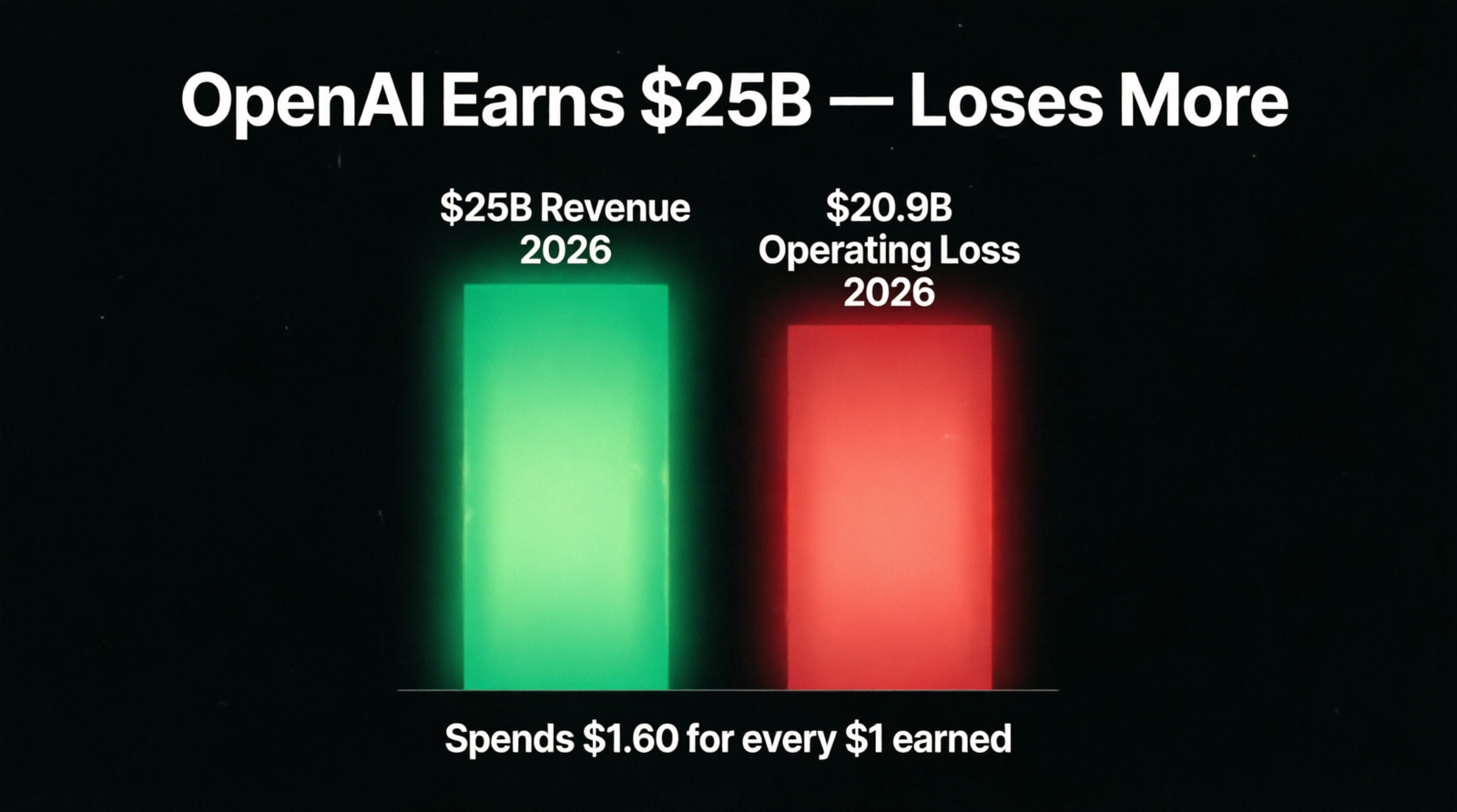
- OpenAI still loses $1.60 for every $1 it earns — posting a $20.92B operating loss in 2025 alone
- ChatGPT subscriptions drive 68% of revenue; enterprise now accounts for 40%+ and is growing fast
- OpenAI filed a confidential S-1 in June 2026 targeting a $1 trillion IPO valuation — delayed to 2027
- Anthropic now surpasses OpenAI on private valuation ($965B vs $852B) and wins ~70% of new enterprise deals

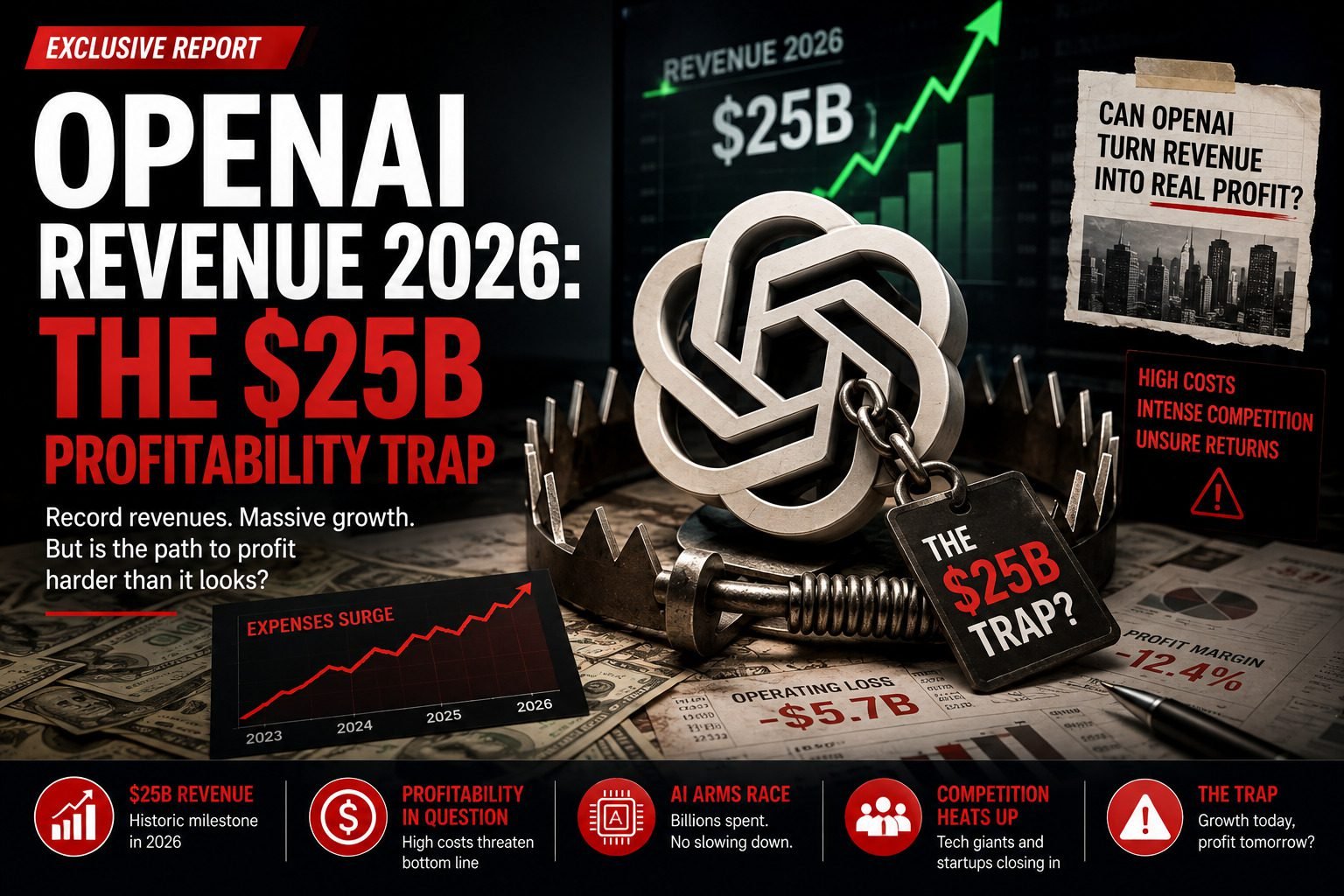
OpenAI Revenue 2026: $25B in the bank, billions more in losses. Source: The Business Perspective
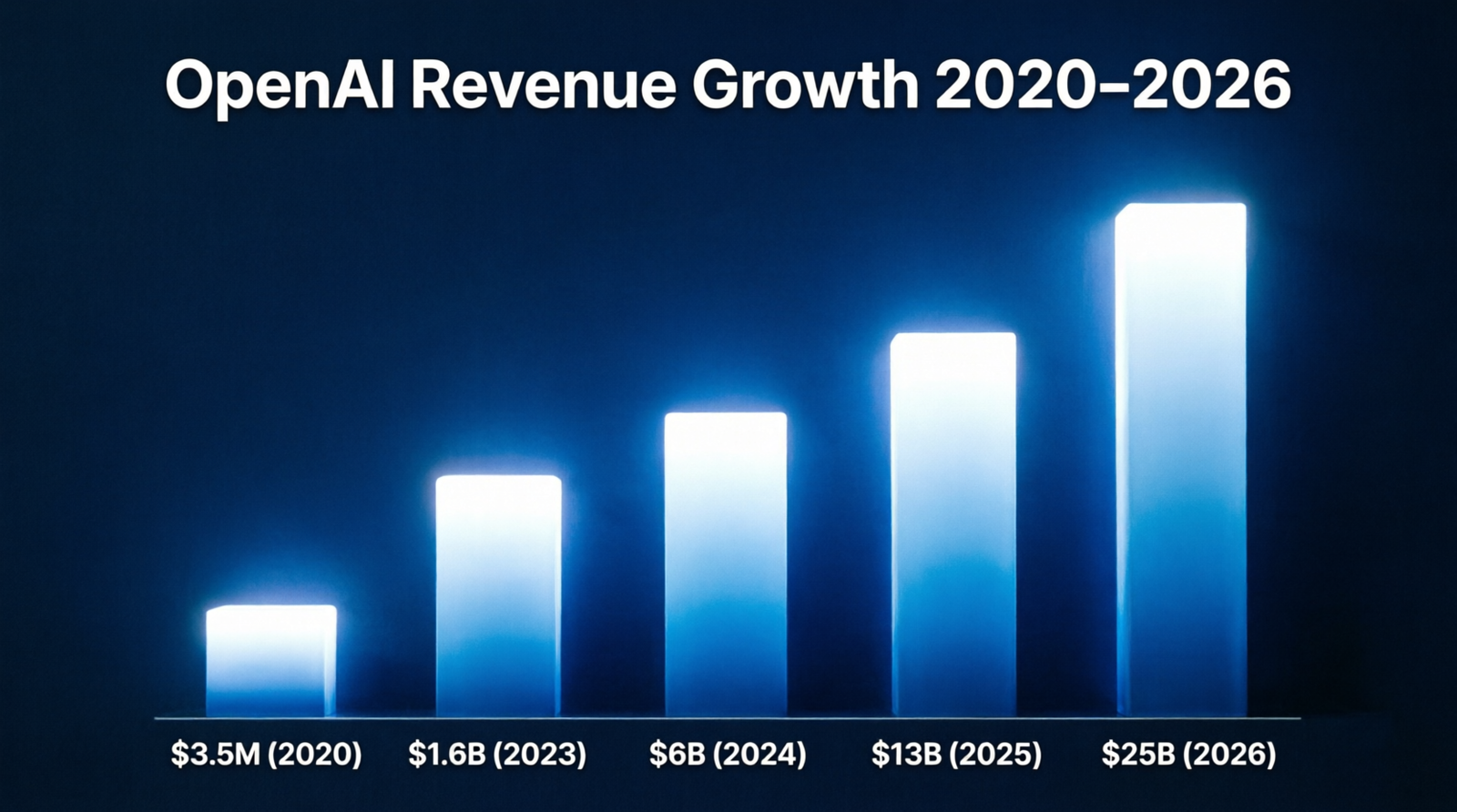
OpenAI Revenue 2026 tells one of the most paradoxical stories in business history. The company grew from $3.5 million in 2020 to $25 billion annualized in 2026 — a 3,600x increase in six years that no technology company has ever matched, according to Epoch AI. And yet, it has never made a single dollar of sustainable profit.
The OpenAI Revenue 2026 figures confirm this is the fastest-scaling revenue story in corporate history. But scale without margin is a trap — and that is exactly where OpenAI sits right now. The Business Perspective breaks down every number: the growth, the losses, the IPO plan, and who is quietly beating OpenAI in the market that matters most.
What Is OpenAI Revenue 2026?
OpenAI Revenue 2026 reached approximately $25 billion annualized by Q1 2026, up from $13.07 billion in full-year 2025 and $6 billion in 2024. Q1 2026 alone generated $5.7 billion — putting the full-year 2026 projection at $30 billion or more, per Reuters and The Information.
These four numbers define the OpenAI Revenue 2026 story better than any headline can:
$25B
Annualized Revenue
Q1 2026
$5.7B
Q1 2026
Revenue Alone
900M
Weekly Active
ChatGPT Users
9M+
Paying Business
Customers
| Year | OpenAI Revenue | Growth vs Prior Year | Key Driver |
|---|
| 2020 | $3.5M | — | Early API access |
| 2022 | $300M | +8,471% | GPT-3 API launch |
| 2023 | $1.6B | +433% | ChatGPT Plus launch |
| 2024 | $6B | +275% | Enterprise expansion |
| 2025 | $13.07B | +118% | GPT-4o, team plans |
| 2026 (annualized) | $25B+ | +91% | Enterprise + API scale |
Sources: Reuters, The Information, Epoch AI, Financial Times, CNBC — based on investor disclosures and CFO statements
How Did OpenAI Grow Revenue So Fast?
OpenAI Revenue 2026 growth happened across three simultaneous fronts — consumer scale, enterprise adoption, and API infrastructure — all accelerating at the same time.
First, ChatGPT became a consumer habit. The product crossed 1 billion monthly active users in June 2026, per Reuters citing Sensor Tower — becoming the fastest consumer application to reach that scale in history. Daily query volume from US users alone hit 330 million, per OpenAI’s own published research data.
Second, enterprise adoption accelerated sharply. 92% of Fortune 500 companies use ChatGPT as of 2026, per OpenAI. Enterprise now contributes over 40% of total OpenAI Revenue 2026, up from a significantly smaller share in 2024. Over 9,000 organisations are each processing more than 10 billion API tokens, per mid-2026 enterprise reporting.
Third, the API became infrastructure. OpenAI’s API processed 15 billion tokens per minute by March 2026 — a 50x increase in under three years — as developers embedded GPT models into applications, agents, and automated workflows across every industry sector.
How Does OpenAI Make Money in 2026?
OpenAI Revenue 2026 comes from three main streams — and the composition has shifted significantly from where it was just 12 months ago. Subscriptions still dominate, but enterprise and emerging ad revenue are changing the picture fast.
| Revenue Stream | Share of Revenue | Annualized Value | Notes |
|---|
| ChatGPT Subscriptions | 68% | ~$17B | Plus ($20/mo), Pro ($200/mo), Team, Enterprise |
| API Access | 26% | ~$6.5B | Developer and enterprise API usage |
| Ads + Sora + Other | 6% | ~$1.5B | Ads pilot hit $100M ARR in 6 weeks |
Source: Feedough analysis citing OpenAI mid-2026 revenue breakdown data
The advertising layer is the most important new variable in the OpenAI Revenue 2026 story. OpenAI launched a self-serve ads pilot within ChatGPT in early 2026. That pilot reached $100 million in ARR in under six weeks — a new revenue stream that did not exist at the start of 2026. If scaled across 900 million weekly users, advertising could fundamentally change OpenAI’s margin profile within 18 months.

OpenAI Revenue 2026: Growth from $3.5M in 2020 to $25B annualized. Source: The Business Perspective
Is OpenAI Profitable in 2026?
The core question about OpenAI Revenue 2026 is simple: does any of it become profit? The answer is no. Despite $25 billion in annualized revenue, OpenAI is not profitable. The company posted a $20.92 billion operating loss in 2025, spending $1.60 for every $1 it earned. Analysts at The Information and Financial Times do not expect sustainable profitability before 2029.
“OpenAI generated $13.07 billion in revenue in 2025 against $34 billion in total costs — spending $1.60 for every dollar earned — while simultaneously scaling ChatGPT to 900 million weekly active users.”
— OpenAI CFO Sarah Friar, confirmed by Financial Times and CNBC via audited documentsThe core problem is compute costs. OpenAI paid $10.59 billion to Microsoft as GPU compute fees in 2025 alone — money flowing directly from OpenAI Revenue 2026 back to Azure. Sam Altman has committed to roughly $1.4 trillion in data centre spending over the next eight years. The scale required to run frontier AI models at consumer scale means margins remain deeply negative even as the top line grows.
OpenAI Revenue 2026: $25B earned, $20.9B lost. Spends $1.60 for every $1 it earns. Source: The Business Perspective
⚠ What Some Analysts Say Differently
Not every analyst sees the losses as alarming. A minority view — held by investors including SoftBank and Sequoia — is that OpenAI’s losses are deliberate infrastructure pre-investment. The same pattern Amazon followed from 1997 to 2015.
The counter-argument: Amazon built physical infrastructure with predictable depreciation curves. OpenAI’s compute dependency is tied to model size, and model sizes are increasing faster than compute costs are falling. The path to margin is far less certain than Amazon’s was — and the timeline to profitability keeps being pushed further out.
What Is OpenAI’s IPO Plan for 2026?
The IPO plan is directly tied to the OpenAI Revenue 2026 growth story. OpenAI filed a confidential S-1 with the SEC on June 8, 2026, targeting a $1 trillion valuation — which would make it the largest technology IPO in history. As of mid-August 2026, the company is leaning toward delaying its listing to 2027.
CFO Sarah Friar and CEO Sam Altman have both stated publicly that any valuation below $1 trillion is a non-starter. The delay reflects two pressures: the gap between OpenAI’s $852 billion private valuation and the $1 trillion IPO target, and the fact that Anthropic now commands a higher private valuation ($965 billion) — shifting the narrative around which AI lab represents the better long-term bet for public market investors.
| IPO Milestone | Date / Status |
|---|
| Confidential S-1 filed with SEC | June 8, 2026 |
| Original target listing date | September 2026 |
| Current status | Delayed — likely 2027 |
| Target IPO valuation | $1 trillion (non-negotiable per CFO) |
| Current private valuation | $852 billion (March 2026 round) |
| Gap to close before IPO | ~$148 billion |
OpenAI vs Anthropic: Who Is Winning in 2026?
The answer depends entirely on which market you are measuring. When it comes to OpenAI Revenue 2026 versus Anthropic, the two companies have split the AI market cleanly down the middle — consumer versus enterprise.
OpenAI dominates consumer AI. ChatGPT’s 900 million weekly active users and 82% share of all AI platform referral traffic make it the undisputed consumer leader. No competitor is close on that metric. 92% of Fortune 500 companies use it, and brand recognition in consumer markets is essentially unbeatable.
Anthropic is winning enterprise. Claude wins approximately 70% of head-to-head enterprise deals against OpenAI, per mid-2026 competitive survey data. Anthropic’s annualized revenue run rate hit $47 billion in May 2026 — nearly double the OpenAI Revenue 2026 figure. And Anthropic’s private valuation ($965 billion) now exceeds OpenAI’s ($852 billion).
| Metric | OpenAI | Anthropic | Winner |
|---|
| Annualized Revenue | ~$25B | ~$47B | Anthropic |
| Private Valuation | $852B | $965B | Anthropic |
| Weekly Active Users | 900M | Not disclosed | OpenAI |
| Enterprise Deal Win Rate | ~30% | ~70% | Anthropic |
| Fortune 500 Adoption | 92% | Not disclosed | OpenAI |
| IPO Target Valuation | $1T | $2T (investor bets) | — |
Sources: Reuters, Bloomberg, mid-2026 enterprise survey data, The Business Perspective analysis
What Comes Next for OpenAI Revenue?
Three variables will determine whether OpenAI Revenue 2026 becomes a launchpad or a ceiling for the company’s long-term position.
Advertising at scale. The ChatGPT ad pilot’s $100M ARR in six weeks signals massive untapped potential. If OpenAI converts even 5% of its 900 million weekly users into an ad-monetised experience, the revenue and margin impact would be transformational — bringing OpenAI closer to profitability faster than any subscription tier expansion could.
Agentic workflows. CFO Sarah Friar confirmed that the next phase of OpenAI’s strategy is agents that run continuously, carry context over time, and act across tools and applications. This is a higher-value, stickier product than chat — and enterprise contracts for agent deployments are priced significantly above standard subscription tiers.
The IPO and transparency it forces. If OpenAI lists at $1 trillion in 2027, full financial disclosure becomes mandatory. Quarterly revenue numbers, cost breakdowns, and profitability timelines would become public record. That transparency could either accelerate investor confidence — or reveal that the losses tied to OpenAI Revenue 2026 growth are structural, not transitional.
Frequently Asked Questions
What is OpenAI Revenue 2026?
OpenAI Revenue 2026 reached approximately $25 billion annualized by Q1 2026, up from $13.07 billion in full-year 2025. Q1 2026 generated $5.7 billion alone, putting the full-year 2026 projection at $30 billion or more, per Reuters and The Information.
Is OpenAI profitable in 2026?
No. Despite $25 billion in annualized OpenAI Revenue 2026, the company is not profitable. OpenAI spent $1.60 for every dollar it earned in 2025, posting a $20.92 billion operating loss. Most analysts do not expect sustainable profitability before 2029.
How does OpenAI make money in 2026?
OpenAI Revenue 2026 comes from ChatGPT subscriptions (68% — Plus at $20/month, Pro at $200/month, Team and Enterprise plans), API access for developers (26%), and emerging streams including Sora and a new advertising pilot that hit $100M ARR in under six weeks.
What is OpenAI’s valuation in 2026?
OpenAI’s valuation reached $852 billion after a $122 billion funding round in March 2026. It has since been surpassed by Anthropic’s $965 billion valuation. OpenAI’s confidential S-1 targets a $1 trillion IPO valuation as the next milestone.
When is the OpenAI IPO?
OpenAI filed a confidential S-1 with the SEC on June 8, 2026, targeting a September 2026 listing. As of mid-2026 the company is leaning toward delaying to 2027. CEO Sam Altman and CFO Sarah Friar have called any valuation below $1 trillion a non-starter.
How does OpenAI Revenue 2026 compare to Anthropic?
Anthropic’s annualized revenue run rate of $47 billion in May 2026 nearly doubles the OpenAI Revenue 2026 figure of $25 billion. Anthropic also wins approximately 70% of new enterprise AI deals. However, OpenAI leads on consumer reach with 900 million weekly ChatGPT users and 92% Fortune 500 adoption.






2 thoughts on “OpenAI Revenue 2026: The $25B Profitability Trap”