
Startup term sheet: 9 clauses that can cost you control
You can own more than half of your company and still lose the vote. It sounds like a loophole, but it is a few lines inside a startup term sheet, and most founders skim past them because the valuation sits so much higher on the page.
Here’s the thing about that valuation. It tells you what you are paid for, not who gets to run the company. The clause that answers that question sits further down, under the board section, and one more line about protective provisions decides what the board cannot do alone.
This guide from The Business Perspective walks through all nine clauses, grouped as price and payout, downside and control, and rights and timing. We lean on Brad Feld and Jason Mendelson’s Venture Deals, Cooley’s Q1 2026 venture financing report and a 2026 founder guide from Causo. Want the answer first? Jump to the clause that decides control.
What is a startup term sheet, and is it binding?
A startup term sheet is a short, mostly non-binding summary of the main terms an investor offers before lawyers draft the full deal documents. Some provisions, such as the no-shop, are usually meant to bind. Treat it as the deal’s blueprint, because the long-form documents follow it.
Think of a startup term sheet as the deal’s blueprint. It lists price, investment amount, investor rights and a handful of legal terms, usually in a couple of pages. Lawyers then turn it into the long-form documents.
Feld and Mendelson of Foundry Group popularized a useful way to read it: split every term into economics or control. Economic terms decide who gets paid and when. Control terms decide which actions a party can take without the other side’s permission.
One surprise from that framework is that ownership percentage is an economic term, not a control term. More shares mean more money at an acquisition or IPO, according to the Holloway venture capital guide, but not necessarily more say.
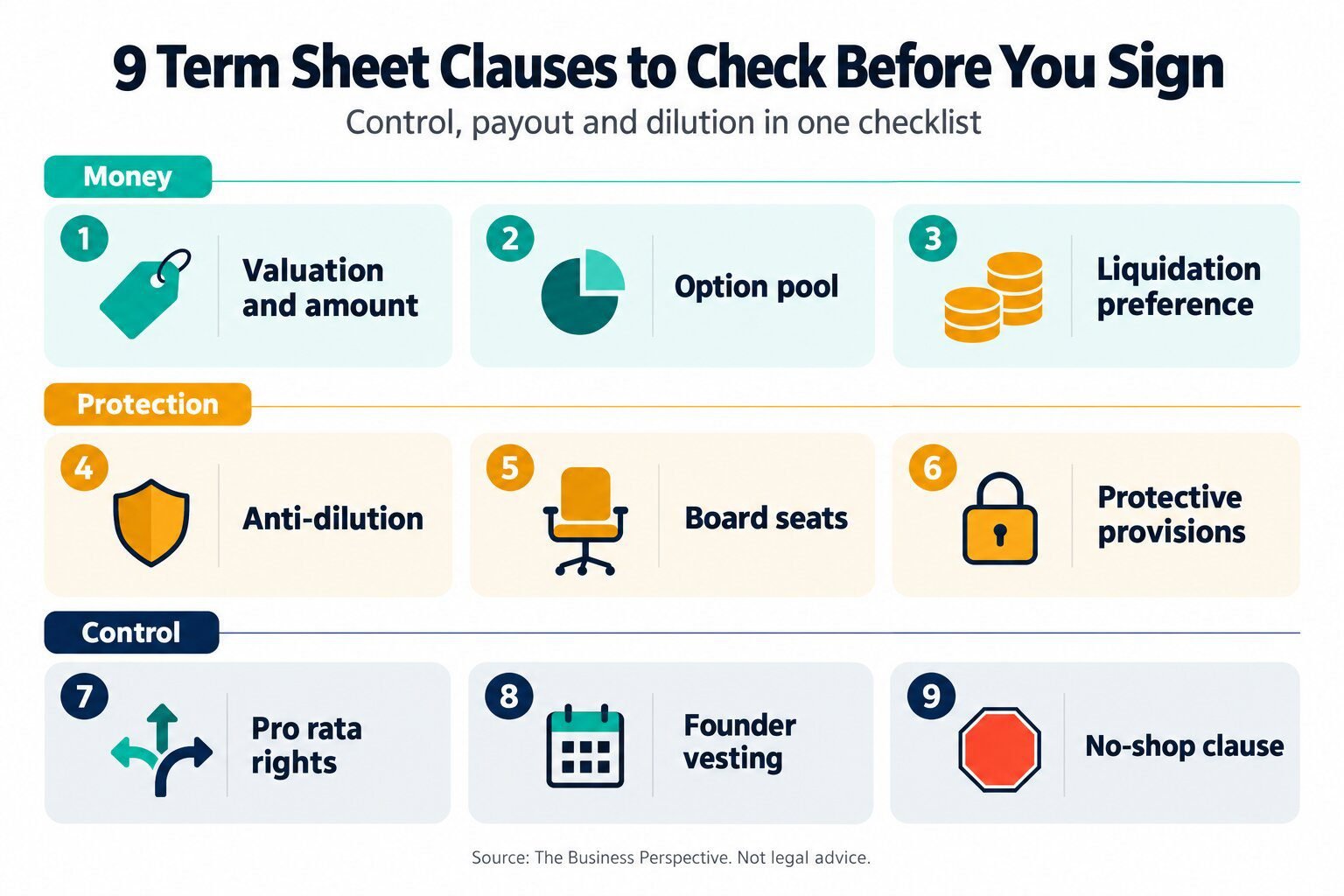
Here are the nine clauses at a glance. The rest of this article takes them in groups. If you raised on a SAFE first, our SAFE note vs convertible note guide shows how earlier instruments convert at your first startup term sheet.
| # | Clause | Group | What to push for |
|---|---|---|---|
| 1 | Valuation and amount | Price and payout | Check how the option pool is counted inside the pre-money |
| 2 | Option pool | Price and payout | Size it to a 12 to 18 month hiring plan |
| 3 | Liquidation preference | Price and payout | 1x non-participating |
| 4 | Anti-dilution | Downside and control | Broad-based weighted average, not full ratchet |
| 5 | Board seats | Downside and control | Founder parity or a real independent seat |
| 6 | Protective provisions | Downside and control | Market-standard scope; check consent for your next financing |
| 7 | Pro rata rights | Rights and timing | Major investors only, next round only |
| 8 | Founder vesting | Rights and timing | Credit for time already served |
| 9 | No-shop clause | Rights and timing | A shorter period, usually 30 to 60 days |
Sources and limits: Brad Feld and Jason Mendelson, Venture Deals, and the Holloway venture capital guide; Cooley’s Q1 2026 and Q3 2025 Venture Financing Reports; Causo, “VC term sheet explained: what to fight for in 2026.” This is education, not legal advice. Have a startup lawyer read your actual term sheet before you sign.
Which startup term sheet clause decides who controls your company?
Board composition. Brad Feld and Jason Mendelson call the board the most powerful element of a company’s management structure, and it can fire the CEO. Protective provisions add a second lock, because they can require preferred investors’ approval for key actions even when founders own more than half the shares.
That is the answer the meta description promised: the board. In a startup term sheet, it decides who runs the company day to day, and it matters more than the percentage you own.
Feld and Mendelson note in Venture Deals that the board almost always has the power to fire the CEO. It also approves budgets, option plans, mergers, financings and C-level hires. The Business Perspective’s read: count the seats, not just the shares.
Causo’s 2026 guide says the seed default is three seats: one founder, one investor and one independent. At Series A, it advises fighting for founder parity.
The second lock: protective provisions
Protective provisions are the investor veto list. The Holloway guide explains they can require votes that pass only with preferred holders’ support, even if founders own more than 50%.
The list can look long, yet Causo says most of it is standard. What matters, in its view, is board composition, board size and whether investors must consent to your next financing.
Before you sign, ask
- How many seats, and who holds them?
- Who nominates and approves the independent?
- What needs preferred approval? Check your next financing and any sale.
- What happens to the board when you raise again?
Still before your first round? Our guide on how to raise seed funding for startups covers the steps that come first.
How do valuation, the option pool and liquidation preference change your payout?
Valuation sets your price, the option pool decides who pays for future hires, and liquidation preference decides who is paid first at exit. Cooley’s Q1 2026 data shows 98.2% of deals carried a 1x preference and 96.4% were non-participating, so anything heavier is worth challenging.
1. Valuation and amount
Valuation is the number everyone reads first in a startup term sheet. Check whether it is pre-money or post-money, and how the investment amount turns into ownership. Our guide to how investors value a startup explains the methods behind the number.
2. Option pool
This is where valuations quietly shrink. Causo, citing Cooley GO, says investors typically size the pool after closing but price it into the pre-money, so every percentage point of pool comes out of existing holders’ ownership.
A hypothetical, not market data: an $8 million pre-money, a $2 million investment and a 15% post-closing pool. The pool’s $1.5 million comes out of the pre-money, so the effective pre-money is $6.5 million.
Causo’s counter: justify the pool with a hiring plan for the next 12 to 18 months.
3. Liquidation preference
This decides who is paid first when the company is sold. A 1x non-participating preference means the investor takes the greater of their money back or their share of the proceeds. Participating preferred lets them take both.
| Term or round type | Share of deals |
|---|---|
| 1x liquidation preference | 98.2% |
| Non-participating preferred stock | 96.4% |
| Pay-to-play provisions | 7.3% |
| Redemption provisions | 6.1% |
| Accruing dividends | 2.4% |
| Up rounds | 86% |
| Flat rounds | 2.6% |
| Down rounds | 11.4% |
Cooley’s numbers cover deals it advised, so The Business Perspective reads them as a benchmark, not a law. Still, with 98.2% at 1x and 96.4% non-participating, a 2x or participating ask is the exception. Causo goes further and treats 2x participating as a walk-away signal.
How does anti-dilution protection work if the next round is a down round?
Anti-dilution protection adjusts investors’ conversion price if you later sell shares at a lower price. Broad-based weighted average softens the hit by weighing the size of the down round, while full ratchet resets earlier shares to the new low price. Push for broad-based and treat full ratchet as a warning sign.
In a startup term sheet, anti-dilution protects investors if you later sell shares at a lower price. Broad-based weighted average adjusts their conversion price in proportion to the size of the down round. Full ratchet resets their price to the new low price, which Causo calls brutal in a meaningful down round.
The Business Perspective reviewed Cooley’s Q1 2026 and Q3 2025 reports. Neither breaks out anti-dilution types, but they show how often it matters. Down rounds were 11.4% of Q1 2026 deals, against 86% up rounds and 2.6% flat.
The ask is simple. Take broad-based weighted average and refuse full ratchet. Read pay-to-play alongside it, since that clause, found in 7.3% of Q1 2026 deals, penalizes investors who skip a later round.
What do pro rata rights, founder vesting and the no-shop clause change?
Pro rata rights let investors keep their percentage in later rounds, founder vesting ties your shares to time served, and the no-shop stops you from talking to other investors while the deal closes. Causo’s 2026 guide says to negotiate scope and credit for time served, and to shorten the no-shop, not remove it.
7. Pro rata rights
Pro rata rights let an investor keep their ownership percentage in future rounds. Causo says rights for major investors are market, but pro rata for every check regardless of size is not. Its counter is a minimum check size and a limit to the next round.
8. Founder vesting
Causo calls four-year vesting with a one-year cliff standard, even for founders who have worked on the company for years. The negotiable part is credit for time already served.
9. The no-shop clause
The no-shop blocks you from talking to other investors while the deal closes. Causo puts it at 30 to 60 days from signing and says shorter is better but rarely worth killing the deal over.
Later rounds put these startup term sheet rights to work, as our Series A funding trends 2026 breakdown shows. If you are still shaping the story investors see, start with our startup pitch deck template.
What do critics say about fighting over term sheet clauses?
Critics say fighting over every clause can cost goodwill for little gain, since market terms are already founder-friendly. Others note the data is narrow and that some loss of control comes with any outside money. Practitioners reply that the board and option pool deserve a real fight.
What skeptics say
- Startup term sheet terms are already founder-friendly. With 98.2% of Q1 2026 deals at 1x, fighting small points can cost goodwill for little gain.
- The data is narrow. Cooley’s 165 deals worth $39.9 billion reflect the deals it advised, so smaller seed rounds and other markets may look different.
- Some control always goes. The Holloway guide says that once you take outside money, you give up some control, so the goal is balance, not zero.
What practitioners say
- Pick your fights. Causo puts valuation first, tells founders to fight on board seats and says to concede on market-standard protective provisions.
- Economics count too. The Holloway guide notes founders often forget they are negotiating for good economics as well as the right control.
Our view at The Business Perspective: in any startup term sheet, negotiate the board and the option pool hardest, accept market terms elsewhere, and spend your legal budget on a lawyer who reads these documents every week.
What are the most common questions about a term sheet?
Short version: the board decides control, 98.2% of Q1 2026 deals used a 1x liquidation preference, and the option pool quietly lowers your real valuation. The Business Perspective answers the six questions founders ask most about a term sheet below, each tied to a named source.
Is a startup term sheet legally binding?
Mostly no. A term sheet summarizes proposed terms that lawyers then turn into the final documents. Some provisions, such as the no-shop and confidentiality, are usually written to bind. Because the line is not always obvious, ask a startup lawyer which parts bind you before you sign anything.
What is the most important clause in a startup term sheet?
Valuation gets the attention, but board composition decides control. Brad Feld and Jason Mendelson call the board the most powerful element of a company’s management structure, and it can fire the CEO. Causo’s 2026 guide also puts valuation and the option pool first when ranking what to negotiate.
What is a standard liquidation preference?
A 1x non-participating preference is the market norm. Cooley’s Q1 2026 report found 98.2% of deals carried a 1x preference and 96.4% used non-participating preferred stock. That means the investor takes the greater of their money back or their share of proceeds, not both.
How long does a no-shop clause last?
Causo’s 2026 guide puts the usual no-shop at 30 to 60 days from signing. It says shorter is better but rarely worth killing the deal over. The realistic ask is to shorten the period, not remove it, so you are not locked in if due diligence drags.
What is the option pool shuffle?
It happens when investors size the employee option pool after closing but count it inside the pre-money valuation. Causo, citing Cooley GO, says every percentage point of pool then comes out of existing holders’ ownership. Founders can counter with a hiring plan covering the next 12 to 18 months.
Can you negotiate a startup term sheet?
Yes, but pick your battles. Causo puts valuation and the option pool first, says to fight on board seats, and advises conceding on market-standard protective provisions. With Cooley data showing most deals use 1x non-participating preferences, heavy asks stand out. Have a startup lawyer review every change.
What is the bottom line on a startup term sheet?
A startup term sheet is two deals in one: what you get paid and who runs the company. Negotiate the board and the option pool hardest, accept market terms on the rest, and have a startup lawyer read every line. The valuation is only the first number on the page.
Back to the opening line: you can own most of the company and still lose the vote, thanks to the board and protective provisions. A startup term sheet rewards the founder who reads past the valuation.
Bring the nine-clause table to your lawyer, mark the three you will fight for, and settle the rest. For more founder and funding stories, see Rise of Startups, and hardware founders can follow sector news at IoT Insights Hub. The Business Perspective will keep publishing practical funding guides, so check back.






One thought on “Startup term sheet: 9 clauses that can cost you control”