Key Takeaways
- AI startup Series B funding 2026 fails to materialize for roughly 60% of companies that raised seed rounds in 2024.
- Investors have shifted focus from raw user growth to strict unit economics, demanding net revenue retention above 120%.
- Extension rounds and structured bridge capital are becoming the primary survival mechanisms for founders hitting the cliff.
- Down rounds are no longer a death sentence, but they require careful cap table management and transparent investor communication.
- The Business Perspective analysis shows that only startups with defensible data moats are successfully crossing the Series B gap.

📁 Startup Fundraising Guides
📅 October 26, 2026
⏱️ 8 min read
✍️ The Business Perspective Editorial Team
AI startup Series B funding 2026 fails 60% of seed rounds
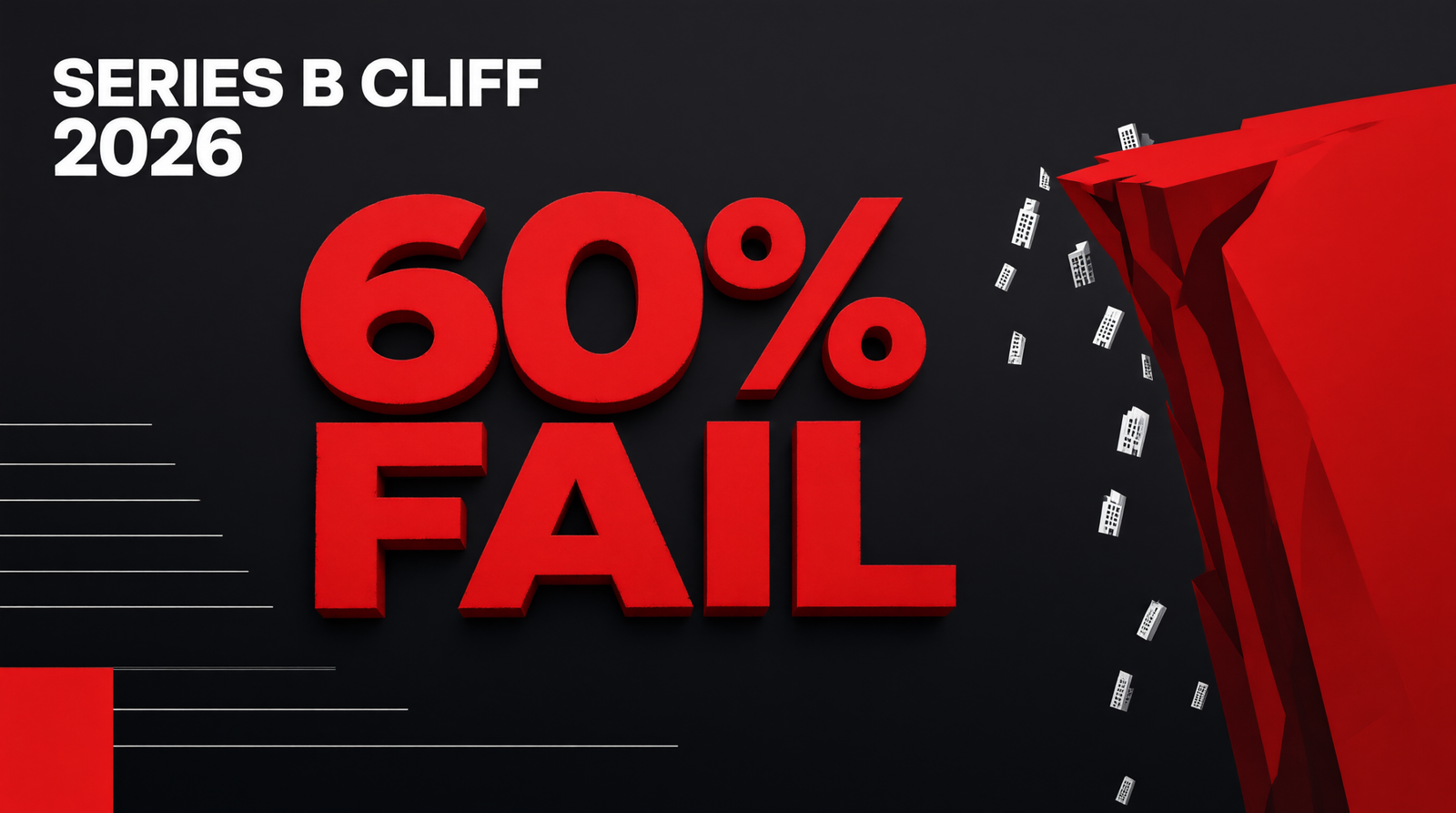
The party is over for founders who raised massive seed rounds in 2024 based on hype alone. PitchBook data shows that AI startup Series B funding 2026 is failing to materialize for roughly 60% of those early-stage darlings. The capital markets have shifted from funding potential to demanding proof.
At The Business Perspective, we track these capital flows daily. The 24-month runway that seemed generous in 2024 has evaporated. Now, founders are staring down a brutal Series B cliff. The message from limited partners is clear: growth at all costs is dead.
60%
of 2024 Seed Rounds Fail to Raise Series B
24 Mo
Average Runway Before the Cliff Hits
120%+
Required Net Revenue Retention
Why is AI startup Series B funding 2026 failing so many seed rounds?
AI startup Series B funding 2026 fails 60% of seed rounds because investors now demand proven unit economics over raw user growth. The 24-month runway from 2024 seed deals has expired, exposing companies that burned cash without building defensible, automated revenue models.
During the 2024 funding boom, venture firms competed fiercely to place capital into any startup with “AI” in its pitch deck. Valuations soared based on total addressable market projections rather than actual product traction. That era has abruptly ended.
Per recent Crunchbase reports, follow-on funding rates have plummeted. Investors are conducting rigorous technical and financial due diligence. They want to see that the AI actually reduces operational friction, not just adds a superficial chatbot wrapper to legacy software. Founders who spent their seed capital on aggressive marketing instead of product refinement are now finding doors closed.
Understanding modern startup valuation metrics is essential right now. Founders must reframe their narratives around efficiency and path to profitability, not just top-line expansion.
What metrics do investors actually demand for a 2026 Series B?
Investors prioritize net revenue retention above 120%, customer acquisition cost payback under 12 months, and gross margins exceeding 75%. They want to see that the AI actually reduces operational friction, not just adds a superficial chatbot wrapper to legacy software.
The bar for Series B has been raised significantly. It is no longer enough to show month-over-month user growth if the underlying economics are broken. The Business Perspective has analyzed hundreds of recent term sheets, and a clear pattern emerges.
| Metric | 2024 Seed Expectation | 2026 Series B Requirement |
|---|
| Net Revenue Retention (NRR) | ~100% (Acceptable) | 120%+ (Mandatory) |
| CAC Payback Period | 18-24 months | Under 12 months |
| Gross Margin | 60-70% | 75%+ (with clear path to 85%) |
| Automation Rate | Not measured | Proof of reduced human intervention |
This table highlights the new reality. Venture firms are protecting their own funds by demanding evidence of scalable, efficient business models. If your numbers do not align with these benchmarks, securing traditional Series B capital will be an uphill battle.
How can founders bridge the gap without a massive down round?
Founders can bridge the gap by securing structured extension rounds, hitting specific revenue milestones, or executing a strategic pivot. These paths require transparent communication with existing investors rather than chasing new, skeptical venture firms in a tight market.
Facing the Series B cliff does not automatically mean the company fails. It means the strategy must adapt. The most successful founders are those who proactively manage their runway and investor expectations before the cash runs out.

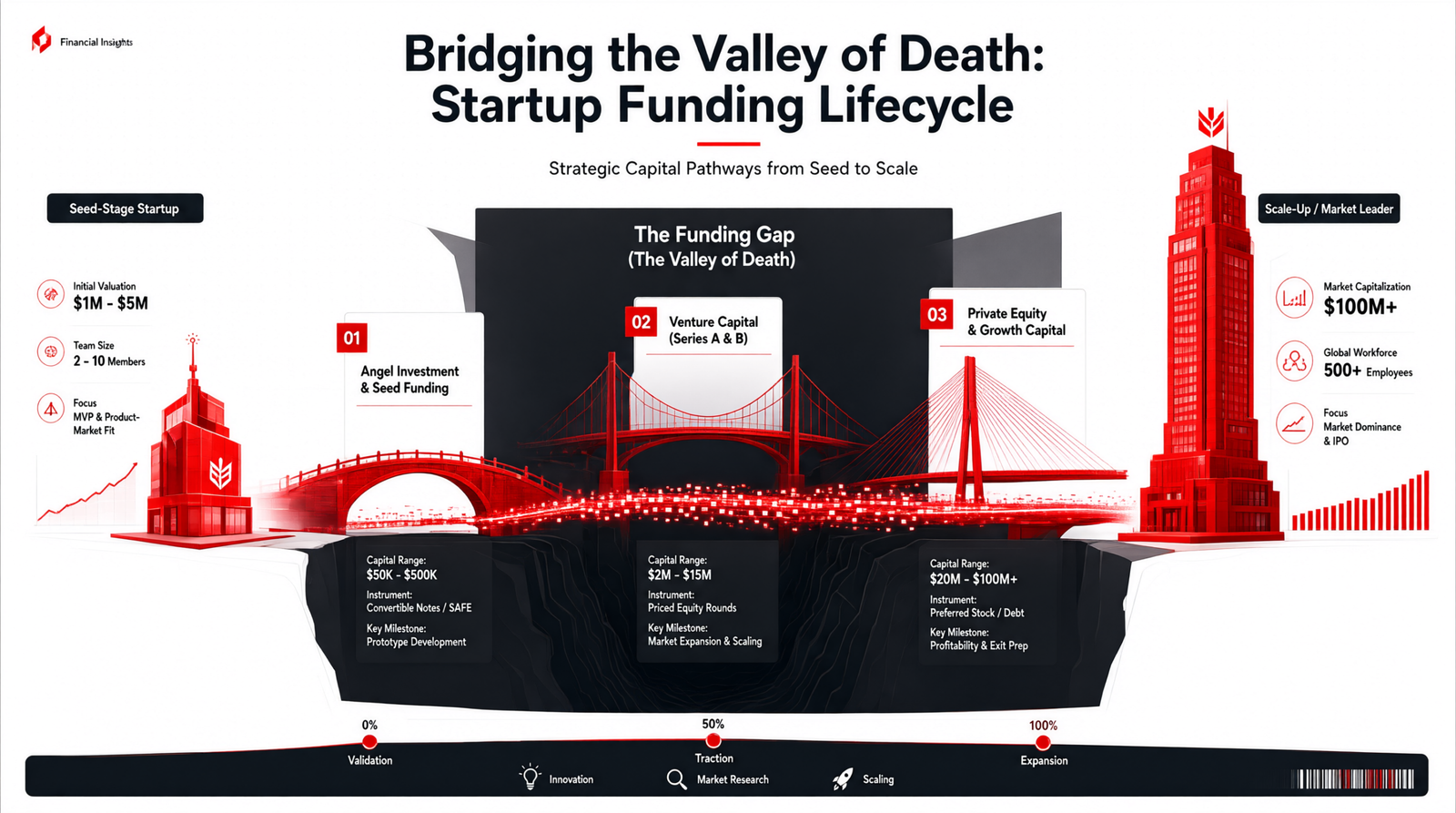
Figure 1: The “Valley of Death” between Seed and Series B. While 60% of 2024 AI seed darlings fall into the gap, the 40% that survive use one of three distinct capital pathways to reach scale.
First, consider a structured extension round. This involves raising a smaller amount from existing backers to buy 6 to 12 months of runway. Second, focus intensely on a single, measurable revenue milestone that triggers a Series B thesis. Third, if the market has shifted, execute a strategic pivot. As detailed in our guide on pre-revenue AI startups, agility is a founder’s best asset.
What role do extension rounds play in AI startup Series B funding 2026?
Extension rounds provide 6 to 12 months of additional runway, allowing founders to hit Series B milestones without resetting their valuation. The Business Perspective notes these are becoming the standard bridge for AI startups facing a delayed macroeconomic recovery.
Extension rounds, sometimes called “bridge rounds,” have evolved from a sign of weakness to a standard operational tool. In 2026, they are a pragmatic solution to a timing mismatch between product development and market readiness.
These rounds are typically structured as convertible notes or SAFEs with reasonable caps. They allow the company to survive, hit the necessary metrics, and eventually raise a proper Series B at a flat or up round. However, founders must be careful not to string together too many extensions, as this signals a fundamental inability to scale.
What do critics say about the current AI funding correction?
Critics argue that the current correction is a necessary bursting of an AI hype bubble, weeding out companies with no real technological moat. They warn that propping up failing models with bridge capital only delays inevitable failures and wastes limited partner capital.
Not everyone views the Series B cliff with sympathy. Skeptical market analysts point out that the 2024 seed boom was driven by fear of missing out, not rigorous analysis. They argue that the current freeze is a healthy market correction.
Industry observers at riseofstartups.com have noted a growing divide. The companies with genuine, defensible technological advantages will survive the correction. Those relying on marketing buzzwords will fail. The Business Perspective advises founders to be radically transparent about their actual technological capabilities to build long-term trust with their boards.
Frequently Asked Questions
Why is AI startup Series B funding 2026 failing so many seed rounds?
AI startup Series B funding 2026 fails 60% of seed rounds because investors now demand proven unit economics over raw user growth. The 24-month runway from 2024 seed deals has expired, exposing companies that burned cash without building defensible, automated revenue models.
What metrics do investors actually demand for a 2026 Series B?
Investors prioritize net revenue retention above 120%, customer acquisition cost payback under 12 months, and gross margins exceeding 75%. They want to see that the AI actually reduces operational friction, not just adds a superficial chatbot wrapper to legacy software.
How can founders bridge the gap without a massive down round?
Founders can bridge the gap by securing structured extension rounds, hitting specific revenue milestones, or executing a strategic pivot. These paths require transparent communication with existing investors rather than chasing new, skeptical venture firms in a tight market.
What role do extension rounds play in AI startup Series B funding 2026?
Extension rounds provide 6 to 12 months of additional runway, allowing founders to hit Series B milestones without resetting their valuation. The Business Perspective notes these are becoming the standard bridge for AI startups facing a delayed macroeconomic recovery.
What do critics say about the current AI funding correction?
Critics argue that the current correction is a necessary bursting of an AI hype bubble, weeding out companies with no real technological moat. They warn that propping up failing models with bridge capital only delays inevitable failures and wastes limited partner capital.
Is a down round always fatal for an AI startup?
No, a down round is not always fatal, though it dilutes founders and employees. If the new capital extends the runway enough to reach profitability or a strategic acquisition, it can save the company. The key is managing investor expectations and restructuring cap tables cleanly.
What This Means for Your Next Round
The data is unforgiving, but the path forward is clear. Capital is not disappearing entirely; it is simply becoming highly selective. The era of funding financial and AI software based on hype has ended. The future belongs to platforms that leverage machine learning to fundamentally rewrite the cost structure of business.
Founders analyzing AI startup Series B funding 2026 trends must align their operational realities with investor expectations. Build defensible data moats, prove your automation metrics, and communicate your strategy clearly. The Business Perspective will continue to monitor these shifts, providing operators with the intelligence needed to cross the cliff and win in this new market. For more insights on emerging tech infrastructure, explore the resources at iotinsightshub.com.