Pricing is metered, not flat. Salesforce charges about $0.10 per Agentforce action, and Microsoft sells Copilot Studio credits at $0.01 each or $200 for a 25,000-credit monthly pack, per both vendors’ published pricing.
Custom builds vary wildly. Agency guides quote $15,000 to $75,000 for a single-purpose agent and $80,000 to $500,000 for multi-agent or compliance-heavy systems, per Beevr.
Upkeep is a second bill. Guides from Conversion System and Uvik put yearly maintenance at 15% to 25% of the build cost.
The quote is not the budget. One agency’s worked example turns $107,000 of visible costs into $139,100 in year one, per Hypersense Software.
The risk is real. Gartner expects more than 40% of agentic AI projects to be cancelled by the end of 2027, citing escalating costs, unclear value and weak risk controls.
Technology & AI9 min readBy The Business Perspective Editorial Team
AI Agent Cost for Business 2026: The Hidden Bill
A vendor quotes you ten cents an action. Six months later, the invoice looks nothing like that number. That gap sits at the heart of AI agent cost for business in 2026, and The Business Perspective set out to price it line by line.
Here’s the thing: the sticker price is the smallest part of the bill. Integration, data cleanup, monitoring and a person who checks the agent’s work all cost money, and most of it arrives after launch. Every figure below carries a named source, and where a number comes from a vendor or agency that sells the service, we say so.
Expect numbers, a couple of arguments and one worked example. Short on time? Jump to the first-year budget table.
$0.10per Agentforce action (Salesforce)
$0.01per Copilot Studio credit (Microsoft)
15-25%yearly upkeep as a share of build cost (agency guides)
40%+of agentic AI projects cancelled by 2027 (Gartner)
What is the real AI agent cost for business in 2026?
The real AI agent cost for business in 2026 runs from about $200 a month for a Microsoft credit pack to $100,000 or more for a production custom build. Prices you see usually cover usage or licences only. Integration, data work, monitoring and upkeep sit on top, and agency guides say they can outweigh the build itself.
Three routes dominate the market, and each prices differently. Buying a platform agent means paying for usage. Building on a low-code tool means paying for credits. Commissioning a custom agent means paying engineers, then paying them again to keep it running.
Three ways to buy an AI agent, and what each one charges
Route
Typical price signal
Source
Platform agent (Salesforce Agentforce)
$0.10 per action or $2 per conversation
Salesforce pricing
Low-code tool (Microsoft Copilot Studio)
$200 a month for 25,000 credits, or $0.01 per credit
Microsoft pricing
Custom single-purpose agent
$15,000 to $75,000 to build
Beevr
Custom multi-agent or compliance-bound system
$80,000 to $500,000 to build
Beevr
The ranges are wide for a reason. Software agency Neoteric argues that scope drives the budget, not the model. The more business systems an agent touches, the more you spend on data, permissions, testing and monitoring.
Be careful with every number in this space, including ours. Gartner estimates that only about 130 of the thousands of vendors selling “agentic AI” offer real agentic capability, a practice it calls agent washing. Some of what you are being quoted for is a chatbot with a new label.
Money is also pouring into the category, which keeps prices unsettled. The Business Perspective tracked 56 rounds in its report on AI agent startup funding in September 2026, and every one of those companies needs paying customers.
How do vendors charge for AI agents in 2026?
Most vendors meter usage instead of charging a flat fee. Salesforce sells Agentforce at about $0.10 per action through Flex Credits, or $2 per conversation. Microsoft bills Copilot Studio in credits, $0.01 each pay-as-you-go or $200 for a 25,000-credit monthly pack. The meter you pick shapes the bill as much as your volume does.
Salesforce launched Agentforce at $2 per conversation in October 2024, then added Flex Credits in May 2025, per licensing advisers Coworker and Redress Compliance. Flex Credits cost $500 per 100,000. A standard action burns 20 credits, which is where the $0.10 comes from.
Voice actions burn 30 credits, so a voice agent runs about $0.15 an action. Do the maths on your own workflow, because an “action” is a single step and one customer conversation can contain many of them.
The break-even sits near 20 actions per conversation, per Redress Compliance. Below that, credits are cheaper. Above it, the flat $2 wins. Advisers also report that one organisation cannot mix the two models, so the choice is a commitment, not a setting.
Microsoft changed its Copilot Studio billing unit from messages to Copilot Credits on 1 September 2025, per Microsoft Learn as relayed by Coworker. A prepaid pack costs $200 a month for 25,000 credits, and unused credits do not roll over, per Macha.
The catch is credits per response. In Microsoft’s own example, as summarised by CloudZero, a reply grounded in company data uses 12 credits, and adding reasoning pushes the same reply past 112. One illustrative calculation from Daily AI Fixs has an agent averaging four credits an interaction at 200 interactions a day, which eats almost a full 25,000-credit pack.
Salesforce and Microsoft agent pricing side by side
Vendor
Meter
List price
Watch for
Salesforce Agentforce
Flex Credits (per action)
$500 per 100,000 credits; 20 credits, about $0.10, per standard action
Voice actions cost 30 credits
Salesforce Agentforce
Conversations
$2 per conversation
Cannot be mixed with credits in one organisation, per advisers
Microsoft Copilot Studio
Capacity pack
$200 a month for 25,000 credits
Unused credits do not roll over
Microsoft Copilot Studio
Pay-as-you-go
$0.01 per credit
Credits per reply vary with grounding and reasoning
Agency guides put a focused proof of concept at roughly $25,000 to $50,000 and a production-ready agent wired into business systems above $100,000. Single-purpose agents with real integrations are quoted at $15,000 to $75,000, and multi-agent systems at up to $500,000. These are seller estimates, so treat them as ranges, not quotes.
Custom AI agent build costs, as quoted by development agencies
Build type
Cost range
Timeline
Source
Focused proof of concept
$25,000 to $50,000
Not stated
Neoteric
Single-purpose agent with integrations
$15,000 to $75,000
Not stated
Beevr
Custom AI agent (general)
$30,000 to $150,000
6 to 16 weeks
Empat
Production-ready, connected to systems
Above $100,000
Not stated
Neoteric
Multi-agent or compliance-bound
$80,000 to $500,000
Not stated
Beevr
Notice the overlap and the disagreement. A proof of concept at $25,000 to $50,000 sits inside another agency’s range for a finished single-purpose agent. That is not an error. It reflects different definitions of done.
Then comes upkeep. Conversion System puts annual maintenance at 15% to 20% of the build cost, and Uvik says 15% to 25%. Models change, APIs change and business rules change, so someone has to keep the agent working.
Plant managers ask the same question with extra safety rules on top. For a factory-floor take on AI agent cost for business, IoT Mail Bridge’s industrial AI agents guide explains why safety approval, not software, often sets the timeline.
Why does AI agent cost for business end up higher than the quote?
Because the quote usually covers licences or build hours, not the work around them. Integration, data cleanup, monitoring, security review and maintenance arrive later. A 2025 survey reported by CIO.com found nearly a quarter of organisations underestimated AI costs by 50% or more, and Gartner links agent cancellations to escalating costs.
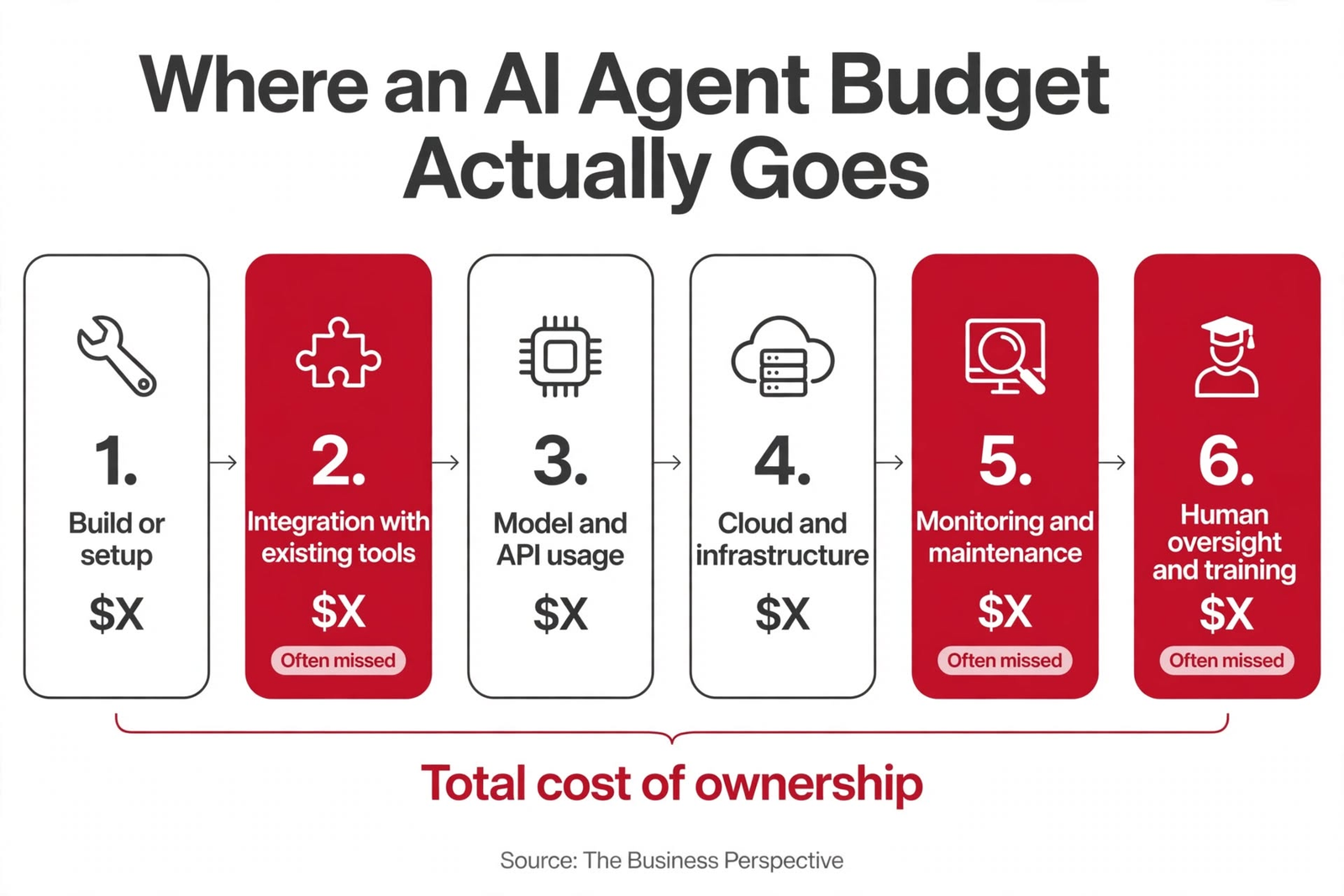
Five lines make up most of the hidden bill:
Integration. Gartner notes that wiring agents into legacy systems is technically complex, often disrupts workflows and needs costly modifications.
Data preparation. CostBench, a software pricing tracker, says cleaning and structuring data can take 20% to 30% of a first-year AI budget.
Monitoring and oversight. Someone must review outputs, handle exceptions and answer for mistakes.
Security and compliance. Reviews, permissions and audit trails cost money before an agent touches live customer data.
Maintenance. 15% to 25% of build cost a year, per the agency guides above.
Bain’s Automation and AI Pathfinder Survey of 951 companies, run in June 2026, found 41% name data access and integration as their top obstacle to realising AI value, as summarised by Conversion System. That is a people-and-plumbing problem, not a software one.
Where an AI agent budget goes, from setup to human oversight. Source: The Business Perspective.
Even the labs feel it. The Business Perspective’s look at OpenAI’s 2026 revenue and profitability shows how heavy the compute bill gets at the top of the stack.
What does a first-year AI agent budget look like?
One agency worked example shows the pattern. A mid-range agent for document processing with CRM integration has $107,000 in visible costs: $80,000 development, $12,000 infrastructure and $15,000 integration. Adding a 30% hidden-cost buffer lifts year one to $139,100, per Hypersense Software. Treat it as an illustration, not a benchmark.
Worked example: year-one cost of a mid-range AI agent (Hypersense Software)
Line item
Amount
Development (vendor quote)
$80,000
Infrastructure (year one)
$12,000
Integration
$15,000
Visible total
$107,000
Hidden-cost buffer (30%)
$32,100
True year-one cost
$139,100
Look at what the buffer represents. That $32,100 is not a luxury. It pays for the surprises that Hypersense says leave most enterprise budgets short by 40% to 60%.
Now add upkeep. At 15% to 25%, an $80,000 build implies $12,000 to $20,000 a year in maintenance, by our arithmetic. Market estimates summarised by Alphacorp, as cited by TeqBlaze, say development may be only 25% to 35% of three-year ownership cost. If that holds, the same build points to roughly $230,000 to $320,000 over three years. That is a rough extrapolation, not a forecast.
How can a business keep AI agent costs under control?
Start with one narrow workflow, run it in advice-only mode, and measure cost per completed task rather than cost per seat. Pick the vendor meter by counting real actions per interaction. Cap usage, review the bill monthly and stop pilots that miss targets. Gartner advises pursuing agents only where they deliver clear value or return on investment.
Pick one workflow with a measurable baseline. Know what the task costs a person today, in minutes and in money.
Count actions before choosing a meter. Salesforce’s break-even sits near 20 actions per conversation, so a short support flow and a long sales sequence need different plans.
Start in advice-only mode. Let the agent suggest while a person approves. IoT Mail Bridge recommends the same for factories in its guide to industrial AI agents.
Budget upkeep on day one. Set aside 15% to 25% of the build price a year, then adjust with real data.
Review monthly and kill what misses. A pilot that cannot show savings in a quarter is a cost, not an experiment.
What do critics say about AI agent cost estimates?
Critics make three points. Most public price ranges come from agencies that sell development, so they carry a sales motive. Falling model prices and shifting vendor pricing could shrink bills faster than guides predict. And Gartner argues many so-called agentic use cases do not need agents at all, which would make the whole question cheaper.
The seller problem. Nearly every range in this article comes from an agency or vendor with something to sell. We cannot independently verify them, and neither can you from a blog post. Get at least three quotes with the same scope written down.
The moving target. Enterprise Monkey notes that model costs are dropping and pricing is moving from fixed licences to usage-based and outcome-based models. Salesforce itself has changed its Agentforce pricing structure more than once since late 2024, which is a reminder that today’s quote has a short shelf life.
The wrong tool. Gartner says many use cases labelled agentic today do not require agentic implementations. If a simpler automation does the job, the cheapest agent is the one you never build.
The counter-argument. Cost is only half the ledger. Gartner still expects at least 15% of day-to-day work decisions to be made autonomously by agentic AI by 2028, up from 0% in 2024. The same tension runs through the wider AI bubble debate that The Business Perspective covered in its AI bubble analysis.
What do readers ask about AI agent cost for business?
Readers mostly ask about monthly cost, hidden costs and why projects fail. The short version: platform plans meter usage from cents per action, custom builds start in the tens of thousands of dollars, upkeep adds 15% to 25% a year, and Gartner expects over 40% of agentic projects to be cancelled by the end of 2027.
How much does an AI agent cost per month for a small business?
It depends on the route. Microsoft’s Copilot Studio starts at $200 a month for 25,000 credits, and Salesforce Agentforce charges about $0.10 per action. Custom builds cost far more upfront, with agency guides quoting $15,000 and up for a single-purpose agent. Usage, not headcount, drives most monthly platform bills.
Is an AI agent cheaper than hiring a person?
It can be for repetitive, high-volume tasks, but no neutral benchmark settles the question. Compare the cost per completed task, including oversight, against the loaded cost of the person doing it today. Gartner warns that unclear business value is one of the main reasons agent projects get cancelled.
What are the hidden costs of AI agents?
Integration and upkeep lead the list. Agency guides put annual maintenance at 15% to 25% of build cost, and CostBench says data cleaning can take 20% to 30% of a first-year budget. Monitoring, security review and human oversight add more. Hypersense Software adds a 30% buffer on top of visible costs.
How much does Salesforce Agentforce cost per action?
About $0.10 per standard action through Flex Credits, sold at $500 per 100,000 credits with 20 credits per action. Voice actions use 30 credits, or $0.15. Salesforce also offers a $2 per-conversation model and per-user licences, and licensing advisers report that one organisation cannot mix Flex Credits and conversations.
How long does it take to build a custom AI agent?
Agency guide Empat suggests 3 to 6 weeks for a proof of concept and 6 to 16 weeks for a custom agent. Integration work and internal approvals stretch those timelines. The Business Perspective treats them as seller estimates, so confirm the schedule with any vendor before you commit budget.
Why do AI agent projects get cancelled?
Gartner expects over 40% of agentic AI projects to be cancelled by the end of 2027 because of escalating costs, unclear business value or inadequate risk controls. It describes many current projects as early experiments driven by hype and often applied to problems that simpler tools could solve.
So what should a business budget for an AI agent?
Budget for the whole lifecycle, not the quote. Add integration, data work, monitoring and 15% to 25% yearly upkeep to any build price, and price platform plans by real actions per task. Then pilot one workflow, measure cost per completed task, and scale only what pays back. That is how you keep AI agent cost for business under control.
The Business Perspective’s read is simple. The price on the vendor’s page is a starting point, and the real bill is built from integration, data, oversight and upkeep. Founders who plan for those lines early rarely get ambushed by the invoice.
The honest summary of AI agent cost for business in 2026 is that nobody can quote it from a price page. Vendors, agencies and analysts disagree on the numbers, and The Business Perspective cannot settle that for you. What we can do is show where the money goes, so the invoice never surprises you.
About this analysis: figures come from Gartner, Salesforce, Microsoft, CIO.com, Bain and the agencies and advisers named in the text, based on published pricing and reports available through September and October 2026. Vendor prices change often, so check any AI agent cost for business figure on the vendor’s own page before you sign.
agentic AI
AI agent cost
AI agent cost for business
AI agent development cost
AI agent pricing
Alexander Sterling is a business journalist and financial analyst
covering startup funding, venture capital, and AI investment trends.
He tracks the deals, valuations, and founder stories shaping the
global business landscape in 2026.
Key Takeaways Pricing is metered, not flat. Salesforce charges about $0.10 per Agentforce action, and Microsoft sells Copilot Studio credits at $0.01 each or $200 for a 25,000-credit monthly pack, per both vendors’ published pricing. Custom builds vary wildly. Agency guides quote $15,000 to $75,000 for a single-purpose agent and $80,000 to $500,000 for multi-agent...
Series A vs Series B is the funding comparison every founder needs before planning a second institutional round, because the cheque, the valuation and the slice you sell all change at once. This guide uses Carta’s July 2026 data to show what Series A vs Series B really costs and what investors expect at each...
Key Takeaways Global venture funding Q3 2026 runs from $159B (Crunchbase) to $170.9B (KPMG) to $187.2B (CB Insights), a $28.2B spread for a single quarter. AI took the biggest share. Crunchbase puts it at 64% ($102B) of Q3 funding, and CB Insights says AI holds 71% of 2026 funding so far. Deal counts do not...