
The Business Perspective · August 12, 2026 · Startup News
📰 News⚡ TL;DR — August 2026 Funding Snapshot
- $6.9B+ raised by global startups in the first week of August 2026 alone
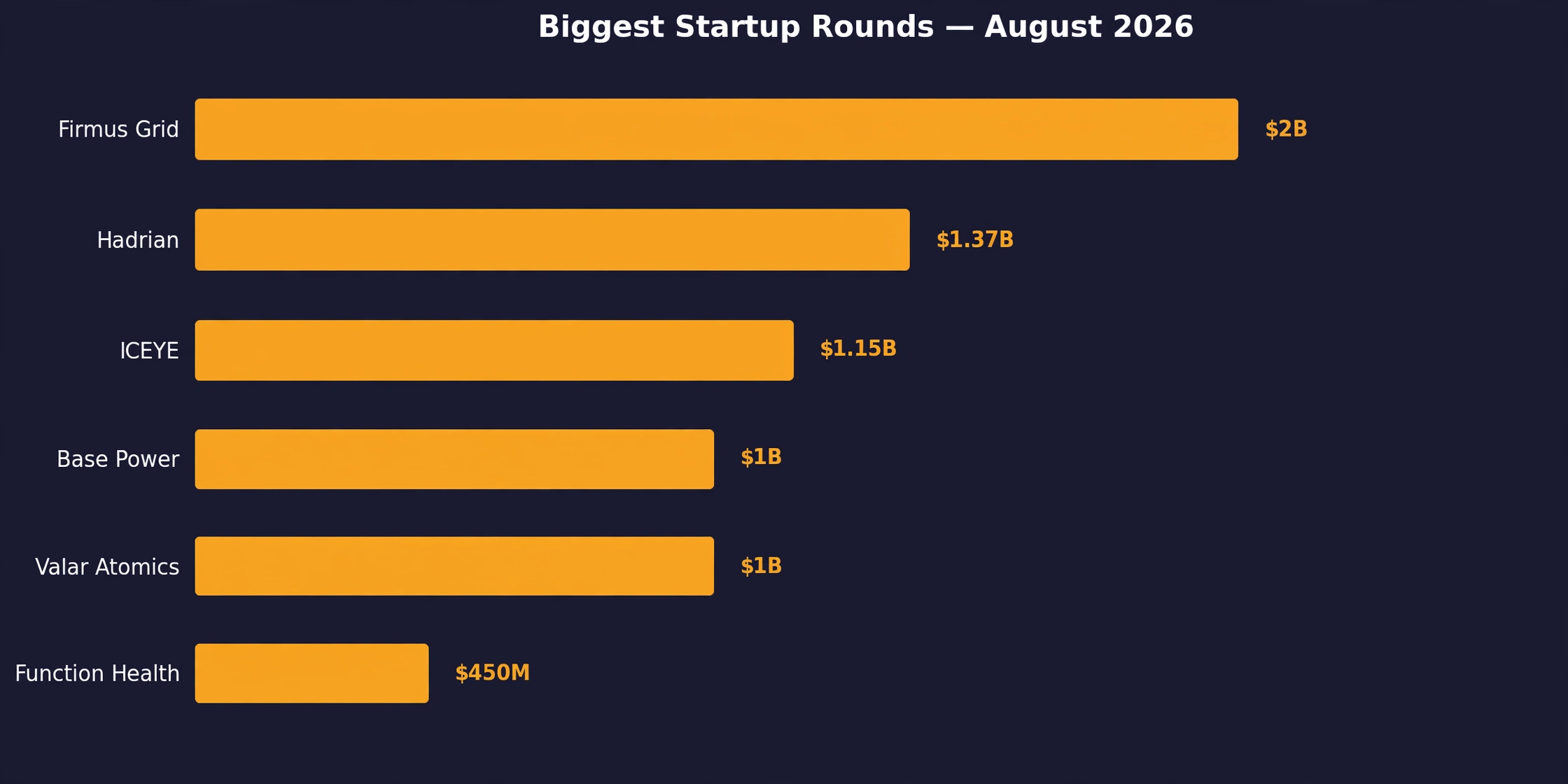
- Firmus Grid ($2B), Hadrian ($1.37B), Base Power ($1B), Valar Atomics ($1B) led the mega-rounds
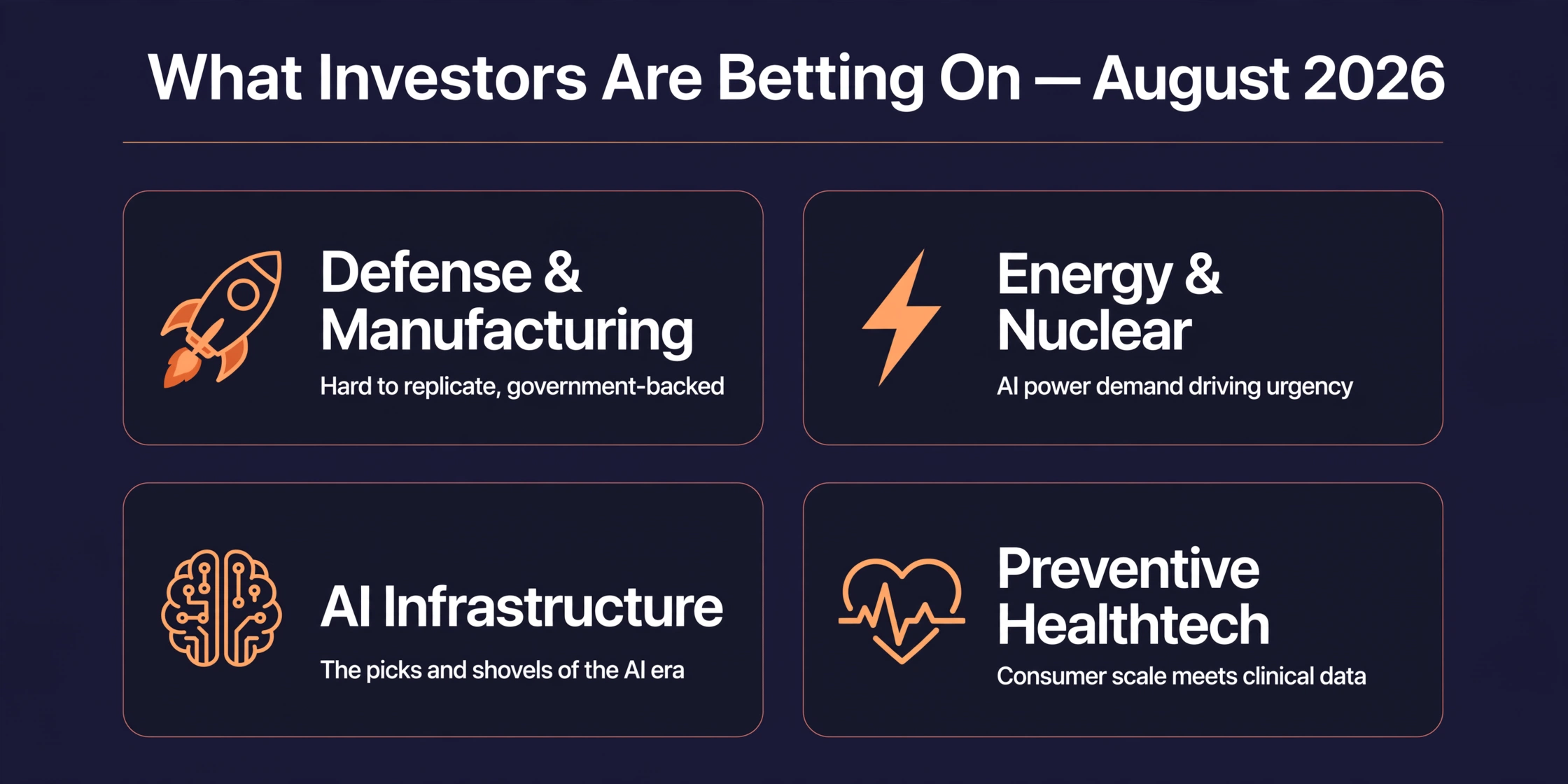
- AI infrastructure, defense manufacturing, and energy are the three dominant investor themes
- HappyRobot ($150M) and Function Health ($450M) show automation and preventive health are scaling fast
- The signal for founders: investors are backing hard problems with defensible solutions — not hype
Capital does not lie. When three companies each raise over a billion dollars in the same week — in defense manufacturing, nuclear energy, and AI infrastructure — that is not coincidence. That is investors reading the same macro signal and acting on it at the same time. August 2026 is telling founders exactly where the next decade of value creation is being built.
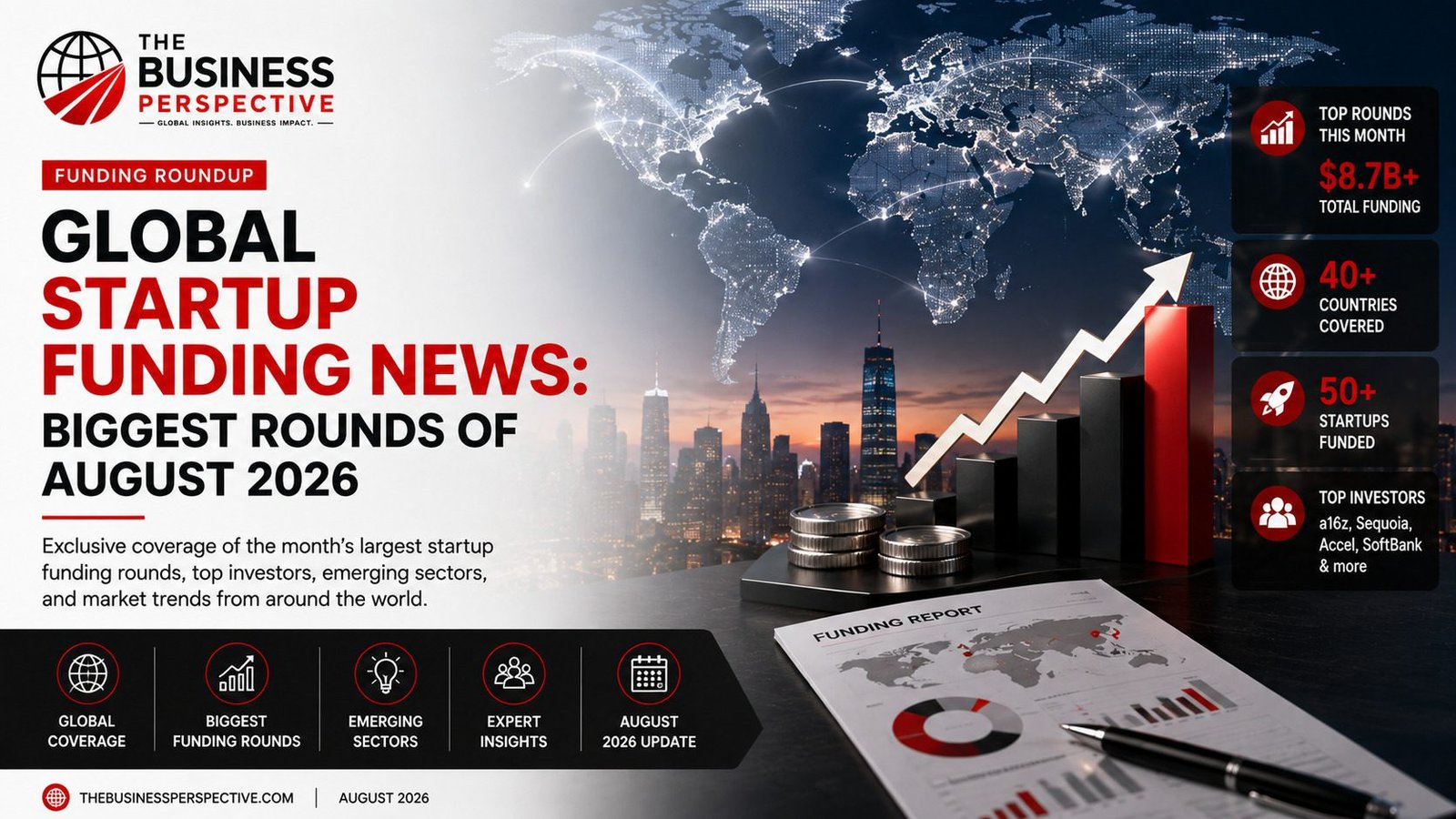
This is The Business Perspective’s monthly global startup funding roundup — tracking the biggest rounds, the sectors attracting capital, and the patterns every founder should understand before their next pitch. All figures are publicly reported and sourced from Crunchbase, TechStartups, and company announcements.
$6.9B+
Raised by global startups in week of Aug 3–10, 2026
3
Separate $1B+ rounds closed in a single week
$10.5B
Firmus Grid valuation — highest of the month
53+
Tracked funding rounds globally in one week
1. The Biggest Funding Rounds of August 2026
Five companies defined the capital story of August 2026’s first week. Together they raised over $5.75 billion — a concentration of capital that points toward three hard, infrastructure-level bets investors are making simultaneously.
🏭 Firmus Grid
📅 August 7, 2026
📍 Australia (Global)
👥 Nvidia · Coatue · Blackstone
Firmus Grid builds immersion-cooled AI factories — physical infrastructure that houses GPU clusters for AI training and inference at industrial scale. Founded in 2019, the company operates what it calls “Cube300” units: containerised 300kW compute nodes that can be deployed outside conventional data centres. The $2B Series G at a $10.5B valuation makes Firmus the largest non-US AI infrastructure bet of August 2026. Nvidia’s participation as a lead investor is a direct signal — the chip giant is backing the physical layer that runs its own hardware.
AI Infrastructure
⚙️ Hadrian
📅 August 6, 2026
📍 USA
👥 WCM · Founders Fund · a16z · JPMorgan
Hadrian builds software-controlled automated factories for aerospace and defense manufacturing — addressing a critical bottleneck in the US military supply chain. The company uses precision CNC machines guided by proprietary software to produce parts that would otherwise take months through traditional suppliers. At an $8B valuation, this Series D round signals that defense-tech manufacturing is now firmly in venture capital’s mainstream investment thesis — not just a government-contract business but a scalable technology company.
Defense Manufacturing
🔋 Base Power
📅 August 4, 2026
📍 Austin, TX, USA
👥 Ribbit · a16z · JPMorgan · Coatue · Lightspeed
Base Power installs home battery systems that provide backup power and grid services — positioning itself as the “Tesla of home batteries” in the distributed energy storage race. After a $1B Series C in late 2025, this Series D at $2.5B+ total raised reflects extreme investor confidence in battery-backed power as extreme weather and AI data-centre load increases grid stress globally. The round included both pure VC (a16z, Lightspeed) and financial infrastructure investors (JPMorgan, Ribbit) — a signal the company is being built for financial-infrastructure scale, not just energy hardware.
Energy Storage
⚛️ Valar Atomics
📅 August 4, 2026
📍 Los Alamos, NM, USA
👥 Sequoia · Point72 · JPMorgan · HOF Capital
Valar Atomics is building compact nuclear reactors specifically designed to power AI data centres and high-compute facilities. The company recently demonstrated a reactor powering an Nvidia AI supercomputer — a proof point that reframed the company from “nuclear startup” to “AI power infrastructure.” The $1B Series B — enormous for a nuclear company at this stage — includes $200M in credit from a JPMorgan-led syndicate alongside the equity. Sequoia leading signals that the fund sees Valar as a potential category-defining investment in the power infrastructure underpinning AI.
Nuclear / AI Power
🏥 Function Health
📅 August 1, 2026
📍 Austin, TX, USA
👥 General Catalyst (Customer Value Fund)
Function Health offers a $365/year membership that gives consumers direct access to 160+ lab tests and AI-powered health analytics — making preventive healthcare accessible without a primary care physician. This $450M growth round from General Catalyst comes just 8 months after Function’s $298M Series B, and follows three acquisitions including AI imaging company Ezra. With 100 million Americans lacking a primary care doctor, Function is building the infrastructure for personalised preventive health at consumer scale.
Preventive Healthtech
🚗 Moove
📅 August 5, 2026
📍 Lagos / UAE
👥 Mubadala · BlackRock · Uber · Woven (Toyota)
Moove builds autonomous mobility infrastructure — financing robotaxi fleets, EV charging networks, and maintenance hubs for ride-hail operators globally. The $250M Series C at a $2.1B valuation is notable for its investor mix: sovereign wealth (Mubadala), institutional asset management (BlackRock), strategic partners (Uber, Toyota’s Woven Capital), and emerging market growth capital (Prosus). That breadth of backer type reflects a company that is simultaneously a technology business, a financial infrastructure player, and a geopolitical bet on mobility in emerging markets.
Autonomous Mobility
🤖 HappyRobot
📅 August 4–5, 2026
📍 Madrid / New York, USA
👥 Prysm Capital · Eurazeo · a16z · YC · Base10
HappyRobot builds AI agents that automate complex enterprise workflows through voice and chat interfaces — handling logistics paperwork, insurance claims, and energy company coordination at scale. Already deployed by DHL and Uber to automate tens of thousands of freight broker hours, HappyRobot’s $150M Series C vaulted it to a $1.2B unicorn valuation. The YC + a16z investor combination signals the highest-conviction stamp of approval in the early-stage AI ecosystem.
AI Automation
2. Full Funding Tracker — August 2026
Here is the complete tracked funding data for the week of August 3–10, 2026, sourced from Crunchbase, Parsers, and company announcements.
| Company | Amount | Stage | Sector | Lead Investor(s) | Country |
|---|
| Firmus Grid | $2B | Series G | AI Infra | Nvidia, Coatue, Blackstone | 🇦🇺 Australia |
| Hadrian | $1.37B | Series D | Defense | WCM, Founders Fund, a16z | 🇺🇸 USA |
| Base Power | $1B | Series D | Energy | Ribbit, a16z, JPMorgan | 🇺🇸 USA |
| Valar Atomics | $1B | Series B | Nuclear | Sequoia, Point72, JPMorgan | 🇺🇸 USA |
| Function Health | $450M | Growth | Healthtech | General Catalyst | 🇺🇸 USA |
| Moove | $250M | Series C | Mobility | Mubadala, BlackRock, Uber | 🇳🇬 Nigeria/UAE |
| Simile | $200M+ | — | AI | Greenoaks, Index Ventures | 🇺🇸 USA |
| CAIS | $170M | Series D | Fintech | Blue Owl, Carlyle, Vista | 🇺🇸 USA |
| HappyRobot | $150M | Series C | AI Auto | Prysm Capital, a16z, YC | 🇪🇸🇺🇸 Spain/USA |
| Eliyan | $145M | Series C | AI Chips | Cisco Investments, Lumentum | 🇺🇸 USA |
| CAIS | $170M | Series D | Wealthtech | Blue Owl, AllianceBernstein | 🇺🇸 USA |
| June AI | $20M | Pre-Seed | AI | Undisclosed | 🇺🇸 USA |
📡 Quick Scan — More August Rounds
Commonwealth Fusion SystemsClean Energy / Fusion$1B
LifeMine TherapeuticsBiotech$188M
OmiliaEnterprise AI / Voice$67M
Faye Travel InsuranceInsurtech / AI$50M
AmbrookVertical SaaS / AgFinance$30M
DelightreeAI Ops / Franchise Software$25M
3. The Three Dominant Investor Themes of August 2026
August 2026’s funding data is not random. Three distinct investment theses are driving the largest checks — and understanding the logic behind each one is more valuable than tracking the headline numbers.
Theme 1 — AI Infrastructure: The Picks and Shovels of the AI Era
Firmus Grid ($2B), Eliyan ($145M), and Simile ($200M+) represent a clear shift in where AI capital is going. The early phase of AI investing backed foundation models. The current phase is backing the physical and connectivity infrastructure that runs them — GPU factories, chip interconnects, and AI-native cloud platforms. Nvidia investing directly in Firmus is the clearest signal: the company making the picks wants to own the shovels too.
🔍 Unique Insight
The AI infrastructure investment theme is structurally different from software AI bets. Infrastructure companies have physical assets, long customer contracts, and defensible moats that software companies lack. Investors backing Firmus at $10.5B are not betting on a model — they are betting on a physical facility network that takes years and billions of dollars to replicate. That is a fundamentally different risk profile than backing an AI SaaS company.
Theme 2 — Defense and Hard Manufacturing: National Security as a VC Thesis
Hadrian’s $1.37B Series D represents something genuinely new in venture capital: institutional VC funds writing billion-dollar checks into defense manufacturing — not just defense software. The thesis is that the US military supply chain is critically fragile, and software-controlled precision manufacturing can compress years of traditional procurement timelines into months. Founders Fund, a16z, and JPMorgan backing Hadrian together is a rare coalition that signals cross-category investor conviction.
💡
What This Means for Founders
Defense-tech is no longer a niche category reserved for ex-military founders or government contractors. If your startup touches manufacturing speed, supply chain resilience, or precision hardware, there is now serious VC appetite for your category. Read more on how investors assess startups in capital-intensive sectors: How to Value a Startup the Way Investors Do →
Theme 3 — Energy: AI’s Power Hunger Is Creating a New Investment Category
Two $1B energy rounds in one week — Base Power (battery storage) and Valar Atomics (nuclear) — are directly connected to a single underlying force: AI data centres consume enormous and growing amounts of electricity, and the grid cannot keep pace. Investors are backing both the short-term solution (distributed battery storage that stabilises the grid) and the long-term solution (compact nuclear reactors that provide always-on clean power). These are not independent bets — they are parallel infrastructure plays on the same AI-driven power demand curve.
🌍 Global Funding Distribution — Week of Aug 3–10, 2026
🇺🇸
United States
$4.58B across 26 tracked rounds. Dominant in AI, defense, energy, and healthtech.
🇦🇺
Australia
$2B from Firmus Grid alone. Surprise leader for AI infrastructure investment this week.
🇬🇧
United Kingdom
$388M across 6 rounds. Consistent deeptech and fintech funding base.
🇮🇱
Israel
$230M across 3 rounds. Cybersecurity and enterprise tech remain strong.
🇮🇳
India
$166M across 9 rounds. EV, AI, and cleantech leading early-stage deal flow.
🇩🇪
Germany
$28.8M across 3 rounds. Industrial deeptech and B2B software attracting capital.
4. What August’s Data Actually Means for Founders
Funding news is only useful if you convert it from a headline into an action. Here is what the August 2026 data is actually telling founders — not the obvious reading, but the structural signal underneath the numbers.
📌 The August 2026 Investor Thesis in One Sentence
Investors are writing the largest checks in history to companies that own a hard, physical, or regulated layer of the AI economy — not companies that sit on top of it. If your startup is a software layer on top of someone else’s infrastructure, your defensibility question just got harder to answer.
Signal 1 — Billion-Dollar Rounds Require Billion-Dollar Problems
Every company that raised $1B+ in August 2026 is solving a problem that costs billions to ignore. The US defense supply chain bottleneck costs the government years of delayed procurement. Grid instability from AI data-centre load costs utilities billions in infrastructure upgrades. The absence of affordable preventive healthcare costs the US system trillions in late-stage treatment. Investors fund the size of the problem, not the elegance of the solution.
Signal 2 — The Investor Coalition Tells You More Than the Amount
When Ribbit Capital (fintech specialist), a16z (tech generalist), JPMorgan (bank), Coatue (growth equity), and Lightspeed (consumer/enterprise) all back the same energy company in one round, that is not a coincidence. It means the company sits at the intersection of multiple investment categories — which is precisely where the most durable businesses are built. Study who co-invests, not just who leads.
Signal 3 — Pre-Seed Can Still Raise $20M — If the Team Is Right
June AI raised $20M at pre-seed — before product, before revenue, before most companies would dream of approaching institutional investors. The signal is not “pre-seed rounds are now $20M.” The signal is that in 2026, exceptional founding teams with the right pedigree can raise pre-seed rounds that look like 2020’s Series A. If you do not have that pedigree, pre-seed capital from angels is still the right path. Read our full breakdown: Angel Investors vs Venture Capital: The Founder’s Decision →
5. Early-Stage Signals — What Smaller Rounds Tell You
The billion-dollar rounds get the headlines. The $20M–$75M rounds tell you where the next generation of billion-dollar companies is being built right now.
🔬 Early-Stage Rounds Worth Watching
🌾
Ambrook — $30M Series B
Vertical SaaS for agricultural finance. Shows that focused domain software can still attract institutional backing without chasing a billion-dollar headline. Led by Lachy Groom.
🏪
Delightree — $25M
AI operating software for franchise and multi-unit brands. Proof that AI-native vertical software in unglamorous industries (franchise ops) attracts real capital when the buyer problem is real.
✈️
Faye — $50M
AI-powered travel insurance. Insurtech is back — but only for AI-native products that reduce claims processing friction with real, measurable unit economics improvement.
🤖
June AI — $20M Pre-Seed
Raised $20M before launching — a record-level pre-seed. The founding team’s background, not the product, drove the round. Shows how much the pre-seed bar has compressed for exceptional operators.
6. What Founders Get Wrong Reading Funding News
❌
Mistake 1: Copying the Round Size Instead of the Business Model
A $1B nuclear energy round and a $1B battery storage round carry completely different capital needs, risk profiles, and paths to revenue. The number is the least informative part. Study the business model, the investor thesis, and the defensibility — not the headline figure.
❌
Mistake 2: Treating Funding as Proof of Product-Market Fit
Large rounds reflect investor belief in future potential — not confirmed product-market fit. Several August 2026 mega-rounds went to companies that are still building commercial-scale products. Funding is not proof the business works. Retention, revenue, and repeat purchase are. Understand the difference before using any funded company as a benchmark.
❌
Mistake 3: Building for the Investor Trend Instead of the Customer Problem
Defense-tech and nuclear energy are attracting capital in August 2026. That does not mean every founder should pivot to defense or nuclear. Investors fund founders who have a genuine right to build in a space — through domain expertise, proprietary access, or lived experience. Trend-chasing without authentic founder-market fit is the fastest route to a passed pitch. Read more: Angel Investors vs Venture Capital — Know Which Fits You →
❌
Mistake 4: Using Market-Size Slides Instead of Customer Evidence
Every sector in August’s funding data — AI, defense, energy, health — has a massive TAM. TAM is not a fundraising argument. Every investor already knows the AI infrastructure market is enormous. What they need from you is proof that your specific team can own a specific slice of it. Customer evidence, letters of intent, paid pilots, and retention data beat any TAM slide.
🙋 People Also Ask
What startup raised the most money in August 2026?
Firmus Grid raised the largest disclosed round of August 2026 — a $2 billion Series G from Nvidia, Coatue, and Blackstone at a $10.5 billion valuation. Hadrian followed with $1.37 billion, and Base Power and Valar Atomics each raised $1 billion in the same week.
Which sectors are getting the most VC funding in 2026?
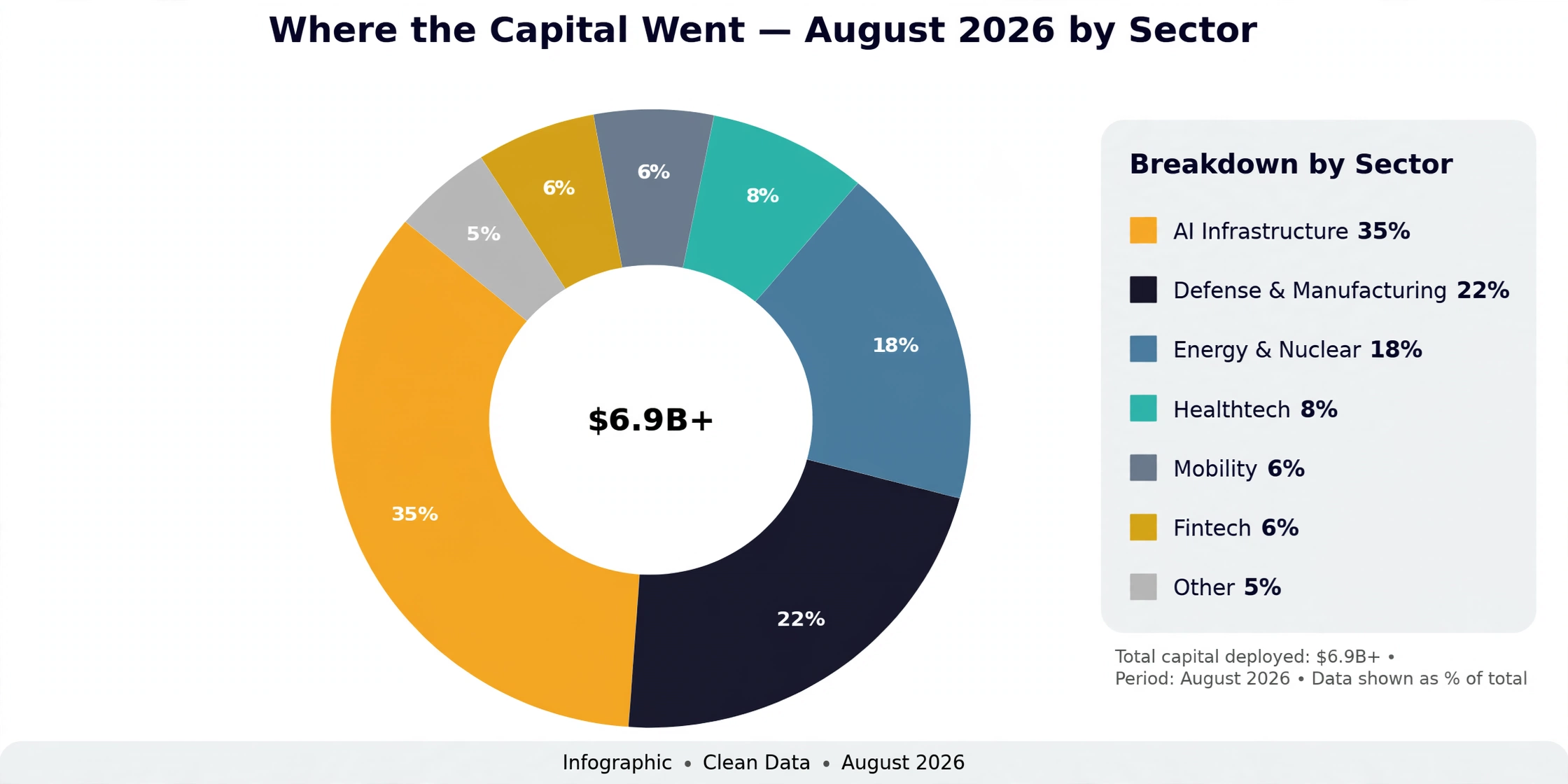
In August 2026, AI infrastructure, defense manufacturing, and energy (nuclear and battery storage) attracted the largest checks. Healthtech and autonomous mobility also saw significant institutional rounds. AI broadly captured an estimated 35% of tracked global venture capital in the period.
How much venture capital was raised globally in August 2026?
In the week of August 3–10, 2026 alone, global startups raised over $6.9 billion across 53+ tracked rounds. The US accounted for approximately $4.58 billion. Full monthly figures will be available once August closes and all rounds are disclosed.
What is Valar Atomics and why did it raise $1 billion?
Valar Atomics builds compact nuclear reactors designed to power AI data centres. The company demonstrated a reactor powering an Nvidia AI supercomputer, reframing itself as AI power infrastructure rather than a traditional nuclear company. It raised $1 billion in a Series B led by Sequoia Capital and JPMorgan in August 2026.
Is venture capital funding increasing or decreasing in 2026?
Global VC funding in 2026 is concentrated rather than distributed — fewer deals but larger individual checks. The mega-round trend (rounds above $500M) has accelerated, while seed and early-stage deal volume has moderated. Total global venture capital in H1 2026 exceeded $412 billion in the US alone, with 81% going to $100M+ rounds.
What is HappyRobot and what does it do?
HappyRobot is a US-Spanish AI startup that builds autonomous agents automating complex enterprise workflows through voice and chat interfaces. It handles logistics paperwork, insurance claims, and operational coordination for companies like DHL and Uber. It raised $150 million in a Series C in August 2026, reaching a $1.2 billion unicorn valuation.
Frequently Asked Questions — August 2026 Startup Funding
Which startup raised the most funding in August 2026?
Firmus Grid raised $2 billion in a Series G round from Nvidia, Coatue, and Blackstone at a $10.5 billion valuation — the largest disclosed single round of August 2026. Hadrian ($1.37B), Base Power ($1B), and Valar Atomics ($1B) followed as the other mega-round companies of the month.
What sectors attracted the most venture capital in August 2026?
AI infrastructure (Firmus Grid $2B, Eliyan $145M), defense and manufacturing (Hadrian $1.37B), and energy — both battery storage (Base Power $1B) and nuclear (Valar Atomics $1B) — dominated August 2026. Healthtech (Function Health $450M) and autonomous mobility (Moove $250M) were also significant themes.
How much total funding did global startups raise in August 2026?
In the first week of August 2026 (Aug 3–10), global startups raised over $6.9 billion across 53+ tracked rounds. The US led with $4.58 billion across 26 rounds, followed by Australia ($2B — Firmus Grid alone), the UK ($388M), Israel ($230M), and India ($166M).
What does August 2026 funding data mean for early-stage founders?
August 2026 shows investors are backing companies that own hard, physical, or regulated layers of the economy — particularly the infrastructure underpinning AI. For early-stage founders, the practical lesson is to build proof before pitching (paid pilots, letters of intent, retention data), identify a specific buyer problem with a defensible solution, and understand which investor type fits your current stage. Read our guide:
Angel Investors vs Venture Capital: The Founder’s Decision →
Why did Firmus Grid raise $2 billion in August 2026?
Firmus Grid builds immersion-cooled GPU factories — physical AI compute infrastructure that can be deployed rapidly outside conventional data centres. Nvidia’s participation as a lead investor reflects the chip giant’s interest in owning the infrastructure layer that runs its hardware. The round funds commercial expansion to meet surging global demand for AI training and inference capacity.
Is AI still attracting venture capital in 2026?
Yes — but the nature of AI investment has shifted significantly. Early AI funding backed foundation models. August 2026 shows capital flowing to AI infrastructure (Firmus Grid $2B), AI automation with real enterprise deployments (HappyRobot $150M), and AI connectivity hardware (Eliyan $145M). Investors are now funding the picks and shovels of AI, not just the models on top.
How should founders use startup funding news in their strategy?
Track 15–20 companies in your space, record each disclosed round with stage, investor, and sector, and write one hypothesis about what the investor believed. Look for patterns across multiple funded companies in your buyer category — repeated funding into the same buyer problem signals genuine commercial demand. Then make one concrete move within 7 days: a customer interview, a pricing test, or a pilot request.
What is the difference between a startup’s funding and its valuation?
Total funding is the capital a company has raised across all financing rounds. Valuation is the estimated company value agreed during a specific transaction — calculated as the price per share multiplied by total shares outstanding. A company can have a high valuation after raising relatively little capital (if investor confidence is high), or vice versa. Founders should model dilution and runway separately from valuation. Read more:
How to Value a Startup the Way Investors Do → Ready to Raise Your Own Round?
Understanding where capital flows is step one. Building a pitch that earns it is step two. Start with our free startup pitch deck template — built around what investors actually look for.
Get the Pitch Deck Template →📅 Next Edition
Global Startup Funding News: Biggest Rounds of September 2026 — Published First Week of September
The Bottom Line
August 2026 is not a subtle month. When three companies raise over a billion dollars in a single week — across defense manufacturing, nuclear energy, and AI infrastructure — investors are making a coordinated structural bet on the physical layer that the next decade of the economy runs on.
The lesson for founders is not to pivot to nuclear or defense. It is to identify the layer of your market that is genuinely hard to replicate — technically, legally, operationally — and build your pitch around owning it. That is what attracted capital in August 2026. That is what will attract it in September too.
The Business Perspective publishes this global funding roundup monthly. Bookmark this page and return each month for the updated edition.






One thought on “Global Startup Funding News: Biggest Rounds of August 2026”
Comments are closed.