A share count alone tells you nothing. Carta’s Peter Walker wrote in January 2026 that an offer of “5,000 shares” means you “don’t know anything.” Before you negotiate startup equity, get the strike price and your ownership percentage.
The 90-day window is the standard trap. Per Carta, 80% of terminated option grants in Q1 2024 carried the usual 90-day exercise window, and in 2022 nearly 50,000 workers at 386 private companies left fully vested options unexercised, worth more than $1.8 billion combined.
Acceleration is the rare ask. Morrison Foerster says double-trigger acceleration is the market standard, yet the typical startup employee is usually not offered any form of it.
Equity is not cash. Carta puts it bluntly: “Equity is not cash. It’s upside only.” Do not swap salary for options dollar for dollar.
Benchmarks are guides, not rights. Underdog.io’s August 2026 guide frames a Series A senior engineer grant at 0.10% to 0.40%, a third-party range you can use to anchor how you negotiate startup equity.
Careers & Startups10 min readBy The Business Perspective Editorial Team
Negotiate Startup Equity: 7 Proven Moves Before You Sign
Your offer letter says 10,000 options. It does not say what they are worth, what happens when you leave, or who gets paid first if the company sells. That silence is why so many candidates never negotiate startup equity at all, and why they sign terms they would question in a rental lease.
The Business Perspective went through guidance from Carta, law firm Morrison Foerster and the hiring platform Underdog.io to pull together seven moves you can make before you sign. Each one is a question or a request, not a confrontation. Where a number comes from a company that sells equity software or hiring services, we say so.
One caution first. This is education, not legal or tax advice, and anything involving taxes or a large grant deserves a qualified adviser. The checklist at the end puts all seven moves on one page.
90 daystypical exercise window after you leave (Carta)
80%of terminated grants in Q1 2024 had that standard window (Carta)
4 yearsstandard vesting with a one-year cliff (Underdog.io)
30 daysstrict filing window for an 83(b) election (Underdog.io)
What does a startup equity offer actually tell you?
A startup equity offer tells you how many options or shares you get, and little else. Without the total shares outstanding, the strike price, the vesting terms and the latest valuation, the number is meaningless. As Carta’s Peter Walker puts it, a bare share count means you “don’t know anything.”
Walker, who writes about startup compensation for Carta, laid out five questions for candidates in a January 17, 2026 article. His starting point is simple. A line like “5,000 options” is a count, not a value, and most candidates receive incentive stock options (ISOs) whose terms sit in documents they have not yet seen.
Here is how to translate what the letter says into what you should ask. The Business Perspective suggests treating the left column as a warning sign and the middle one as your script.
Reading an equity offer: what it says, what to ask, why it matters
The letter says
Ask for
Why it matters
10,000 options
Total fully diluted shares outstanding
Turns a count into an ownership percentage
Strike price set by the board
The exact price and the valuation behind it
The strike price is what you pay per share to exercise
Vests over four years
Cliff length and vesting start date
Leave before the cliff and nothing typically vests
Standard terms
The post-termination exercise window
Decides how long you have to decide after leaving
Competitive equity
Last post-money valuation and the date it closed
Shows what the company was valued at, and how stale that figure is
The same logic runs through how investors price a company, which is why it helps to understand how a startup is valued before you start a negotiation. A grant that looks generous at a low valuation can look thin once a big round lands.
Walker’s bluntest line is the one to keep in your head during the call. “Equity is not cash. It’s upside only,” he writes, and that framing shapes every move below.
What are the 7 moves to negotiate startup equity before you sign?
The seven moves are: ask for your ownership as a percentage, get the strike price and latest valuation, check vesting and the cliff, push on the exercise window, ask about acceleration, ask what common stock needs to turn a profit, and request a written refresh review. Each is a question you can ask before you sign.
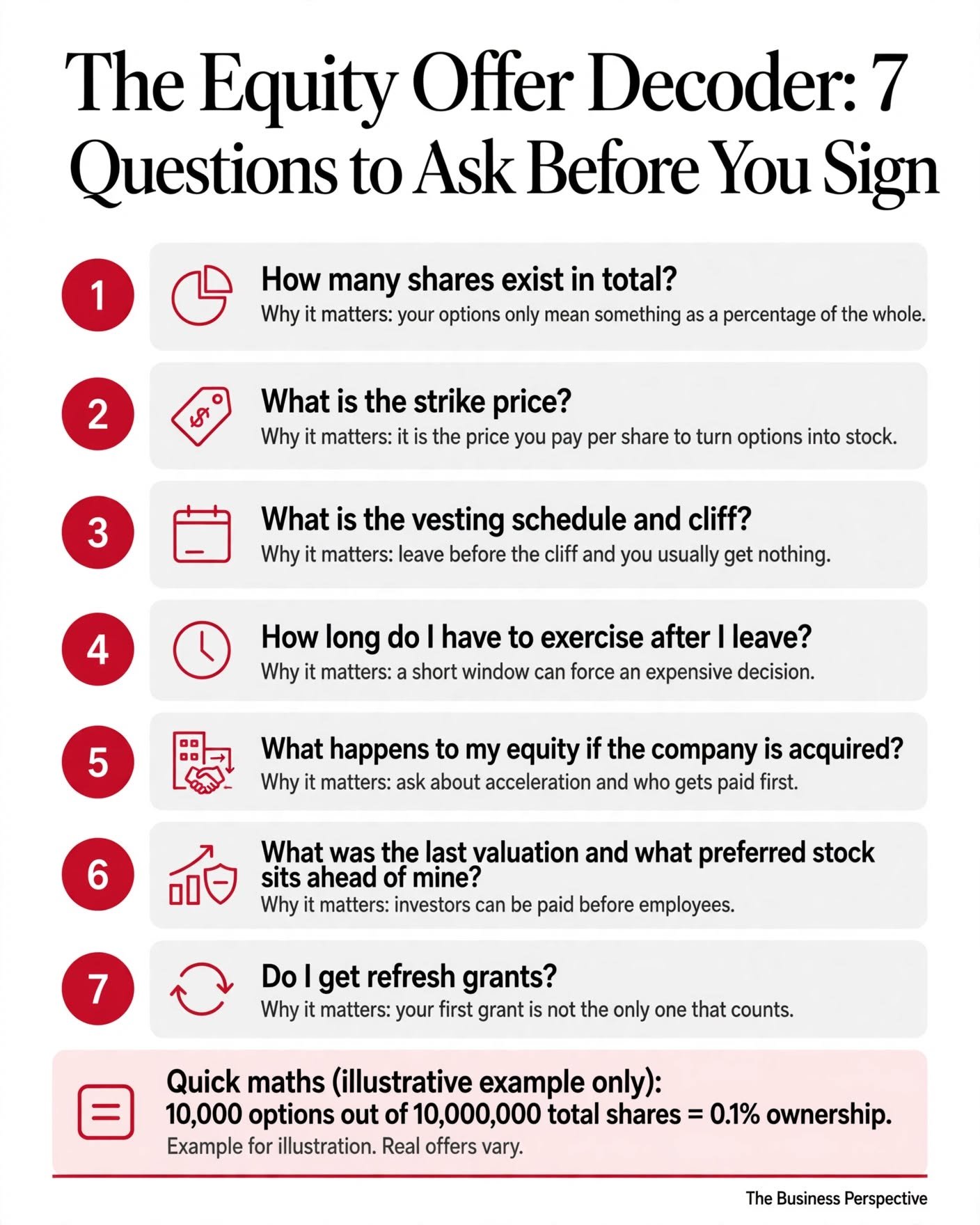
The Equity Offer Decoder: seven questions to ask before you sign. The 0.1% example is for illustration only; real offers vary.
1. Ask for ownership as a percentage
This is the single most useful question. Walker advises asking for the strike price and the percentage your shares represent, because a raw count hides the denominator. Say you are offered 10,000 options and the company has 10,000,000 fully diluted shares. That is 0.1% ownership, our arithmetic.
Underdog.io adds three follow-ups. Ask whether the total includes the unissued employee pool, whether the percentage is pre-money or post-money, and whether it reflects the current cap table. Your share count does not rise when new shares are issued, so your percentage can shrink with each round.
2. Get the strike price and the latest valuation
Walker suggests asking for the last post-money valuation, when that round closed, and whether the company has taken convertible bridge financing since. Ask too whether it plans to raise again soon. A company that raised two years ago and is quietly stretching its cash is in a different position from one that closed a round last month.
Bridge money often arrives as notes rather than priced equity, which can hide dilution coming your way. Our explainer on SAFE notes versus convertible notes shows how those instruments convert and why the cap table can shift overnight.
3. Check the vesting schedule and the cliff
The baseline Underdog.io describes is four years with a one-year cliff. You earn 25% at month 12, then the rest monthly over the next 36 months. That is a starting point, not a rule, and it is worth asking whether your vesting clock starts on your first day or on the offer date.
If you are joining after a funding round, compare the vesting terms with those of earlier hires. Different cohorts sometimes get different terms. You will not know unless you ask, and a recruiter will rarely volunteer it.
4. Push on the exercise window
This is where candidates lose real money. Carta says employees typically have about three months after leaving to exercise vested options, and that the figure is usually quoted as 90 days. Miss it and the options lapse.
What Carta’s data says about the 90-day exercise window
Measure
Figure
Source
Typical window after leaving
About three months (89 to 92 days)
Carta
Companies with a median window of 89 to 92 days
82% of a 386-company sample
Carta
Terminated grants with the standard 90-day window, Q1 2024
80%
Carta
Vested options exercised before expiry, Q4 2023
23%, down from 31% in Q4 2022
Carta
Value left unexercised in 2022 by nearly 50,000 workers at 386 private companies valued over $1 billion
More than $1.8 billion; over $47,000 per employee on average
Carta
Some companies go further. Pinterest gives former employees up to seven years to exercise vested options, per Carta. There is a catch. Stretching the window beyond three months means ISOs no longer qualify for their tax advantages, so Underdog.io notes the trade-off when it suggests asking for a longer window.
Carta also lists the costs a company weighs: more dilution, more administration and higher tax bills for employees. Ask anyway. Even a move from 90 days to a year changes the choice you face on your last day.
5. Ask about acceleration if the company is sold
Acceleration decides what happens to unvested equity if the company is sold. Morrison Foerster calls double-trigger acceleration “the market and standard approach.” It needs two events: a sale, then a termination without cause or a resignation for good reason within a set period.
Single-trigger, which vests on the sale alone, is strongly disfavored by acquirers, per the same firm. And here is the honest part. MoFo says the typical startup employee is usually not offered any form of acceleration. Underdog.io suggests asking for double-trigger first, with a sample request covering 50% of unvested equity.
6. Ask what common stock needs to turn a profit
Investors usually hold preferred stock, and employees hold common stock. Walker’s fifth question is what exit valuation the company must reach before common stockholders make a profit. He warns that liquidation preferences and participating preferred can make it harder for employees to realise value, even at an exit.
Investors set these rules long before you arrive, and you can only negotiate startup equity around them, so it pays to know what a term sheet contains. Also ask about liquidity. Walker says late-stage companies are “worth prodding about” plans to let employees sell before an IPO or acquisition.
7. Request a written refresh review
Underdog.io suggests asking for a written refresh review after your first performance cycle, with timing and criteria on paper. Your first grant is not the only one that counts. If new shares are issued and you receive no refresh, your slice keeps shrinking.
Promises made on a call tend to evaporate. Get anything that matters into the offer letter or an email the hiring manager confirms. That includes the exercise window, any acceleration and the refresh review.
How much equity should you ask for?
There is no single right number. Underdog.io’s August 2026 guide frames a senior engineer’s grant at 0.10% to 0.40% at Series A and 0.50% to 2.00% at seed. These are third-party benchmarks, not entitlements. Stage, role and hiring order all move the figure, so use them to anchor a conversation.
The table below is Underdog.io’s framework for three common roles. It is a guide drawn from third-party sources, and the firm itself warns against applying early-stage ranges mechanically to later hires.
Benchmark equity ranges by stage and role (Underdog.io, August 2026)
Stage
Senior engineer
Engineering manager
Senior product manager
Seed
0.50% to 2.00%
0.50% to 2.00%
0.25% to 1.00%
Series A
0.10% to 0.40%
0.15% to 0.50%
0.15% to 0.50%
Series B
0.10% to 0.30%
0.10% to 0.35%
0.10% to 0.30%
Series C
0.05% to 0.20%
0.10% to 0.25%
0.05% to 0.20%
The Business Perspective has not independently verified these ranges. Hiring order matters too. Underdog.io cites SaaStr data showing a median grant of 1.50% for hire number one and 0.85% for hire number two. If you are joining at stage Series A or Series B, expect the lower end of the early-stage ranges.
Do not confuse a headline percentage with a payout. Underdog.io’s example is a $170,000 base, a $15,000 signing bonus and 0.15% equity at a $15 million post-money valuation. The $22,500 headline value (0.15% of $15 million, our arithmetic) is not an expected cash outcome.
Hot sectors can shift valuations quickly, and fresh capital changes your dilution picture. For a sense of how fast money is moving in one corner of the market, see the ten biggest AI agent rounds of October 2026.
Should you take more equity or more salary?
Take enough salary to cover your life first, then negotiate equity on top. Carta’s Peter Walker argues startup equity is not cash, so swapping $10,000 of salary for “$10,000 more in equity” is an inaccurate bargain. If pay bands are fixed, a signing bonus is often the easier lever, per Underdog.io.
Walker gives two reasons to discount early-stage equity. You cannot spend it today, and there is a high chance it ends up worth zero. That does not make equity worthless. It means you should negotiate startup equity as upside, not as a replacement for the paycheck.
Think of the offer as a set of levers rather than one number. When a company says it cannot move on salary, there is usually another lever it can pull.
Negotiation levers beyond the headline grant
Lever
What to ask
Watch for
Base salary
The top of the band for your role
Cash is what protects you if the company fails
Signing bonus
A one-time payment when bands are fixed
Repayment terms if you leave early
Equity size
A higher percentage or more options
The denominator behind the number
Exercise window
More than 90 days
Tax treatment of ISOs beyond three months
Acceleration
Double-trigger on part of the unvested grant
Rarely offered to typical employees
Refresh review
A written review after the first cycle
Only counts if it is documented
What should you know about taxes before you exercise early?
Early exercise lets you buy shares before they vest, and an 83(b) election taxes you on today’s lower value. The filing window is a strict 30 days, per Underdog.io. Early exercise can also create cash and alternative minimum tax exposure, so get advice from a qualified tax professional before you act.
Tax rules are where equity gets expensive for the unwary. Carta explains that ISO tax benefits last only three calendar months after employment ends. Holders pay capital gains rates on a later sale if they keep the stock at least one year after exercise and two years after the grant.
Extend the window past three months and each ISO grant loses ISO treatment, so exercises after that point are taxed like non-qualified stock options, per Carta. That is why 90 days became the default in the first place. The Business Perspective is not a tax adviser, and your situation will differ, so check the numbers with a professional before you exercise anything.
What do critics say when you negotiate startup equity?
Critics make three points. Early-stage equity often ends up worth nothing, so trading salary for options can backfire. Longer exercise windows cost companies in dilution and administration, and benchmark tables are third-party averages, not rules. Negotiating still helps, but expect limits.
Here is what sceptics say, and they have a point.
Equity may be worth nothing. Carta’s Walker says the potential of startup equity to be worth zero is “high.” Our report on global business failure in 2026 is a reminder of how many companies never reach a payout.
Companies bear real costs. Carta lists dilution, administrative burden and higher tax obligations among the downsides of longer exercise windows, which is why many companies refuse.
Benchmarks mislead. Underdog.io says its ranges are not guaranteed ownership targets and the scenario maths relies on unverified assumptions.
Tone matters. Walker notes you must balance enthusiasm for the role with making sure you are not getting a raw deal.
Our read at The Business Perspective is that none of this argues against asking. It argues for asking specific questions instead of demanding a bigger number. A company that will not disclose its fully diluted share count or put promises in writing has told you something, and Underdog.io says that is a reason to walk away.
What do candidates ask about startup equity offers?
Candidates most often ask whether equity is negotiable, how much to ask for, how long the exercise window should be, what acceleration means, whether equity beats salary and how the 83(b) election works. The Business Perspective’s six answers below are short, sourced and easy to check.
Can you negotiate startup equity at an early-stage company?
Yes, though the room to move depends on stage and role. Early companies often have flexible grants but little cash. Ask for ownership as a percentage, a longer exercise window, acceleration terms and a written refresh review. Even if the headline number holds, those terms can change what your equity is worth.
How much equity should a startup employee get?
It varies by stage, role and hiring order. Underdog.io’s August 2026 guide cites benchmark ranges such as 0.10% to 0.40% for a senior engineer at Series A and 0.50% to 2.00% at seed. These are third-party benchmarks, not entitlements, so compare them with the company’s fully diluted share count.
What is a good exercise window for startup stock options?
The common default is about 90 days after you leave, which Carta says covered 80% of terminated grants in Q1 2024. A longer window gives you more time to decide. Some companies, such as Pinterest, offer up to seven years, though extending past three months can change ISO tax treatment.
What is double-trigger acceleration?
Double-trigger acceleration vests your unvested equity only if two things happen: the company is sold, and you are then let go without cause or leave for good reason within a set period. Morrison Foerster calls it the market standard. Single-trigger, which vests on the sale alone, is strongly disfavored by acquirers.
Is startup equity worth more than a higher salary?
Not reliably. Carta’s Peter Walker argues that startup equity is not cash: it is upside only, and early-stage equity has a high chance of ending up worth zero. Cover your living costs with salary first, then negotiate equity as a bonus on top rather than a dollar-for-dollar swap.
What is an 83(b) election and when is it due?
An 83(b) election lets you pay tax on restricted stock at its current value when you receive it, instead of when it vests. The filing window is a strict 30 days, per Underdog.io. It often pairs with early exercise, which can create cash and tax exposure, so speak to a qualified tax professional first.
What should you do before you negotiate startup equity?
Before you sign, get seven things in writing: your ownership percentage, the strike price and valuation, the vesting schedule and cliff, the exercise window, acceleration terms, what common stock needs to profit and a refresh review. Then you can negotiate startup equity from facts instead of guesses.
The short version is that equity is a bet, and a bet is only as good as its terms. Most of what makes a grant valuable sits outside the headline number, in the denominator, the window and the order in which people get paid. That is where a few polite questions pay off.
Your seven-move checklist
☐ Ownership as a percentage on a fully diluted basis
☐ Strike price and the valuation behind it
☐ Vesting schedule, cliff and vesting start date
☐ Post-termination exercise window, ideally longer than 90 days
☐ Acceleration, starting with double-trigger
☐ Exit value at which common stock turns a profit
☐ A written refresh review after your first cycle
Take the list into your next offer call, and put every answer in writing so you can negotiate startup equity with confidence. The Business Perspective will keep publishing practical guides like this one for the people on the other side of the cap table.
Sources: Carta (Peter Walker, January 17, 2026; post-termination exercise period guidance; Q1 2024 option data), Morrison Foerster (single- vs double-trigger acceleration), Underdog.io (August 21, 2026 equity guide, citing SaaStr data). Benchmarks are third-party estimates and vary by company. This article is education, not legal, tax or financial advice. Published by The Business Perspective Editorial Team as a practical guide to negotiate startup equity.
cap table
employee equity
equity compensation
equity negotiation
ESOP
Why startups fail is rarely explained by the famous 90% claim, and the real causes are easier to spot than most founders think. This guide from The Business Perspective shows why startups fail using official survival data and post-mortem studies. Key Takeaways The 90% figure is narrower than it sounds. One review says its origin...
Key Takeaways A share count alone tells you nothing. Carta’s Peter Walker wrote in January 2026 that an offer of “5,000 shares” means you “don’t know anything.” Before you negotiate startup equity, get the strike price and your ownership percentage. The 90-day window is the standard trap. Per Carta, 80% of terminated option grants in...
Funding & VC • Exclusive Breakdown Key Takeaways Manus AI funding $500M closed Oct 8, 2026 — first round since Meta had to unwind its $2B acquisition in April, per company WeChat post. $4B valuation — doubles the ~$2B price Meta agreed to in Dec 2025, per Bloomberg and LatePost reporting Oct 8. Boyu Capital...